Oklahoma Social Studies OKH.C.3.2
Standard Cluster
- OKH.C.3
- Evaluate the major political and economic events that transformed the land and its people in the post-Civil War era to statehood.
Evaluate the lasting effect of early industries on economic growth. Describe the economic and environmental effects of commercial extraction of Indian Territory's coal deposits on the development of regional communities, including the role of entrepreneur James J. McAlester. Trace the routes of cattle trails across Indian Territory and describe the growth of the cattle industry, including the associated role of railroad transportation to meet the needs of an expanding economy. Examine the origins and changing perceptions of the “American cowboy culture” (e.g., dime novels, artwork, motion pictures) versus the reality of the profession.
Oklahoma Academic Standards for Social Studies (2026) · OKH.C.3
Cluster contents
Standards in This Cluster
OKH.C.3.2 is a cluster heading. These are the individual standards under it.
- OKH.C.3.2.A
Describe the economic and environmental effects of commercial extraction of Indian Territory's coal deposits on the development of regional communities, includi...
- OKH.C.3.2.B
Trace the routes of cattle trails across Indian Territory and describe the growth of the cattle industry, including the associated role of railroad transportati...
- OKH.C.3.2.C
Examine the origins and changing perceptions of the “American cowboy culture” (e.g., dime novels, artwork, motion pictures) versus the reality of the profession...
Teacher's field guide
What This Cluster Means
What Students Need to Do
- Students explain how coal mining brought jobs and rail links to Indian Territory while damaging land and water. They trace cattle trails to Kansas railheads and explain how trains carried cattle to distant markets. They compare cowboy stories and images with records of the people who did the work.
What Mastery Looks Like
- A student can map the Chisholm and Great Western trails and explain how James J. McAlester helped coal towns grow. They can name a cost of mining and show how a dime novel or film leaves out the long hours and varied backgrounds of working cowhands.
Common Misconceptions
- Students may think cattle rode trains from Texas, rather than walking to railheads first. They may credit McAlester alone for the coal industry or overlook mining's damage to land and water. Cowboy films can leave them thinking most cowhands were white men who spent their days in gunfights.
How to Assess It
- Give students a blank Indian Territory map. Ask them to draw one cattle trail to a Kansas railhead, then write how trains helped ranchers, how coal mining affected a town and its land, and one way a film cowboy differs from a working cowhand.
Lesson moves
Ways to Teach It
Give pairs a blank map and colored pencils to mark McAlester, the Chisholm and Great Western trails, and Kansas railheads.
Read a cowboy diary excerpt beside a dime novel cover; ask, 'Which daily tasks or workers does the cover leave out?'
Give teams coal jobs, mine waste, cattle drive, railhead, and train cards to sort into benefits, costs, and transport links.
Use an Oklahoma coal mine reclamation notice and a local jobs chart; ask who gained from mining and who pays for cleanup.
Free download
Printable OKH.C.3.2 Worksheet
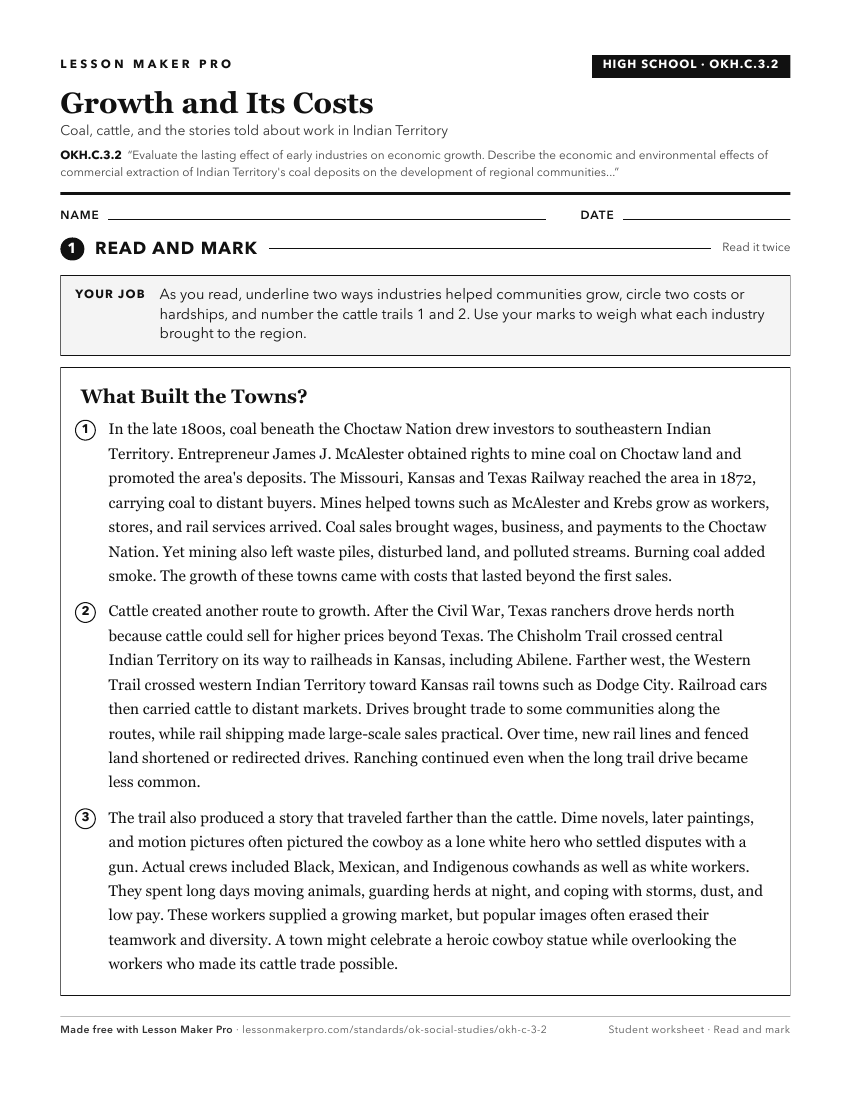
A ready-to-print activity worksheet aligned to OKH.C.3.2, with an answer key for the teacher on its own page. No account needed.
PDF, US Letter, prints cleanly in black and white.
Download the worksheetKeep exploring
Related Standards
- OKH.C.8.2
Analyze the impact of growth in various sectors of the state economy.
- USH.C.2.1.D
Identify the impact of new inventions and industrial production methods on the growth of the American economy and standard of living (e.g., technologies develop...
- MWH.C.5.2
Analyze responses to and the legacy of the Industrial Revolution.
- WG.C.6
Analyze the impact of industrialization on economic development.
Turn this cluster into a lesson
Grade, subject, topic, and the complete cluster are prefilled. Create one free, no account needed.
Also for this cluster:Make a WorksheetMake a QuizMake a Sub Lesson