Oklahoma Social Studies MWH.C.5.2.E
The Standard
- MWH.C.5
- Analyze the massive social, economic, and cultural change brought about by the Industrial Revolution.
- MWH.C.5.2
- Analyze responses to and the legacy of the Industrial Revolution.
Describe the European intellectual revolution and the ideal of academic freedom, including leading figures (e.g., Marie Curie, Charles Darwin, Gregor Mendel).
Oklahoma Academic Standards for Social Studies (2026) · MWH.C.5.2
Teacher's field guide
What This Standard Means
What Students Need to Do
- Match Darwin with natural selection, Mendel with inherited traits, and Curie with radioactivity. Explain how evidence from their work changed scientific ideas. Describe why researchers need room to investigate and publish findings that others may question.
What Mastery Looks Like
- A student can name what each scientist studied and give a specific example, such as Mendel's pea plants. They can explain that academic freedom protects research and publication, not claims from criticism or demands for evidence.
Common Misconceptions
- Students may think Darwin said individual animals change traits because they need to, or that Mendel found traits always blend. Some think Curie invented radiation, or that academic freedom means every claim must be accepted.
How to Assess It
- Exit ticket: Match Darwin, Mendel, and Curie to natural selection, inheritance, and radioactivity. Pick one scientist and explain how academic freedom could help that person investigate and publish a finding.
Lesson moves
Ways to Teach It
Give pairs two purple-flowered parent cards and 16 offspring flower cards, 12 purple and 4 white; ask what Mendel could infer.
Ask students to write: Should a university let a scientist publish findings that challenge common beliefs? Use Darwin's work as an example.
Read clues about finches, pea flowers, and radioactive elements; students hold up Darwin, Mendel, or Curie cards and explain one choice.
Read a scenario about a university researcher pressured to hide climate data; ask students how academic freedom could protect the researcher's work.
Free download
Printable MWH.C.5.2.E Worksheet
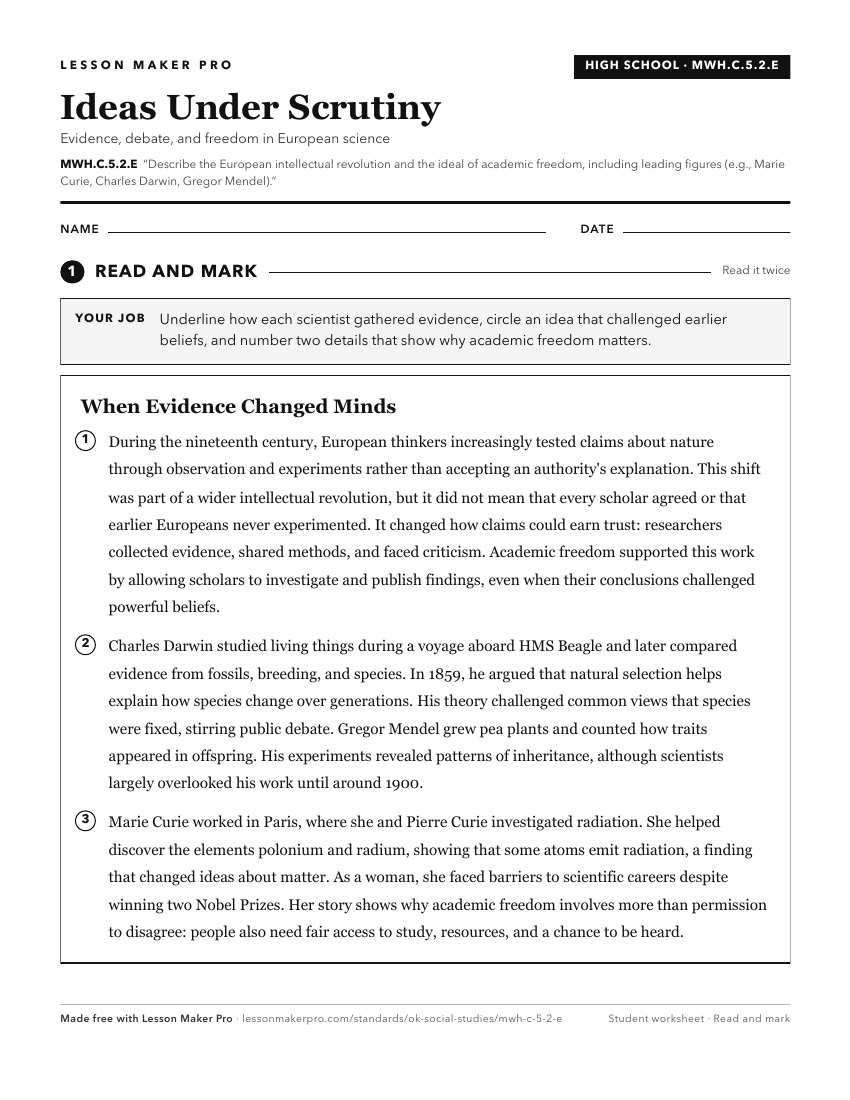
A ready-to-print activity worksheet aligned to MWH.C.5.2.E, with an answer key for the teacher on its own page. No account needed.
PDF, US Letter, prints cleanly in black and white.
Download the worksheetKeep exploring
Related Standards
- MWH.C.2.4.B
Describe the accomplishments of major figures of the Scientific Revolution (e.g., Nicolaus Copernicus, Galileo Galilei, Isaac Newton) as well as the impact of I...
- MWH.C.2.4
Evaluate the legacy of the Scientific Revolution on society, focusing on major theories and discoveries.
- 8.C.1.5.B
Describe the intellectual origins of American political thought as proposed by such Enlightenment philosophers as John Locke and his theory on natural rights.
- MWH.C.2.2.A
Examine intellectual development and advances (i.e., vernacular literature and expanded literacy, the arts, engineering, human anatomy) focusing on selected his...
Turn this exact standard into a lesson
Grade, subject, topic, and the complete standard are prefilled. Create one free, no account needed.
Also for this standard:Make a WorksheetMake a QuizMake a Sub Lesson