Oklahoma Social Studies MWH.C.2.4.B
The Standard
- MWH.C.2
- Analyze patterns of social, economic, political, and cultural changes during the Late Middle Ages to the Age of Exploration.
- MWH.C.2.4
- Evaluate the legacy of the Scientific Revolution on society, focusing on major theories and discoveries.
Describe the accomplishments of major figures of the Scientific Revolution (e.g., Nicolaus Copernicus, Galileo Galilei, Isaac Newton) as well as the impact of Islamic and Hindu learning on global scholarship and scientific thought.
Oklahoma Academic Standards for Social Studies (2026) · MWH.C.2.4
Teacher's field guide
What This Standard Means
What Students Need to Do
- Students describe what Copernicus, Galileo, and Newton contributed to scientific thought. They explain how mathematical work from India and scholarship in the Islamic world spread and helped later scholars.
What Mastery Looks Like
- A student links Copernicus to a sun-centered model, Galileo to telescopic observations, and Newton to laws of motion and gravity. They can explain how Indian place-value notation and Islamic algebra gave scholars tools for solving problems.
Common Misconceptions
- Students may say Galileo invented the telescope or that Copernicus used one to prove his model. They may treat Islamic scholars as mere copyists. They may also assume place-value notation began in Europe.
How to Assess It
- On an exit ticket, have students match Copernicus, Galileo, and Newton to one contribution each, then explain how Indian place-value notation and Islamic algebra helped later scholars.
Lesson moves
Ways to Teach It
Give pairs a flashlight, two balls, and four beads to model a sun-centered system and Galileo's observations of Jupiter's moons.
Ask students to write two sentences explaining why Indian place-value notation and al-Khwarizmi's algebra helped scholars solve problems.
Play a matching relay with cards for five contributions and their sources, then have teams defend each match.
Show a satellite weather image and ask students how Newton's laws help explain why the satellite stays in orbit.
Free download
Printable MWH.C.2.4.B Worksheet
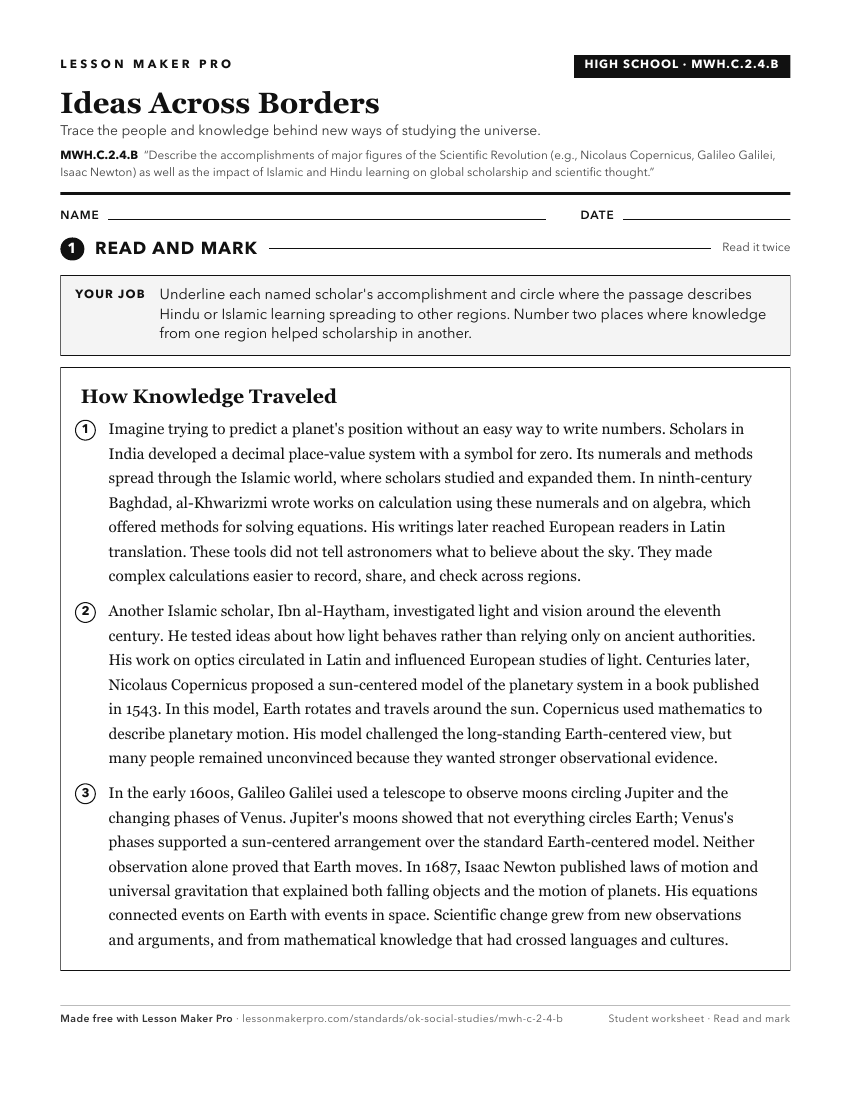
A ready-to-print activity worksheet aligned to MWH.C.2.4.B, with an answer key for the teacher on its own page. No account needed.
PDF, US Letter, prints cleanly in black and white.
Download the worksheetKeep exploring
Related Standards
- MWH.C.2.4
Evaluate the legacy of the Scientific Revolution on society, focusing on major theories and discoveries.
- 2.C.4.9
Examine how inventors from other nations and other times made a difference in the way people live today (e.g., Leonardo da Vinci, Marie Curie, Louis Braille, Al...
- MWH.C.5.2.E
Describe the European intellectual revolution and the ideal of academic freedom, including leading figures (e.g., Marie Curie, Charles Darwin, Gregor Mendel).
- AWH.C.9.4
Describe the impact and legacy of Islam and the Islamic empire, including discoveries in science and mathematics, the spread of Islam in the Middle East, Africa...
Turn this exact standard into a lesson
Grade, subject, topic, and the complete standard are prefilled. Create one free, no account needed.
Also for this standard:Make a WorksheetMake a QuizMake a Sub Lesson