Oklahoma Social Studies MWH.C.5.2.A
The Standard
- MWH.C.5
- Analyze the massive social, economic, and cultural change brought about by the Industrial Revolution.
- MWH.C.5.2
- Analyze responses to and the legacy of the Industrial Revolution.
Examine how the abolition of slavery within the British Empire was influenced by Christian humanitarianism and examine the role of various antislavery societies, including the work of William Wilberforce.
Oklahoma Academic Standards for Social Studies (2026) · MWH.C.5.2
Teacher's field guide
What This Standard Means
What Students Need to Do
- Students explain how Christian beliefs about human dignity shaped British antislavery arguments. They show how abolition societies used petitions and boycotts, while William Wilberforce pressed the issue in Parliament.
What Mastery Looks Like
- A student can connect a moral argument to a campaign tactic and explain Wilberforce's role. They distinguish the 1807 ban on the slave trade from the 1833 law ending slavery in most British colonies.
Common Misconceptions
- Students may think the 1807 law ended slavery, rather than the slave trade. They may credit Wilberforce alone and overlook abolition societies and enslaved people's resistance. Some assume all Christians opposed slavery, though others defended it.
How to Assess It
- On an exit ticket, ask: How did a Christian argument, an antislavery society's action, and Wilberforce's work help change British law? Name what changed in 1807 and 1833.
Lesson moves
Ways to Teach It
Show pairs the 1787 antislavery seal; have them mark its appeal to Christian brotherhood and draft a petition headline.
Ask students to write: How could a claim about human dignity persuade someone to sign a petition or boycott sugar?
Run a timeline relay: match society formation in 1787 and 1823 with the 1807 trade ban and 1833 emancipation law.
Place an antislavery sugar boycott notice beside a fair trade chocolate label; ask students how each links buying choices to labor conditions.
Free download
Printable MWH.C.5.2.A Worksheet
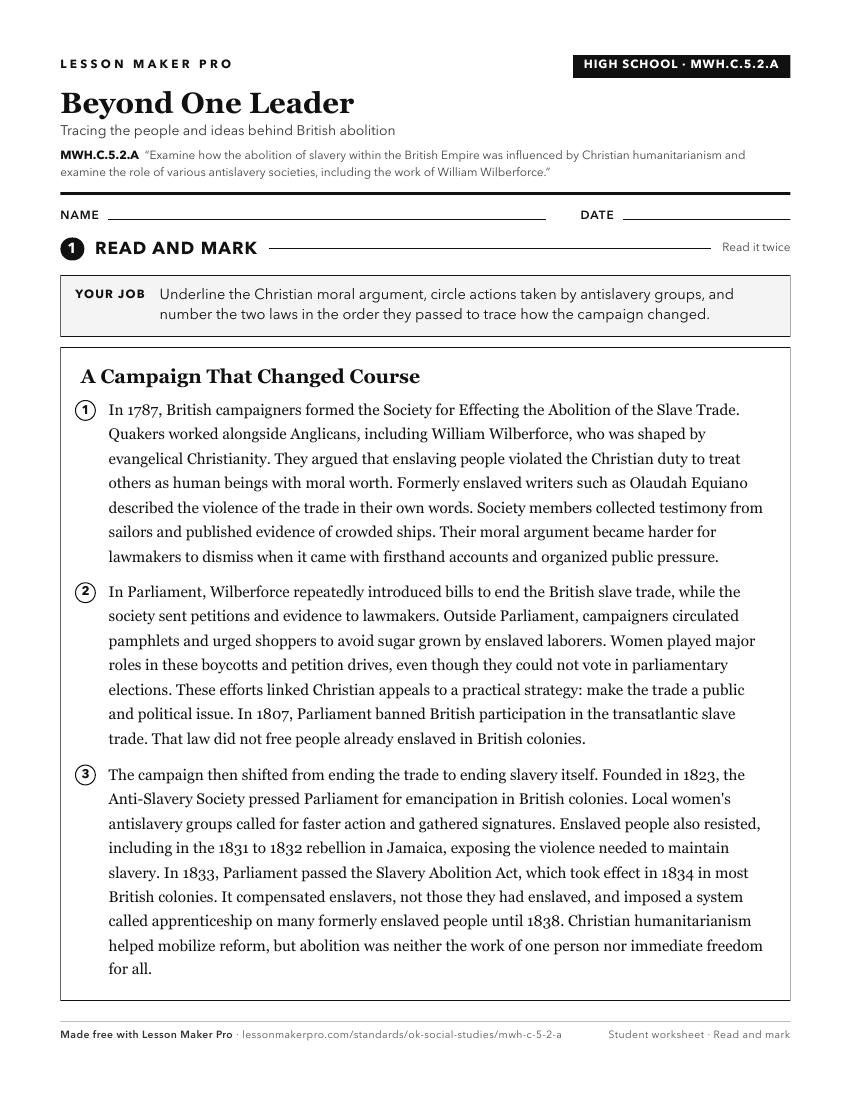
A ready-to-print activity worksheet aligned to MWH.C.5.2.A, with an answer key for the teacher on its own page. No account needed.
PDF, US Letter, prints cleanly in black and white.
Download the worksheetKeep exploring
Related Standards
- 8.C.10.3.A
Assess the impact of the work of notable abolitionists, such as Frederick Douglass, William Lloyd Garrison, and Sojourner Truth.
- 8.C.2.2.E
Examine the views of free and enslaved Blacks toward the revolution, including petitions to colonial governments for a ban on slavery and the British recruitmen...
- 8.C.10.3
Summarize the impact of the Abolitionist Movement on the institution of slavery.
- 5.C.2.6
Compare the experiences of both free and enslaved persons in the British colonies, including resistance efforts by enslaved peoples and attempts to preserve asp...
Turn this exact standard into a lesson
Grade, subject, topic, and the complete standard are prefilled. Create one free, no account needed.
Also for this standard:Make a WorksheetMake a QuizMake a Sub Lesson