Oklahoma Social Studies 8.C.10.3
Standard Cluster
- 8.C.10
- Analyze the social and economic transformations of the early nineteenth century.
Summarize the impact of the Abolitionist Movement on the institution of slavery. Assess the impact of the work of notable abolitionists, such as Frederick Douglass, William Lloyd Garrison, and Sojourner Truth. Describe the rise of the Underground Railroad, including the efforts of Harriet Tubman and the impact of Harriet Beecher Stowe’s Uncle Tom’s Cabin on the abolitionist movement.
Oklahoma Academic Standards for Social Studies (2026) · 8.C.10
Cluster contents
Standards in This Cluster
8.C.10.3 is a cluster heading. These are the individual standards under it.
- 8.C.10.3.A
Assess the impact of the work of notable abolitionists, such as Frederick Douglass, William Lloyd Garrison, and Sojourner Truth.
- 8.C.10.3.B
Describe the rise of the Underground Railroad, including the efforts of Harriet Tubman and the impact of Harriet Beecher Stowe’s Uncle Tom’s Cabin on the abolit...
Teacher's field guide
What This Cluster Means
What Students Need to Do
- Students explain how speeches, newspapers, a novel, and escape networks challenged slavery. They describe what Douglass, Garrison, Truth, Tubman, and Stowe each did. They connect that work to growing opposition to slavery.
What Mastery Looks Like
- A student links Garrison's newspaper, Douglass's and Truth's speeches, Tubman's rescue trips, and Stowe's novel to their effects. They explain that the Underground Railroad was a network of helpers and routes, not a train. They know abolitionists built pressure against slavery but did not end it on their own.
Common Misconceptions
- Students may picture the Underground Railroad as a train or think Tubman worked alone. They may mistake Stowe for an escape guide rather than a novelist. Some assume a speech or book ended slavery right away.
How to Assess It
- Exit ticket: Pick Douglass, Garrison, or Truth and name one way that person opposed slavery. Then explain how Tubman's rescue work and Stowe's novel challenged slavery in different ways.
Lesson moves
Ways to Teach It
Use yarn and a map to trace routes from Maryland to Pennsylvania and Canada, marking risks and places where helpers might assist.
Ask students to write: How did Stowe's novel and Truth's speeches reach people in different ways?
Match name cards to action and effect cards for Douglass, Garrison, Truth, Tubman, and Stowe, then explain one match aloud.
Show a current advocacy flyer and a Garrison newspaper excerpt; have students circle each audience and the action each piece seeks.
Free download
Printable 8.C.10.3 Worksheet
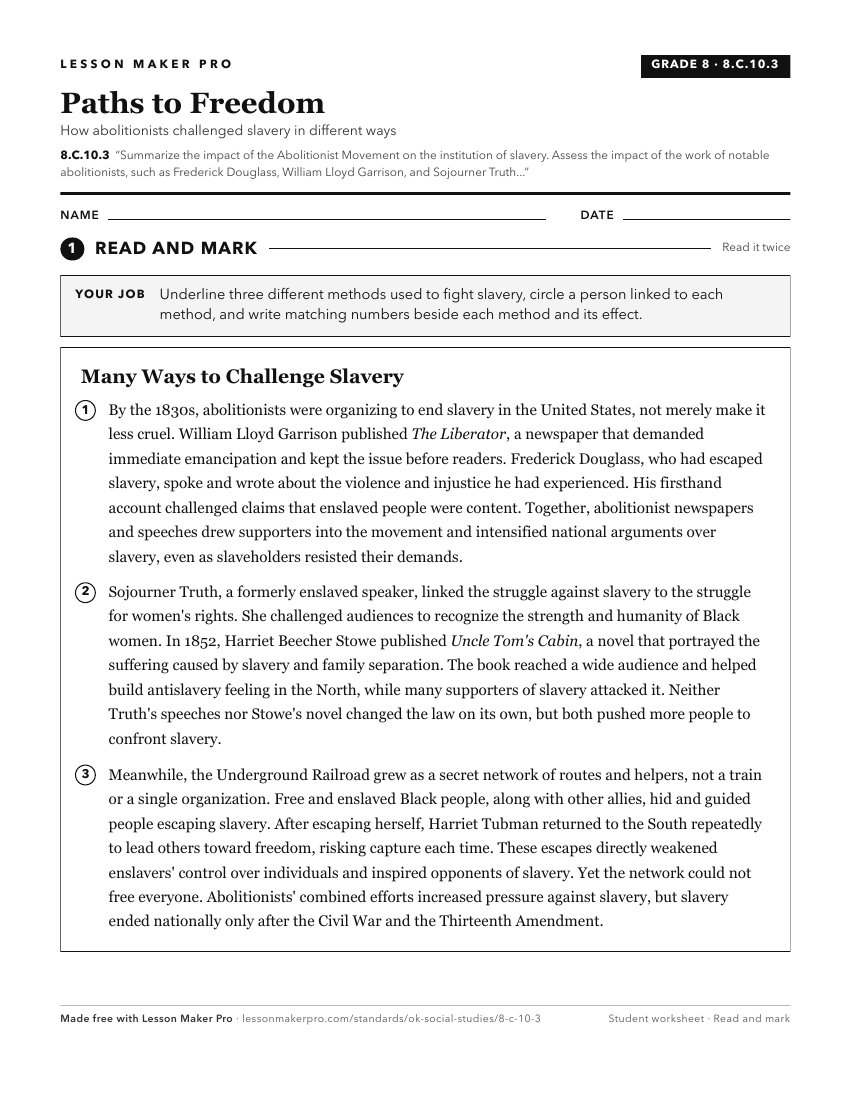
A ready-to-print activity worksheet aligned to 8.C.10.3, with an answer key for the teacher on its own page. No account needed.
PDF, US Letter, prints cleanly in black and white.
Download the worksheetKeep exploring
Related Standards
Turn this cluster into a lesson
Grade, subject, topic, and the complete cluster are prefilled. Create one free, no account needed.
Also for this cluster:Make a WorksheetMake a QuizMake a Sub Lesson