Oklahoma Social Studies MWH.C.5.1
Standard Cluster
- MWH.C.5
- Analyze the massive social, economic, and cultural change brought about by the Industrial Revolution.
Examine the causes and characteristics of the Industrial Revolution. Explain how the Industrial Revolution began in England, including its access to natural resources and capital, entrepreneurial culture, labor supply, and political stability. Evaluate the extent to which the Second Agricultural Revolution and innovations in energy, mechanization, and transportation enabled industrialization. Describe the social and economic consequences of industrialization, such as population growth, increased life expectancy, rural to urban migration, harsh living conditions for the urban poor, and growth of the middle class.
Oklahoma Academic Standards for Social Studies (2026) · MWH.C.5
Cluster contents
Standards in This Cluster
MWH.C.5.1 is a cluster heading. These are the individual standards under it.
- MWH.C.5.1.A
Explain how the Industrial Revolution began in England, including its access to natural resources and capital, entrepreneurial culture, labor supply, and politi...
- MWH.C.5.1.B
Evaluate the extent to which the Second Agricultural Revolution and innovations in energy, mechanization, and transportation enabled industrialization.
- MWH.C.5.1.C
Describe the social and economic consequences of industrialization, such as population growth, increased life expectancy, rural to urban migration, harsh living...
Teacher's field guide
What This Cluster Means
What Students Need to Do
- Students explain why industrial production started in England, using coal, iron, investment money, available workers, business owners, and political stability. They trace how changes in farming, steam power, machines, and railways helped factories grow. They describe population growth, longer life expectancy, migration to cities, harsh housing for the urban poor, and the growth of the middle class.
What Mastery Looks Like
- A student can explain how higher farm yields fed growing towns and freed workers for factories. They can show how coal-powered machines and railways raised production, then give examples of both new opportunities and harsh conditions for city workers.
Common Misconceptions
- Students may credit one invention, or coal alone, with starting industrialization in England. They may assume everyone grew richer right away or that early factory towns were healthier than rural villages.
How to Assess It
- On an exit ticket, ask: Why did factories take off in England? Name two conditions, explain how one farming or transport change helped, and give one benefit and one cost.
Lesson moves
Ways to Teach It
Give groups coal, iron, farm, bank, and worker cards; have them build and label a cause-and-effect map for England's first factories.
Ask students to write four sentences on whether an 1840 railway helped factory owners or workers more, using two effects as evidence.
Play a card sort: students place enclosure, steam engine, textile mill, and tenement under causes or consequences, then defend their choices.
Show photos of a textile mill and a modern distribution center; students list how machines, shipping, and work schedules shape each job.
Free download
Printable MWH.C.5.1 Worksheet
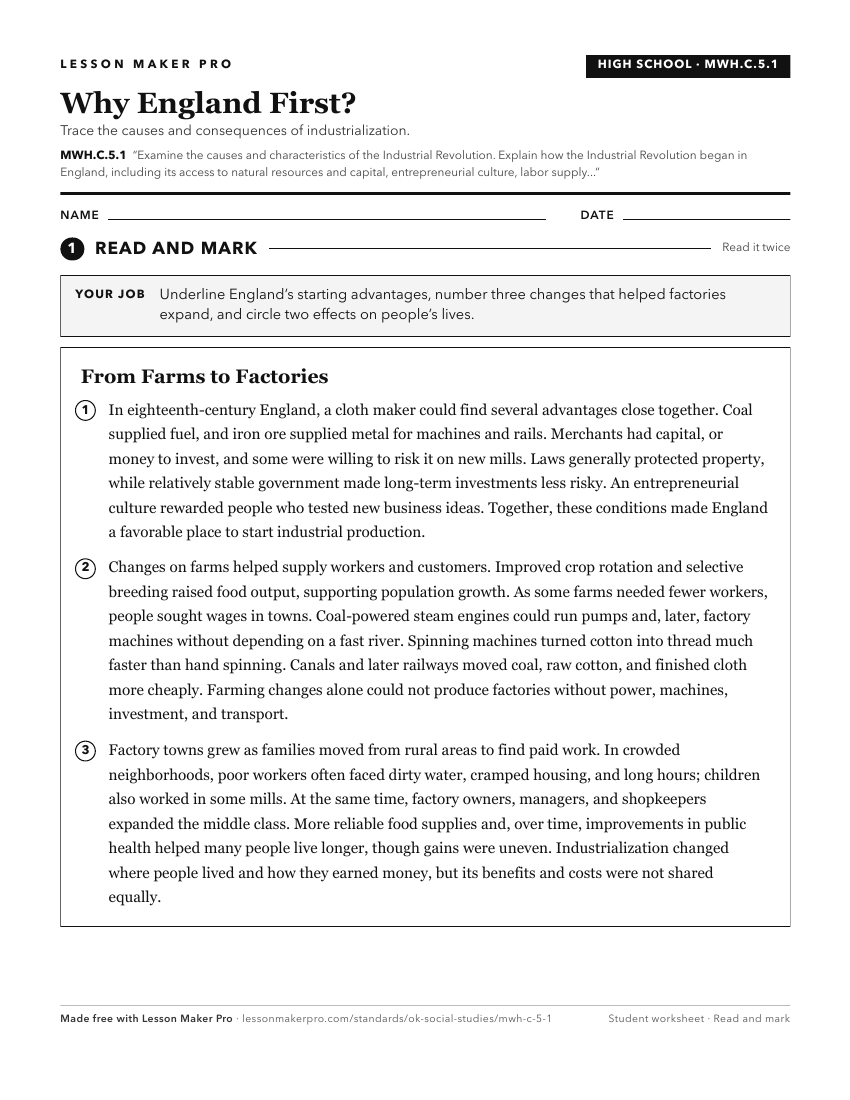
A ready-to-print activity worksheet aligned to MWH.C.5.1, with an answer key for the teacher on its own page. No account needed.
PDF, US Letter, prints cleanly in black and white.
Download the worksheetKeep exploring
Related Standards
- USH.C.2.1
Evaluate the transformation of American society, economy, politics, and culture during the American Industrial Revolution.
- MWH.C.5
Analyze the massive social, economic, and cultural change brought about by the Industrial Revolution.
- MWH.C.5.2
Analyze responses to and the legacy of the Industrial Revolution.
Turn this cluster into a lesson
Grade, subject, topic, and the complete cluster are prefilled. Create one free, no account needed.
Also for this cluster:Make a WorksheetMake a QuizMake a Sub Lesson