Oklahoma Social Studies MWH.C.5.1.C
The Standard
- MWH.C.5
- Analyze the massive social, economic, and cultural change brought about by the Industrial Revolution.
- MWH.C.5.1
- Examine the causes and characteristics of the Industrial Revolution.
Describe the social and economic consequences of industrialization, such as population growth, increased life expectancy, rural to urban migration, harsh living conditions for the urban poor, and growth of the middle class.
Oklahoma Academic Standards for Social Studies (2026) · MWH.C.5.1
Teacher's field guide
What This Standard Means
What Students Need to Do
- Students explain why factory jobs drew families from farms into cities. They connect industrial growth to larger populations, longer lives over time, crowded housing for poor workers, and a growing middle class.
What Mastery Looks Like
- A student can trace how factory jobs led to migration and crowded city housing. They can explain why merchants and managers gained new opportunities while many factory workers stayed poor. They can describe how better food supplies and sanitation later helped people live longer.
Common Misconceptions
- Students may assume every factory worker became middle class or that city life improved for everyone. They may treat rising life expectancy as proof that early factory neighborhoods were healthy. Some confuse population growth with migration: one adds people, while the other moves them.
How to Assess It
- Exit ticket: A family leaves a farm for a factory city in 1850. Explain why they move, name one housing problem they might face, and explain how life expectancy could still rise over time.
Lesson moves
Ways to Teach It
Give groups a blank town map and 20 counters; add a factory, move farm counters into city blocks, and mark overcrowded housing.
Ask: How could industrial cities have crowded housing while life expectancy rose over time? Have students write a two-sentence answer.
Have pairs match cards labeled factory jobs, rural migration, shop ownership, and middle-class growth, then explain each match.
Use a local map to find a factory or warehouse; students mark nearby housing and explain why workers might move closer.
Free download
Printable MWH.C.5.1.C Worksheet
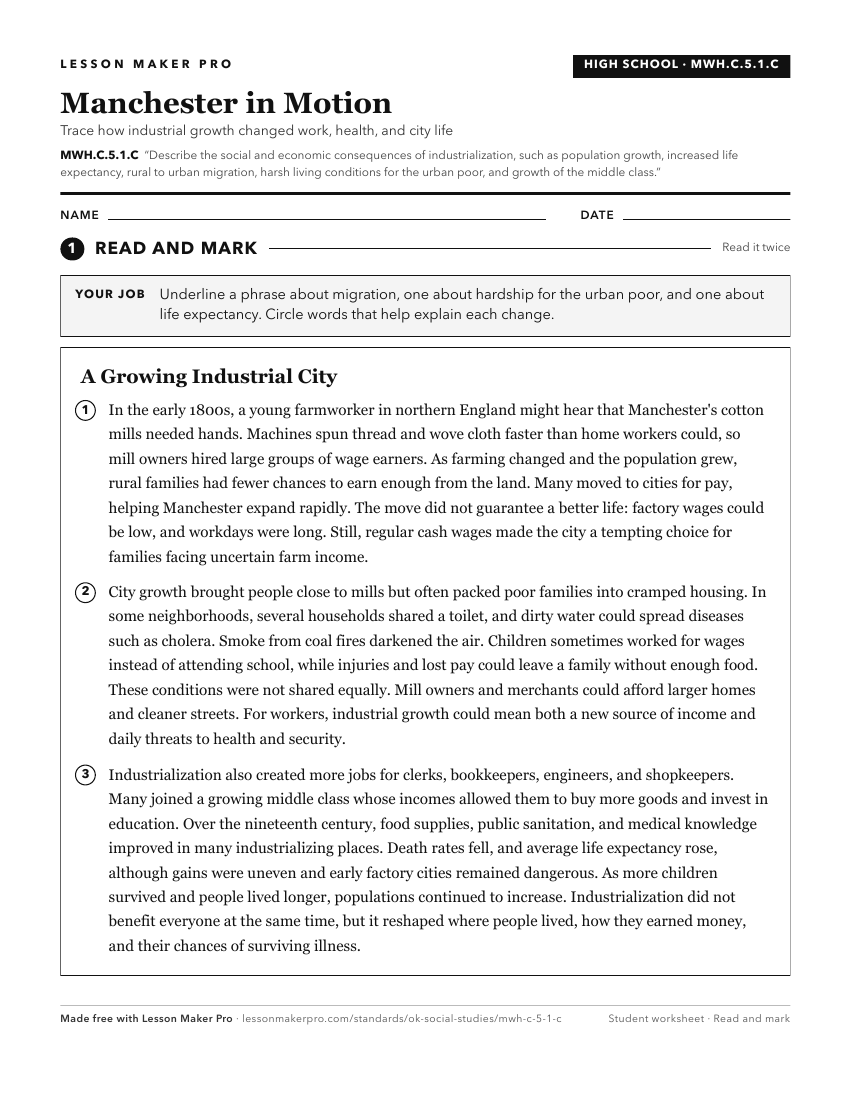
A ready-to-print activity worksheet aligned to MWH.C.5.1.C, with an answer key for the teacher on its own page. No account needed.
PDF, US Letter, prints cleanly in black and white.
Download the worksheetKeep exploring
Related Standards
- USH.C.2.1.A
Explain how the United States was transformed from an agrarian to an increasingly industrial, urbanized society and how this transformation created both new eco...
- MWH.C.5
Analyze the massive social, economic, and cultural change brought about by the Industrial Revolution.
- USH.C.5.4.B
Explain changes in society during the postwar era (e.g., urban population migration to the suburbs, the baby boom, growth of the middle class, home ownership, d...
- WG.C.6
Analyze the impact of industrialization on economic development.
Turn this exact standard into a lesson
Grade, subject, topic, and the complete standard are prefilled. Create one free, no account needed.
Also for this standard:Make a WorksheetMake a QuizMake a Sub Lesson