Oklahoma Social Studies MWH.C.5.2.B
The Standard
- MWH.C.5
- Analyze the massive social, economic, and cultural change brought about by the Industrial Revolution.
- MWH.C.5.2
- Analyze responses to and the legacy of the Industrial Revolution.
Explain the rise of trade unionism and the birth of the Labor Party, including the effects of various social and political reforms, such as Liberalism (John Stuart Mill) and modern conservatism (school of Edmund Burke).
Oklahoma Academic Standards for Social Studies (2026) · MWH.C.5.2
Teacher's field guide
What This Standard Means
What Students Need to Do
- Students trace how British workers formed unions and then sought seats in Parliament through the Labour Party. They explain how union laws and wider voting helped. They compare Mill's support for broader rights with Burke's preference for gradual change.
What Mastery Looks Like
- A student can link union organizing, legal recognition, and wider voting to the push for a workers' party. They can use Mill's and Burke's ideas to explain different views of reform.
Common Misconceptions
- Students may think unions and the Labour Party began at the same time. Unions organized earlier, while the push for party representation came later. Some assume Burke opposed every reform or that Mill founded the Labour Party.
How to Assess It
- On an exit ticket, ask: How did union recognition and wider voting help workers form the Labour Party? Add one sentence comparing Mill's and Burke's views of reform.
Lesson moves
Ways to Teach It
Have pairs arrange cards for union organizing, the 1871 union law, the 1884 voting reform, the 1900 representation committee, and the 1906 Labour Party.
Write Mill's wider voting and Burke's gradual reform on the board; ask which view better explains the 1884 voting change and why.
Play a card sort with low wages, a strike fund, the 1871 union law, and the 1900 representation committee; students label each role.
Show a union endorsement flyer for a candidate; ask how a workplace demand could become a campaign promise or proposed law.
Free download
Printable MWH.C.5.2.B Worksheet
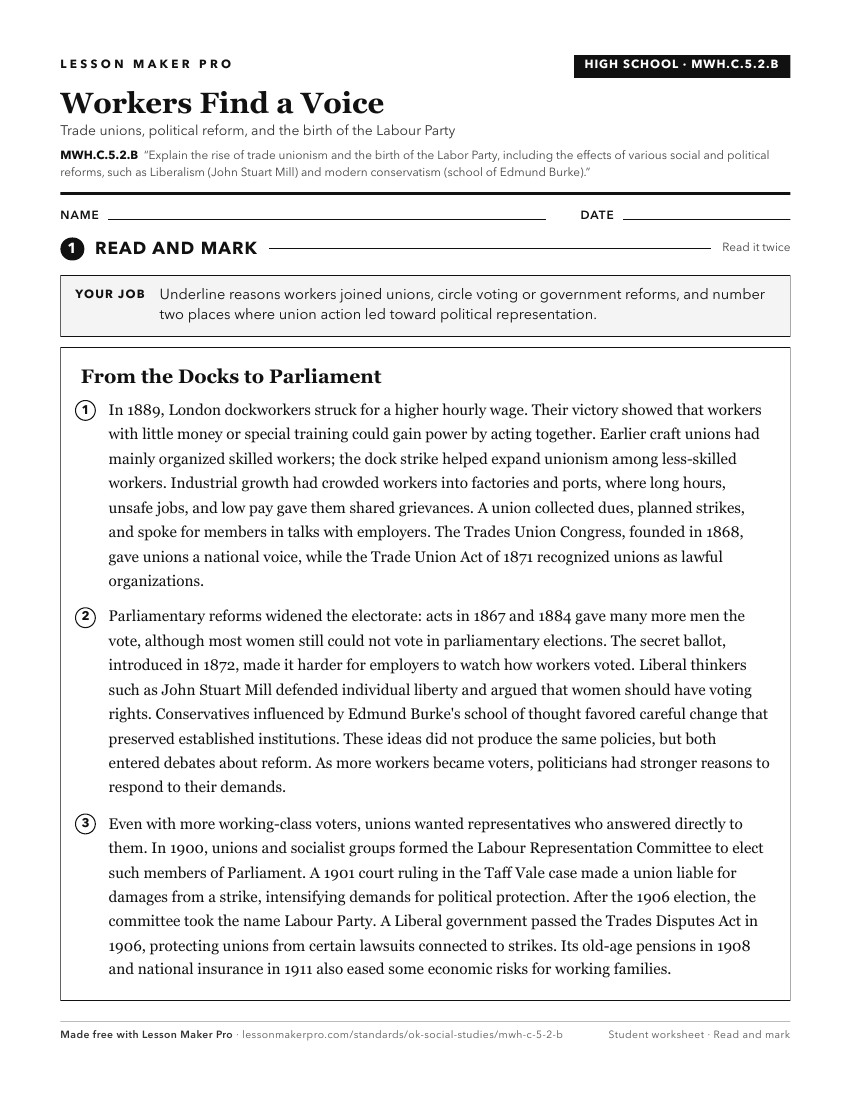
A ready-to-print activity worksheet aligned to MWH.C.5.2.B, with an answer key for the teacher on its own page. No account needed.
PDF, US Letter, prints cleanly in black and white.
Download the worksheetKeep exploring
Related Standards
- MWH.C.5.2.D
Describe the rise of socialism, including the ideas and influence of Robert Owen and Karl Marx, as well as the major ideas of Marx and Engels’ The Communist Man...
- USH.C.4.2.F
Explain growing labor unrest and industry’s reactions by describing the use of sit-down strikes and court injunctions and examining why socialism and communism ...
- USH.C.2.1.G
Assess the significance of the Labor Movement, including the leadership of Samuel Gompers and Eugene V. Debs, by comparing its early goals (e.g., formation of t...
- TOT.C.2.1.C
United Kingdom’s Labour Party.
Turn this exact standard into a lesson
Grade, subject, topic, and the complete standard are prefilled. Create one free, no account needed.
Also for this standard:Make a WorksheetMake a QuizMake a Sub Lesson