Oklahoma Social Studies USH.C.4.2.F
The Standard
- USH.C.4
- Analyze the cycles of economic boom and bust of the 1920s and 1930s on the transformation of the United States of America’s government and society.
- USH.C.4.2
- Analyze the prosperity of the Roaring Twenties and the collapse of the United States of America’s economy, leading to the Great Depression.
Explain growing labor unrest and industry’s reactions by describing the use of sit-down strikes and court injunctions and examining why socialism and communism appealed to labor.
Oklahoma Academic Standards for Social Studies (2026) · USH.C.4.2
Teacher's field guide
What This Standard Means
What Students Need to Do
- Students explain why workers stayed inside factories to stop production. They describe how employers sought court orders to end strikes. They explain why low pay and limited worker power made socialism and communism appealing to some workers.
What Mastery Looks Like
- Given an account of the Flint sit-down strike, a student can identify the workers' tactic and explain that an injunction is a judge's order, not a company rule. The student can distinguish socialism's call for public control of industry from communism's goal of common ownership and a classless society. They do not assume every striker supported either idea.
Common Misconceptions
- Students may picture a sit-down strike as a protest outside the plant rather than workers staying inside. They may think a company can issue an injunction on its own. They may assume all union members were communists or that socialism and communism mean the same thing.
How to Assess It
- Use this exit ticket: “Workers occupy a factory, and its owner asks a judge to order them out. Name the workers' tactic and the owner's legal response, then explain why socialism and communism might each appeal to these workers.”
Lesson moves
Ways to Teach It
Give pairs four index cards labeled factory occupation, halted production, company court request, and judge's order; have them sequence the events.
Write three sentences comparing why socialism and communism might each appeal to a Flint autoworker facing low pay.
Match four clue cards, factory occupation, court order, public ownership, classless society, to sit-down strike, injunction, socialism, and communism.
Compare a recent strike news article with a Flint strike excerpt; underline worker demands and employer responses in each.
Free download
Printable USH.C.4.2.F Worksheet
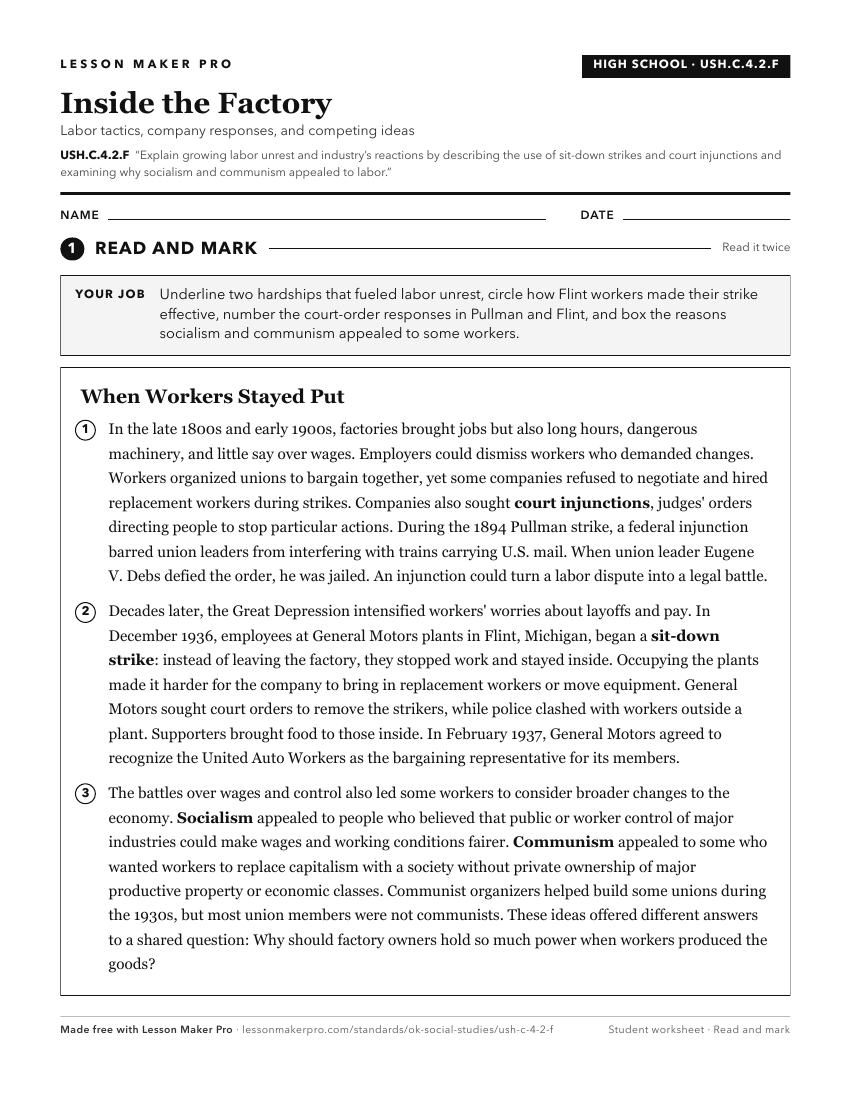
A ready-to-print activity worksheet aligned to USH.C.4.2.F, with an answer key for the teacher on its own page. No account needed.
PDF, US Letter, prints cleanly in black and white.
Download the worksheetKeep exploring
Related Standards
- MWH.C.5.2.D
Describe the rise of socialism, including the ideas and influence of Robert Owen and Karl Marx, as well as the major ideas of Marx and Engels’ The Communist Man...
- MWH.C.5.2.B
Explain the rise of trade unionism and the birth of the Labor Party, including the effects of various social and political reforms, such as Liberalism (John Stu...
- TOT.C.2.3
Trace the rise and limited appeal of the Industrial Workers of the World and the Socialist Party in the United States of America.
- USH.C.2.1.G
Assess the significance of the Labor Movement, including the leadership of Samuel Gompers and Eugene V. Debs, by comparing its early goals (e.g., formation of t...
Turn this exact standard into a lesson
Grade, subject, topic, and the complete standard are prefilled. Create one free, no account needed.
Also for this standard:Make a WorksheetMake a QuizMake a Sub Lesson