Oklahoma Social Studies USH.C.2
Standard Cluster
Analyze the social, economic, and political changes that occurred during the American Industrial Revolution, the Gilded Age, and reform movements. Evaluate the transformation of American society, economy, politics, and culture during the American Industrial Revolution. Explain how the United States was transformed from an agrarian to an increasingly industrial, urbanized society and how this transformation created both new economic opportunities, as well as societal problems. Describe the changing role of the American farmer, including the establishment of the Granger movement. Analyze the impact of capitalism and laissez-faire policy on business practices, such as monopolies, the characterization of “robber barons” and the role of industrialists in economic growth, as well as philanthropy (e.g., Cornelius Vanderbilt, J.P. Morgan, John D. Rockefeller, and Andrew Carnegie, including his Gospel of Wealth essay on society). Identify the impact of new inventions and industrial production methods on the growth of the American economy and standard of living (e.g., technologies developed by Thomas Edison, Alexander G. Bell, Henry Ford, and the Bessemer Process). Examine the complex conditions that characterized the Gilded Age (e.g., rapidly expanding economy, concentration of wealth, corrupt politics, poverty). Evaluate the role of muckrakers and social reformers (e.g., Jane Addams, Ida Tarbell, Jacob Riis, Upton Sinclair) on increased awareness of business practices and societal concerns, including child labor, working conditions, and the regulation of big business. Assess the significance of the Labor Movement, including the leadership of Samuel Gompers and Eugene V. Debs, by comparing its early goals (e.g., formation of trade unions,favorable legislation) to repercussions following the Pullman Strike and the Haymarket Affair . Evaluate the efforts of major reform movements in addressing social issues. Describe the Women’s Suffrage Movement, focusing on the leadership of Susan B. Anthony and Elizabeth Cady Stanton, as well as strategies used to bring attention to the suffrage cause. Explain how the Social Gospel movement emphasized the application of Christian principles of social justice to societal problems, such as poverty, inequality, and injustice. Summarize changing race relations as a result of the Plessy v. Ferguson decision, establishing a doctrine that became known as "separate but equal.” Describe continued attempts to disenfranchise African Americans through the use of poll taxes and literacy tests by some state governments. Compare the viewpoints of early civil right leaders, such as Booker T. Washington, W.E.B. DuBois, and Ida B. Wells, in response to rising racial tensions. Evaluate the influence of the Niagara Movement and the National Association for the Advancement of Colored People (NAACP) on expanding opportunities for African Americans. Evaluate the rise and reforms of Populism and the Progressive Movement. Describe how democratic processes (e.g., direct primary, initiative petition, referendum, recall) intended to limit political corruption by making politicians and lawmaking more immediately responsive to the people. Explain the impact of William Jennings Bryan and his Cross of Gold message on the political landscape. Trace the series of events leading to and the effects of the 16th and 17th Amendments to the Constitution of the United States of America. Describe how the rise of trusts and monopolies impacted consumers and workers, prompting government’s response with the Sherman and Clayton Antitrust Acts. Analyze and compare the personalities, actions and policies of presidents during the Progressive Era. Describe the efforts of President Theodore Roosevelt’s administration, including the promises of the Square Deal, Meat Inspection Act, trust-busting laws, and support for conservation. Examine President William Howard Taft’s trust-busting agenda, the Pure Food and Drug Act, and formation of the Interstate Commerce Commission. Evaluate the significance of the 1912 presidential election, including the rise of Roosevelt's Bull Moose Party and the viability of Eugene V. Debs’ Socialist Party. Describe the work of President Woodrow Wilson’s administration, including the promises of “New Freedom” and passage of the Federal Reserve Act.
Oklahoma Academic Standards for Social Studies (2026)
Cluster contents
Standards in This Cluster
USH.C.2 is a cluster heading. These are the individual standards under it.
- USH.C.2.1
Evaluate the transformation of American society, economy, politics, and culture during the American Industrial Revolution.
- USH.C.2.1.A
Explain how the United States was transformed from an agrarian to an increasingly industrial, urbanized society and how this transformation created both new eco...
- USH.C.2.1.B
Describe the changing role of the American farmer, including the establishment of the Granger movement.
- USH.C.2.1.C
Analyze the impact of capitalism and laissez-faire policy on business practices, such as monopolies, the characterization of “robber barons” and the role of ind...
- USH.C.2.1.D
Identify the impact of new inventions and industrial production methods on the growth of the American economy and standard of living (e.g., technologies develop...
- USH.C.2.1.E
Examine the complex conditions that characterized the Gilded Age (e.g., rapidly expanding economy, concentration of wealth, corrupt politics, poverty).
- USH.C.2.1.F
Evaluate the role of muckrakers and social reformers (e.g., Jane Addams, Ida Tarbell, Jacob Riis, Upton Sinclair) on increased awareness of business practices a...
- USH.C.2.1.G
Assess the significance of the Labor Movement, including the leadership of Samuel Gompers and Eugene V. Debs, by comparing its early goals (e.g., formation of t...
- USH.C.2.2
Evaluate the efforts of major reform movements in addressing social issues.
- USH.C.2.2.A
Describe the Women’s Suffrage Movement, focusing on the leadership of Susan B. Anthony and Elizabeth Cady Stanton, as well as strategies used to bring attention...
- USH.C.2.2.B
Explain how the Social Gospel movement emphasized the application of Christian principles of social justice to societal problems, such as poverty, inequality, a...
- USH.C.2.2.C
Summarize changing race relations as a result of the Plessy v. Ferguson decision, establishing a doctrine that became known as "separate but equal.”
- USH.C.2.2.D
Describe continued attempts to disenfranchise African Americans through the use of poll taxes and literacy tests by some state governments.
- USH.C.2.2.E
Compare the viewpoints of early civil right leaders, such as Booker T. Washington, W.E.B. DuBois, and Ida B. Wells, in response to rising racial tensions.
- USH.C.2.2.F
Evaluate the influence of the Niagara Movement and the National Association for the Advancement of Colored People (NAACP) on expanding opportunities for African...
- USH.C.2.3
Evaluate the rise and reforms of Populism and the Progressive Movement.
- USH.C.2.3.A
Describe how democratic processes (e.g., direct primary, initiative petition, referendum, recall) intended to limit political corruption by making politicians a...
- USH.C.2.3.B
Explain the impact of William Jennings Bryan and his Cross of Gold message on the political landscape.
- USH.C.2.3.C
Trace the series of events leading to and the effects of the 16th and 17th Amendments to the Constitution of the United States of America.
- USH.C.2.3.D
Describe how the rise of trusts and monopolies impacted consumers and workers, prompting government’s response with the Sherman and Clayton Antitrust Acts.
- USH.C.2.4
Analyze and compare the personalities, actions and policies of presidents during the Progressive Era.
- USH.C.2.4.A
Describe the efforts of President Theodore Roosevelt’s administration, including the promises of the Square Deal, Meat Inspection Act, trust-busting laws, and s...
- USH.C.2.4.B
Examine President William Howard Taft’s trust-busting agenda, the Pure Food and Drug Act, and formation of the Interstate Commerce Commission.
- USH.C.2.4.C
Evaluate the significance of the 1912 presidential election, including the rise of Roosevelt's Bull Moose Party and the viability of Eugene V. Debs’ Socialist P...
- USH.C.2.4.D
Describe the work of President Woodrow Wilson’s administration, including the promises of “New Freedom” and passage of the Federal Reserve Act.
Teacher's field guide
What This Cluster Means
What Students Need to Do
- Students trace how factories, railroads, and new inventions changed jobs, farms, cities, and daily life. They explain who gained wealth and who faced low wages, discrimination, or political corruption. They compare how farmers, unions, suffragists, civil rights leaders, and presidents responded.
What Mastery Looks Like
- A student can use a population chart and a worker's account to explain both urban growth and criticism of factory work. They can link a problem, such as a monopoly or voter suppression, to a response such as antitrust laws or the NAACP. They can explain what a reform changed and what it left unresolved.
Common Misconceptions
- Students may assume industrial growth raised everyone's standard of living equally. They may confuse trusts, labor unions, and government regulators, or assume reforms worked right away. They may think emancipation ended legal discrimination, missing segregation, poll taxes, and literacy tests.
How to Assess It
- Exit ticket: How did railroads help farmers and hurt them? Name one action the Grange took against high shipping rates.
Lesson moves
Ways to Teach It
Give pairs a railroad map, wage table, city population chart, and Grange complaint; have them label who gained and who paid.
Read excerpts from Washington's Atlanta speech and Du Bois's Niagara declaration; write which demands voting rights now, citing one phrase.
Play a card match: unsafe meat, trusts, railroad rates, and Senate corruption against the Meat Inspection Act, Sherman Act, Grange, and 17th Amendment.
Compare a current USDA meat recall notice with a paragraph from The Jungle; students list one food safety problem and the government's response.
Free download
Printable USH.C.2 Worksheet
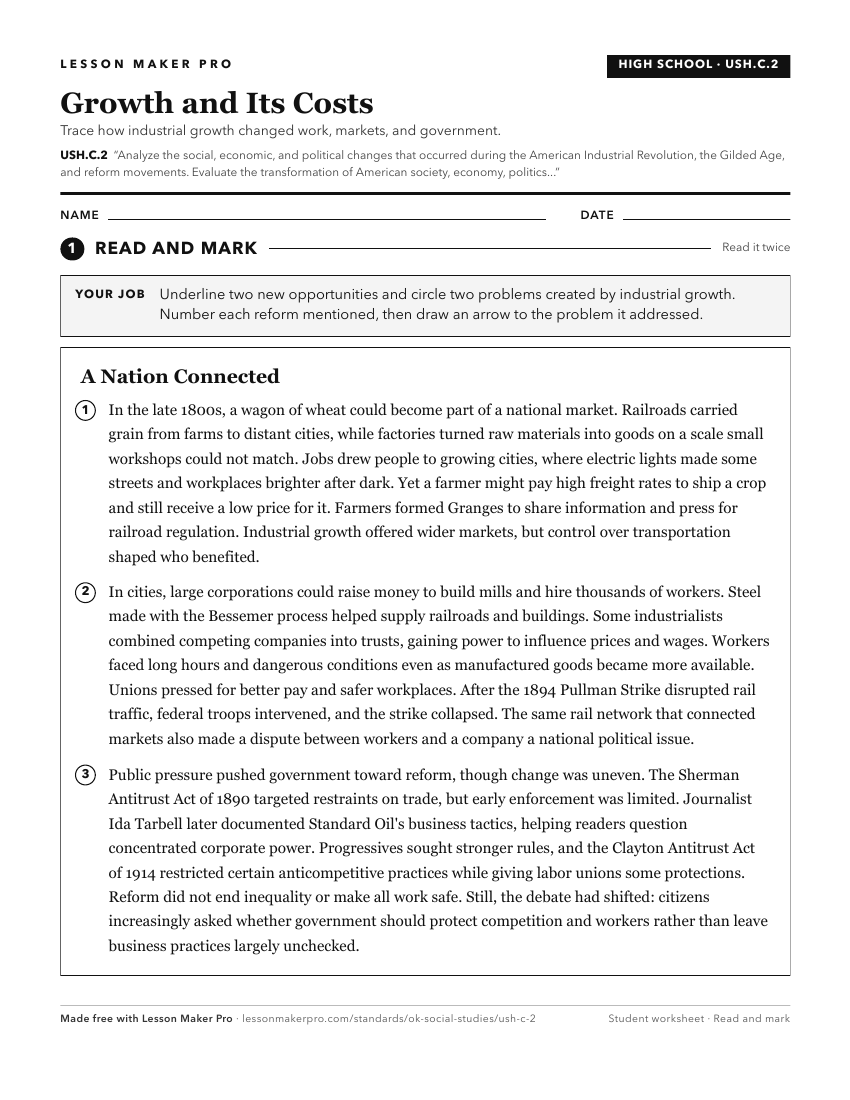
A ready-to-print activity worksheet aligned to USH.C.2, with an answer key for the teacher on its own page. No account needed.
PDF, US Letter, prints cleanly in black and white.
Download the worksheetKeep exploring
Related Standards
- 8.C.10
Analyze the social and economic transformations of the early nineteenth century.
- MWH.C.4
Analyze the political, economic, and social transformations brought about by the events of the age of revolutions.
- MWH.C.5
Analyze the massive social, economic, and cultural change brought about by the Industrial Revolution.
Turn this cluster into a lesson
Grade, subject, topic, and the complete cluster are prefilled. Create one free, no account needed.
Also for this cluster:Make a WorksheetMake a QuizMake a Sub Lesson