Oklahoma Social Studies USH.C.2.3.C
The Standard
- USH.C.2
- Analyze the social, economic, and political changes that occurred during the American Industrial Revolution, the Gilded Age, and reform movements.
- USH.C.2.3
- Evaluate the rise and reforms of Populism and the Progressive Movement.
Trace the series of events leading to and the effects of the 16th and 17th Amendments to the Constitution of the United States of America.
Oklahoma Academic Standards for Social Studies (2026) · USH.C.2.3
Teacher's field guide
What This Standard Means
What Students Need to Do
- Students build two timelines. One follows the 1895 income tax ruling to new federal tax authority. The other follows state legislature deadlocks to direct Senate elections.
What Mastery Looks Like
- Students place the 1909 tax proposal and the 1912 Senate election proposal before ratification in 1913. They explain that Congress could tax income without dividing the tax among states by population. They also explain that voters, rather than state legislators, began choosing senators.
Common Misconceptions
- Students may think the federal government collected no taxes before 1913, though it collected tariffs and excise taxes. Some think presidents chose senators before direct elections; state legislatures did. Others think the tax amendment set income tax rates, but Congress sets them.
How to Assess It
- On an exit ticket, complete two chains from problem to proposal to 1913 ratification to effect. Start one with the 1895 tax ruling and the other with Senate election deadlocks.
Lesson moves
Ways to Teach It
Give pairs cards labeled 1895 tax ruling, 1909 tax proposal, Senate deadlocks, 1912 election proposal, and both 1913 ratifications; build two timelines.
Read a three-ballot state legislature deadlock scenario; write why voters might want direct Senate elections and what power legislators would lose.
Read cards naming Senate deadlocks, the 1895 tax ruling, direct elections, and income tax without apportionment; teams sort problems and effects.
Compare a sample pay stub and Senate ballot; mark federal income tax and direct voting, then name the constitutional change behind each.
Free download
Printable USH.C.2.3.C Worksheet
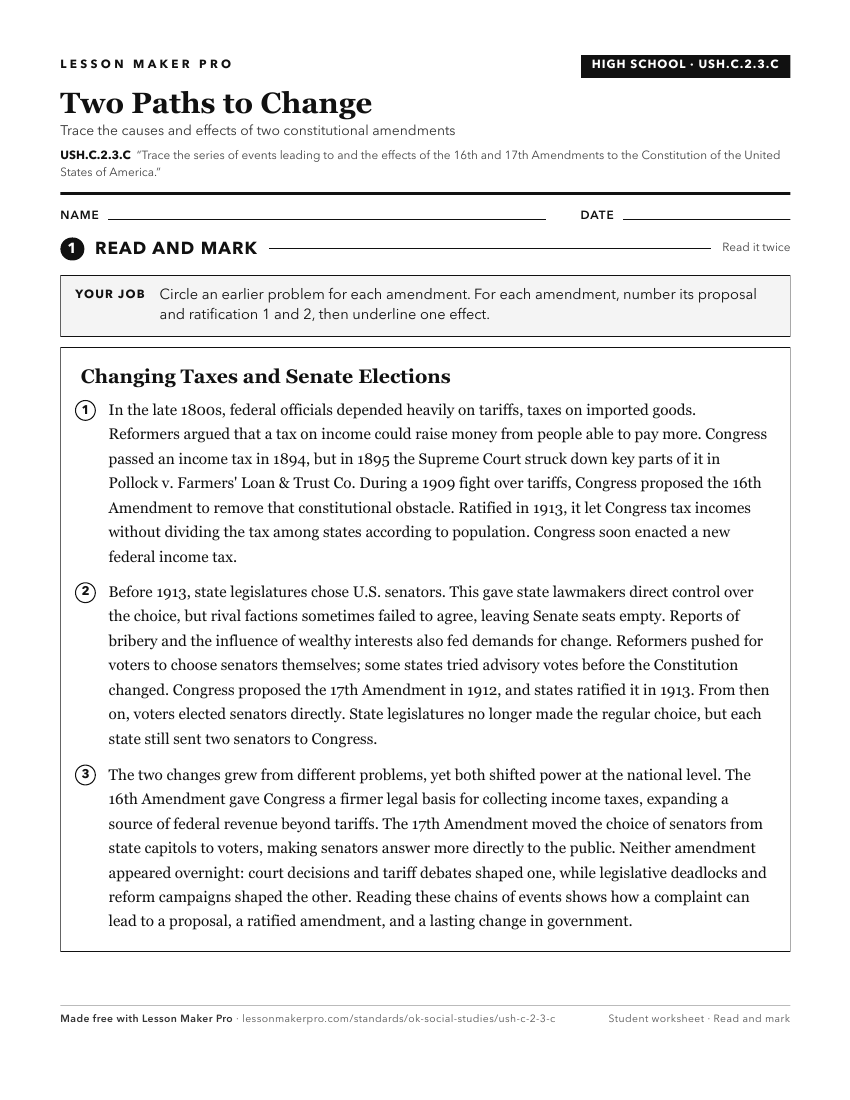
A ready-to-print activity worksheet aligned to USH.C.2.3.C, with an answer key for the teacher on its own page. No account needed.
PDF, US Letter, prints cleanly in black and white.
Download the worksheetKeep exploring
Related Standards
- USH.C.1.1.A
Summarize the fundamental principles of the United States of America’s constitutional republic and how events of the post-war era affected the Constitution’s ba...
- 8.C.13.2.A
Explain the impact of the 13th, 14th, and 15th Amendments on the status of formerly enslaved persons, as well as the relationship of the federal government to t...
- USH.C.1.1.C
Examine the meaning and effects of the Reconstruction Amendments (13th, 14th, and 15th Amendments) and the Civil Rights Act of 1867, assessing the extent to whi...
- 8.C.3.3
Examine the process to ratify the Constitution of the United States of America.
Turn this exact standard into a lesson
Grade, subject, topic, and the complete standard are prefilled. Create one free, no account needed.
Also for this standard:Make a WorksheetMake a QuizMake a Sub Lesson