Oklahoma Social Studies USH.C.2.2.C
The Standard
- USH.C.2
- Analyze the social, economic, and political changes that occurred during the American Industrial Revolution, the Gilded Age, and reform movements.
- USH.C.2.2
- Evaluate the efforts of major reform movements in addressing social issues.
Summarize changing race relations as a result of the Plessy v. Ferguson decision, establishing a doctrine that became known as "separate but equal.”
Oklahoma Academic Standards for Social Studies (2026) · USH.C.2.2
Teacher's field guide
What This Standard Means
What Students Need to Do
- Students explain how an 1896 Supreme Court decision upheld separate train cars and gave legal support to wider Jim Crow rules. They describe how those rules limited Black Americans' access to public spaces and reinforced unequal treatment.
What Mastery Looks Like
- Given a train-car rule and an example of segregated schools, a student can explain how the ruling was used beyond rail travel. They can explain why separate facilities were often unequal in practice.
Common Misconceptions
- Students may think the ruling created segregation from scratch or made separate facilities equal. Some may think it applied only to trains, rather than being used to defend other segregation laws.
How to Assess It
- Exit ticket: A state opens separate waiting rooms for Black and white passengers after 1896. Explain how the ruling could defend that rule and why the rooms might still be unequal.
Lesson moves
Ways to Teach It
Give pairs two paper school supply lists, one full and one sparse, and ask whether separate schools could be called equal.
Ask students to write two sentences: How could a ruling about train cars be used to defend segregated schools?
Run a four-card timeline race using Louisiana's railcar law, the 1896 ruling, later Jim Crow rules, and legal challenges.
Compare Amtrak's passenger nondiscrimination policy with Louisiana's railcar law, focusing on where a Black passenger could sit.
Free download
Printable USH.C.2.2.C Worksheet
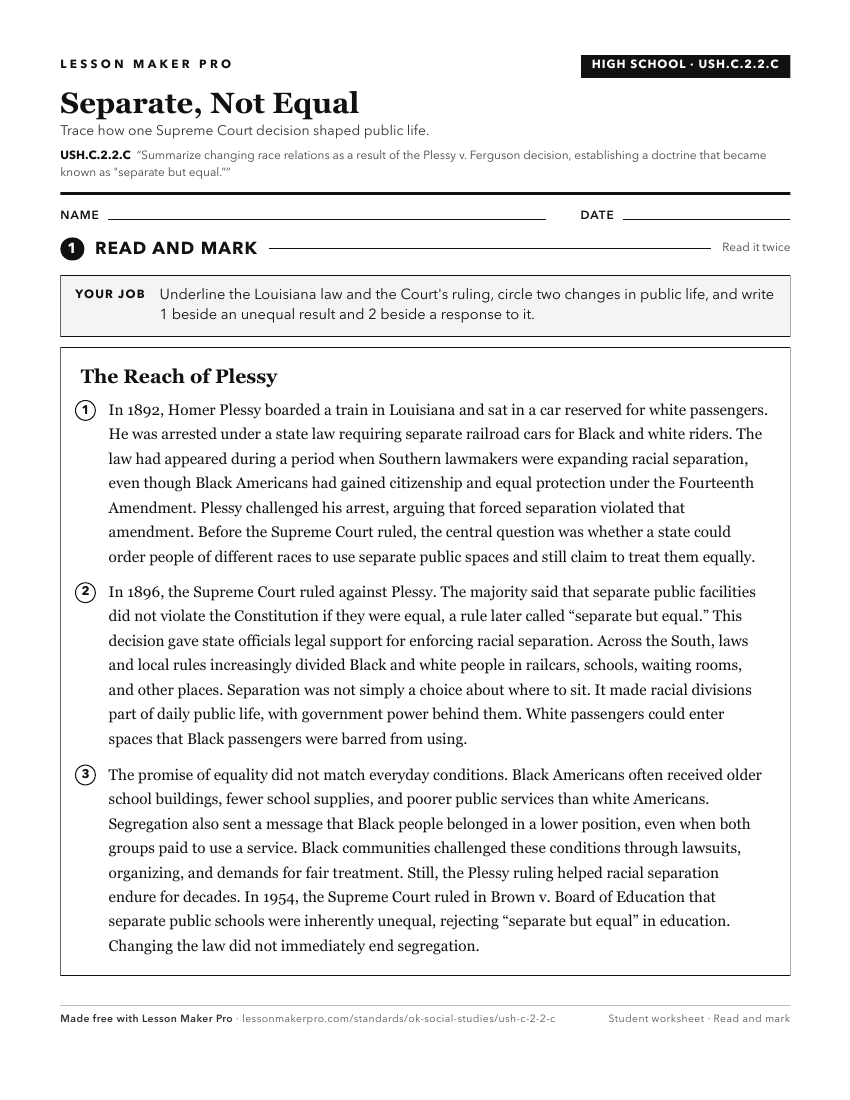
A ready-to-print activity worksheet aligned to USH.C.2.2.C, with an answer key for the teacher on its own page. No account needed.
PDF, US Letter, prints cleanly in black and white.
Download the worksheetKeep exploring
Related Standards
- 8.C.13.4.B
Examine the development of segregated societies in the South as a result of social norms and legal statutes such as Black Codes.
- USH.C.1.2
Analyze the post-Reconstruction civil rights struggles of African Americans.
- USH.C.7.1.B
Describe the legal attacks on segregation by the NAACP and its attorney Thurgood Marshall, summarizing major Supreme Court’s rulings (e.g., Sipuel v. Board of R...
- USH.C.7.1.A
Explain how segregation took multiple forms by comparing de jure segregation (e.g., miscegenation laws, public transportation) and de facto segregation (e.g., r...
Turn this exact standard into a lesson
Grade, subject, topic, and the complete standard are prefilled. Create one free, no account needed.
Also for this standard:Make a WorksheetMake a QuizMake a Sub Lesson