Oklahoma Social Studies 8.C.13.4.B
The Standard
- 8.C.13
- Analyze the political, social, and economic transformations during the Reconstruction Era.
- 8.C.13.4
- Assess the lasting impact of factors leading to the end of Reconstruction.
Examine the development of segregated societies in the South as a result of social norms and legal statutes such as Black Codes.
Oklahoma Academic Standards for Social Studies (2026) · 8.C.13.4
Teacher's field guide
What This Standard Means
What Students Need to Do
- Students trace the shift from Black Codes after the Civil War to later segregation laws in the South. They explain how written laws and unwritten rules, backed by threats, restricted Black people's daily lives.
What Mastery Looks Like
- A student can explain how a vagrancy law limited freedom to choose work and how a later law required separate railcars. They can put those laws in time order and describe how social pressure also enforced separation.
Common Misconceptions
- Students may treat Black Codes and later segregation laws as the same laws, passed at the same time. They may also think segregation depended only on written laws, overlooking threats and unwritten rules.
How to Assess It
- Exit ticket: Explain how Mississippi's 1865 vagrancy law and Louisiana's 1890 separate-car law restricted Black residents differently. Add one way an unwritten rule could enforce separation.
Lesson moves
Ways to Teach It
Have pairs underline restrictions in excerpts from Mississippi's 1865 vagrancy law and Louisiana's 1890 rail segregation law, then place both on a timeline.
Ask: How could a town keep Black families out of a park without a law, and what might make that rule hard to resist?
Deal six scenario cards, including a vagrancy arrest, a separate railcar, and a threat; students sort each as law or social pressure.
Show a photo of a segregated train waiting room; students describe the barrier and ask whether law, custom, or both enforced it.
Free download
Printable 8.C.13.4.B Worksheet
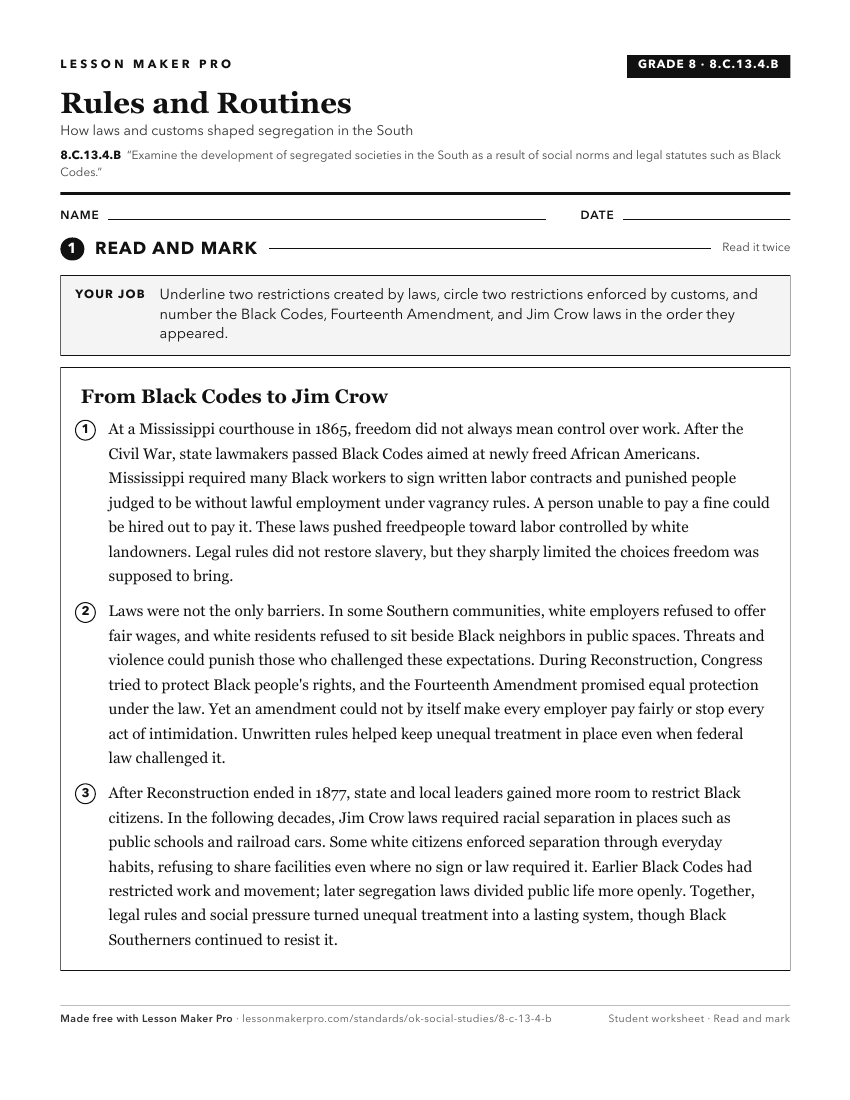
A ready-to-print activity worksheet aligned to 8.C.13.4.B, with an answer key for the teacher on its own page. No account needed.
PDF, US Letter, prints cleanly in black and white.
Download the worksheetKeep exploring
Related Standards
- USH.C.1.2
Analyze the post-Reconstruction civil rights struggles of African Americans.
- 8.C.10.2
Analyze experiences of enslaved persons, including common conditions of life under slavery, acts of resistance to slavery, such as Nat Turner’s Rebellion, and l...
- 8.C.13.3
Analyze the emerging social structure of the postwar South.
- USH.C.7.1.A
Explain how segregation took multiple forms by comparing de jure segregation (e.g., miscegenation laws, public transportation) and de facto segregation (e.g., r...
Turn this exact standard into a lesson
Grade, subject, topic, and the complete standard are prefilled. Create one free, no account needed.
Also for this standard:Make a WorksheetMake a QuizMake a Sub Lesson