Oklahoma Social Studies USH.C.2.4
Standard Cluster
- USH.C.2
- Analyze the social, economic, and political changes that occurred during the American Industrial Revolution, the Gilded Age, and reform movements.
Analyze and compare the personalities, actions and policies of presidents during the Progressive Era. Describe the efforts of President Theodore Roosevelt’s administration, including the promises of the Square Deal, Meat Inspection Act, trust-busting laws, and support for conservation. Examine President William Howard Taft’s trust-busting agenda, the Pure Food and Drug Act, and formation of the Interstate Commerce Commission. Evaluate the significance of the 1912 presidential election, including the rise of Roosevelt's Bull Moose Party and the viability of Eugene V. Debs’ Socialist Party. Describe the work of President Woodrow Wilson’s administration, including the promises of “New Freedom” and passage of the Federal Reserve Act.
Oklahoma Academic Standards for Social Studies (2026) · USH.C.2
Cluster contents
Standards in This Cluster
USH.C.2.4 is a cluster heading. These are the individual standards under it.
- USH.C.2.4.A
Describe the efforts of President Theodore Roosevelt’s administration, including the promises of the Square Deal, Meat Inspection Act, trust-busting laws, and s...
- USH.C.2.4.B
Examine President William Howard Taft’s trust-busting agenda, the Pure Food and Drug Act, and formation of the Interstate Commerce Commission.
- USH.C.2.4.C
Evaluate the significance of the 1912 presidential election, including the rise of Roosevelt's Bull Moose Party and the viability of Eugene V. Debs’ Socialist P...
- USH.C.2.4.D
Describe the work of President Woodrow Wilson’s administration, including the promises of “New Freedom” and passage of the Federal Reserve Act.
Teacher's field guide
What This Cluster Means
What Students Need to Do
- Compare Roosevelt’s public campaigning, Taft’s use of antitrust lawsuits, and Wilson’s New Freedom. Link each president to specific actions and laws. Use 1912 results to explain the Republican split and Debs’s Socialist vote.
What Mastery Looks Like
- Students can connect Roosevelt to meat inspection and conservation, Taft to antitrust cases, and Wilson to the Federal Reserve. They can explain how Roosevelt’s third-party run split Republican voters and how Debs’s vote showed support for socialism.
Common Misconceptions
- Students may credit Taft with the 1906 Pure Food and Drug Act, but it passed under Roosevelt. The Interstate Commerce Commission began in 1887; Taft later expanded its powers. Debs ran as a Socialist, not as part of Roosevelt’s Bull Moose Party.
How to Assess It
- Exit ticket: Name one action each by Roosevelt, Taft, and Wilson. Then use Roosevelt’s 27% and Debs’s 6% of the 1912 vote to explain what each third-party campaign showed.
Lesson moves
Ways to Teach It
Sort policy and date cards under Roosevelt, Taft, Wilson, or earlier; include the 1887 commission, 1906 food law, and 1913 Federal Reserve.
Ask pairs to use a 1912 vote table to explain Wilson’s win and what Debs’s share shows about Socialist support.
Play policy bingo: call out conservation, Taft’s antitrust cases, and the Federal Reserve; students mark the president and explain one match.
Show a photo of a USDA inspection stamp on meat packaging; students connect it to the 1906 Meat Inspection Act and Roosevelt.
Free download
Printable USH.C.2.4 Worksheet
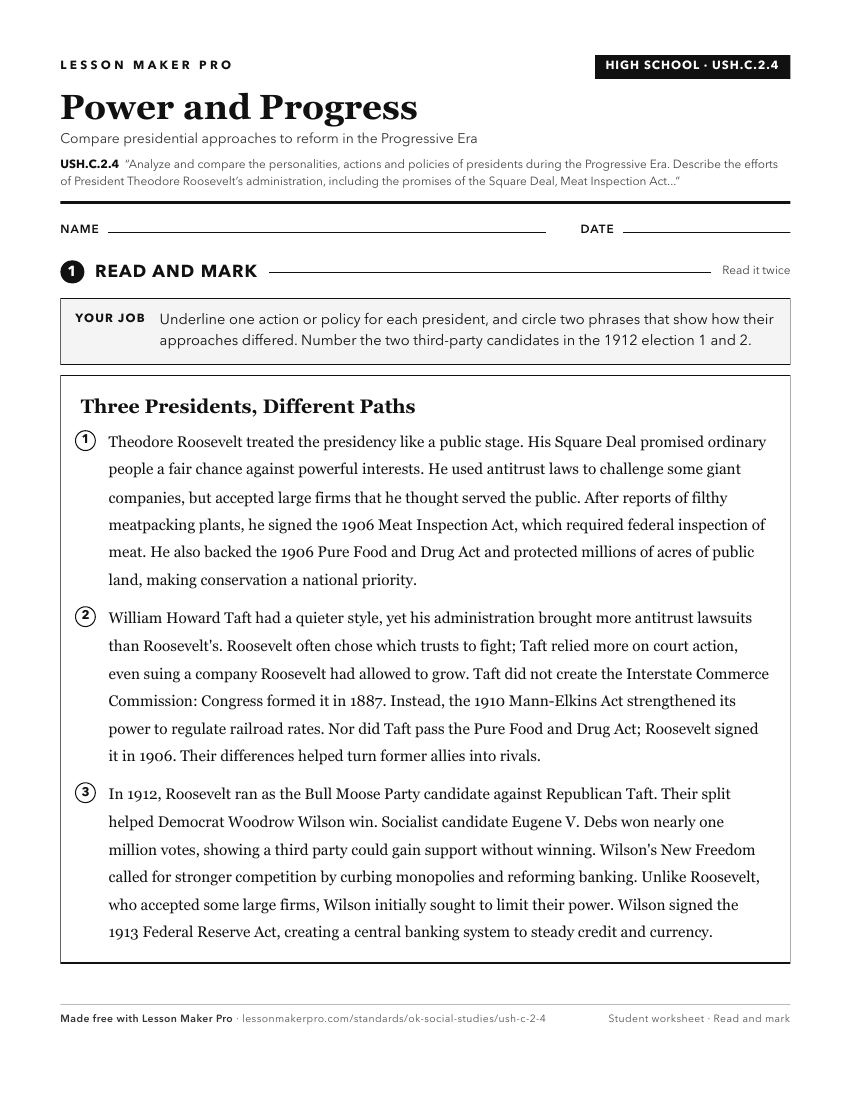
A ready-to-print activity worksheet aligned to USH.C.2.4, with an answer key for the teacher on its own page. No account needed.
PDF, US Letter, prints cleanly in black and white.
Download the worksheetKeep exploring
Related Standards
- USH.C.2.3
Evaluate the rise and reforms of Populism and the Progressive Movement.
- USH.C.2
Analyze the social, economic, and political changes that occurred during the American Industrial Revolution, the Gilded Age, and reform movements.
- 8.C.13
Analyze the political, social, and economic transformations during the Reconstruction Era.
- 8.C.7
Examine the political, economic and social transformations during the “Era of Good Feelings.”
Turn this cluster into a lesson
Grade, subject, topic, and the complete cluster are prefilled. Create one free, no account needed.
Also for this cluster:Make a WorksheetMake a QuizMake a Sub Lesson