Oklahoma Social Studies 8.C.10
Standard Cluster
Analyze the social and economic transformations of the early nineteenth century. Explain the impact of the Industrial Revolution on American culture and its economy. Describe major technological improvements and inventions that contributed to industrial growth in the North, resulting in heavily populated manufacturing and transportation centers. Explain how the invention of the cotton gin impacted Southern plantation economies by increasing the profitability of the crop and leading to the expansion of slavery. Analyze the connection between cotton production in the South to the economic success of Northern textile industries. Examine the role of women as the primary workforce in New England textile factories and leaders in the reform of working conditions. Examine the rise of nativist movements in response to increased immigration during industrialization, including debates over assimilation, labor competition, and political influence. Analyze experiences of enslaved persons, including common conditions of life under slavery, acts of resistance to slavery, such as Nat Turner’s Rebellion, and legal restrictions, such as Slave Codes. Summarize the impact of the Abolitionist Movement on the institution of slavery. Assess the impact of the work of notable abolitionists, such as Frederick Douglass, William Lloyd Garrison, and Sojourner Truth. Describe the rise of the Underground Railroad, including the efforts of Harriet Tubman and the impact of Harriet Beecher Stowe’s Uncle Tom’s Cabin on the abolitionist movement. Evaluate the goals and efforts of the Women’s Suffrage Movement toward political equality. Trace the emergence of the women’s rights movement from the abolitionist movement. Describe the role of the movement’s primary leaders (e.g., Susan B. Anthony, Elizabeth Cady Stanton, Lucretia Mott, Grimké sisters). Identify the ideals, democratic principles, and demands expressed in the Declaration of Sentiments. Evaluate the significance and key leaders of the Second Great Awakening including how it sparked a number of reform movements, such as temperance and abolitionism, which addressed societal issues.
Oklahoma Academic Standards for Social Studies (2026)
Cluster contents
Standards in This Cluster
8.C.10 is a cluster heading. These are the individual standards under it.
- 8.C.10.1
Explain the impact of the Industrial Revolution on American culture and its economy.
- 8.C.10.1.A
Describe major technological improvements and inventions that contributed to industrial growth in the North, resulting in heavily populated manufacturing and tr...
- 8.C.10.1.B
Explain how the invention of the cotton gin impacted Southern plantation economies by increasing the profitability of the crop and leading to the expansion of s...
- 8.C.10.1.C
Analyze the connection between cotton production in the South to the economic success of Northern textile industries.
- 8.C.10.1.D
Examine the role of women as the primary workforce in New England textile factories and leaders in the reform of working conditions.
- 8.C.10.1.E
Examine the rise of nativist movements in response to increased immigration during industrialization, including debates over assimilation, labor competition, an...
- 8.C.10.2
Analyze experiences of enslaved persons, including common conditions of life under slavery, acts of resistance to slavery, such as Nat Turner’s Rebellion, and l...
- 8.C.10.3
Summarize the impact of the Abolitionist Movement on the institution of slavery.
- 8.C.10.3.A
Assess the impact of the work of notable abolitionists, such as Frederick Douglass, William Lloyd Garrison, and Sojourner Truth.
- 8.C.10.3.B
Describe the rise of the Underground Railroad, including the efforts of Harriet Tubman and the impact of Harriet Beecher Stowe’s Uncle Tom’s Cabin on the abolit...
- 8.C.10.4
Evaluate the goals and efforts of the Women’s Suffrage Movement toward political equality.
- 8.C.10.4.A
Trace the emergence of the women’s rights movement from the abolitionist movement.
- 8.C.10.4.B
Describe the role of the movement’s primary leaders (e.g., Susan B. Anthony, Elizabeth Cady Stanton, Lucretia Mott, Grimké sisters).
- 8.C.10.4.C
Identify the ideals, democratic principles, and demands expressed in the Declaration of Sentiments.
- 8.C.10.5
Evaluate the significance and key leaders of the Second Great Awakening including how it sparked a number of reform movements, such as temperance and abolitioni...
Teacher's field guide
What This Cluster Means
What Students Need to Do
- Trace how cotton, enslaved labor, Northern mills, and new transport linked regions and grew cities. Explain how immigration sparked nativism and how enslaved people and women mill workers resisted unfair conditions. Explain how religious revivals fed temperance and abolition, and how abolition work shaped demands for women's voting rights.
What Mastery Looks Like
- Students can show how the cotton gin raised cotton profits, expanded slavery, and supplied Northern textile mills. They can explain how canals, railroads, and factory machines helped cities grow, and why some native-born workers opposed immigrants. They can use a Slave Code, an abolitionist's writing, and the Declaration of Sentiments to explain different fights for rights.
Common Misconceptions
- The cotton gin did not end slavery. It made cotton more profitable and increased demand for enslaved labor. Northern mills depended on Southern cotton, and the Underground Railroad was a network of people and routes, not a train.
How to Assess It
- Ask on an exit ticket: “How did the cotton gin help Northern mills and expand slavery? Name one person who fought slavery and describe what that person did.”
Lesson moves
Ways to Teach It
Give pairs a U.S. map and cotton, mill, canal, and railroad cards; have them place the cards and draw cotton's route to market.
Read lines from Douglass and the Declaration of Sentiments; ask, “Which rights does each writer say are denied?”
Match name cards for Nat Turner, Tubman, Garrison, Stowe, Truth, Stanton, Mott, Anthony, and the Grimké sisters to action cards.
Inspect a cotton T-shirt label, then sketch where raw cotton, mills, workers, and shipping fit in its supply chain.
Free download
Printable 8.C.10 Worksheet
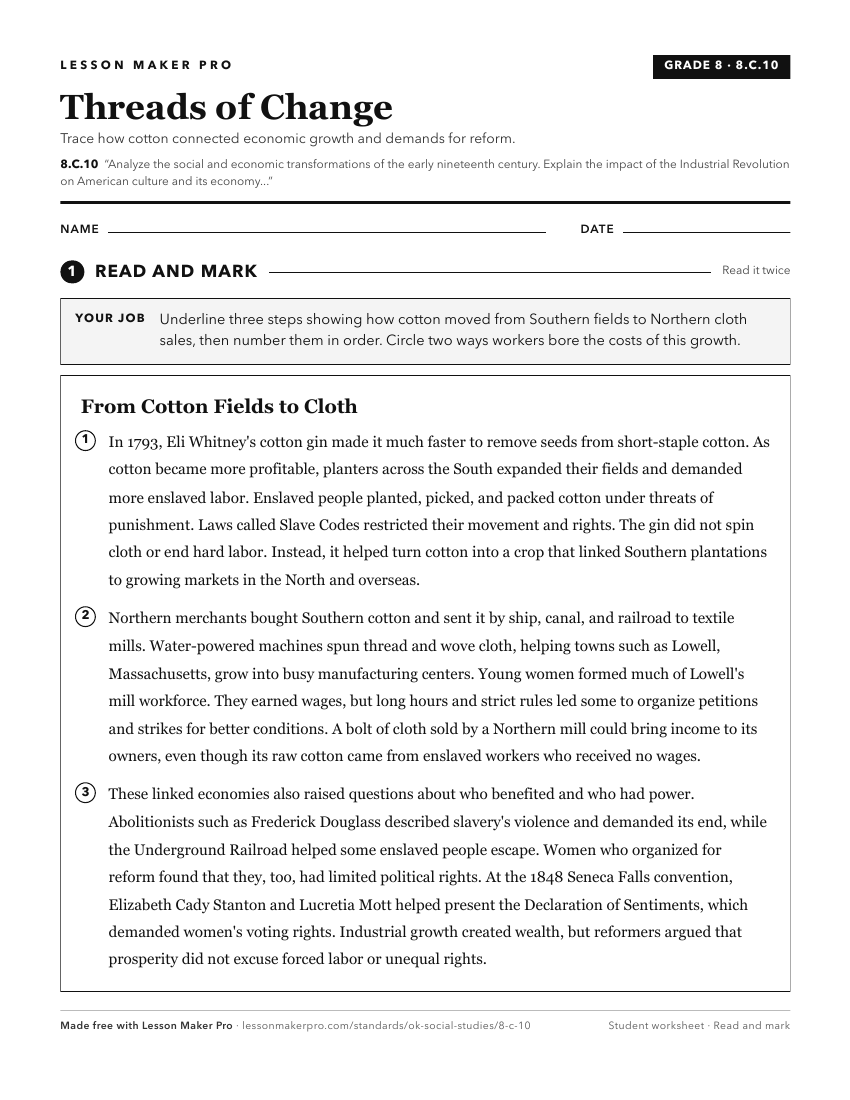
A ready-to-print activity worksheet aligned to 8.C.10, with an answer key for the teacher on its own page. No account needed.
PDF, US Letter, prints cleanly in black and white.
Download the worksheetKeep exploring
Related Standards
- MWH.C.4
Analyze the political, economic, and social transformations brought about by the events of the age of revolutions.
- USH.C.2
Analyze the social, economic, and political changes that occurred during the American Industrial Revolution, the Gilded Age, and reform movements.
- 8.C.13
Analyze the political, social, and economic transformations during the Reconstruction Era.
- MWH.C.5
Analyze the massive social, economic, and cultural change brought about by the Industrial Revolution.
Turn this cluster into a lesson
Grade, subject, topic, and the complete cluster are prefilled. Create one free, no account needed.
Also for this cluster:Make a WorksheetMake a QuizMake a Sub Lesson