Oklahoma Social Studies 8.C.10.1.B
The Standard
- 8.C.10
- Analyze the social and economic transformations of the early nineteenth century.
- 8.C.10.1
- Explain the impact of the Industrial Revolution on American culture and its economy.
Explain how the invention of the cotton gin impacted Southern plantation economies by increasing the profitability of the crop and leading to the expansion of slavery.
Oklahoma Academic Standards for Social Studies (2026) · 8.C.10.1
Teacher's field guide
What This Standard Means
What Students Need to Do
- Students explain how faster seed removal made cotton growing more profitable. They connect larger plantations to increased demand for enslaved field workers.
What Mastery Looks Like
- A student can explain why planters grew more cotton after the gin made processing faster. They can explain why the machine did not reduce the demand for enslaved field workers.
Common Misconceptions
- Students may think the gin picked cotton or replaced workers in the fields. Some assume any labor-saving machine would have reduced slavery.
How to Assess It
- Exit ticket: The gin removed seeds faster. Why did that lead to more enslaved people working on Southern plantations rather than fewer? Answer in two sentences.
Lesson moves
Ways to Teach It
Give pairs a cotton boll photo and a gin diagram; have them label seed removal and field picking as separate steps.
Ask students to write: Why might a machine that saves work still lead planters to demand more forced labor?
Play a cause-and-effect card game with faster processing, higher profits, larger plantations, and forced field labor; require an explanation for each link.
Bring a cotton T-shirt and have students mark Southern cotton fields and Northern textile mills on a map, then trace cotton's route.
Free download
Printable 8.C.10.1.B Worksheet
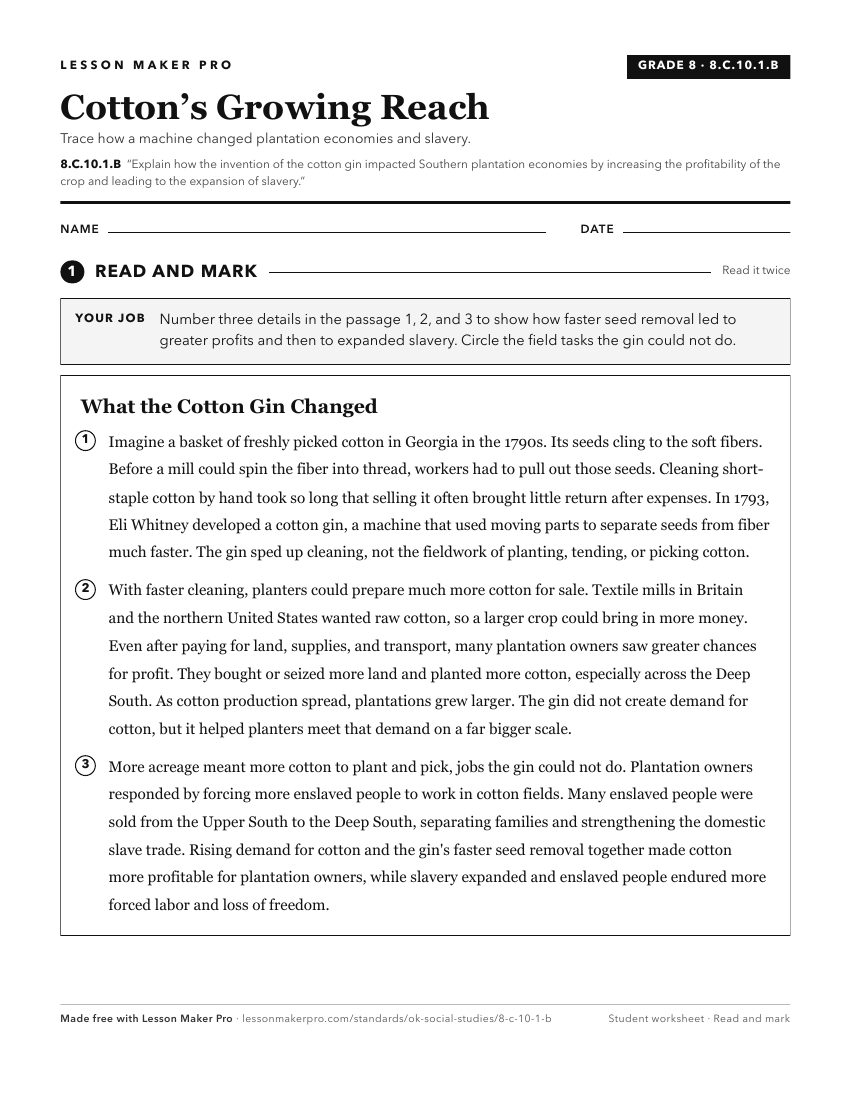
A ready-to-print activity worksheet aligned to 8.C.10.1.B, with an answer key for the teacher on its own page. No account needed.
PDF, US Letter, prints cleanly in black and white.
Download the worksheetKeep exploring
Related Standards
- 6.C.3.6.D
Explain the effects of plantation agriculture and the importation of enslaved labor on the economic development and cultural heritage of regions.
- 8.C.13.3.B
Describe the expansion of the tenant and sharecropper systems which enabled landowners to reestablish a labor force severely restricting economic mobility.
- MWH.C.2.5.E
Explain how overseas expansion led to the development of the trans-Atlantic slave trade.
- 8.C.10.1.C
Analyze the connection between cotton production in the South to the economic success of Northern textile industries.
Turn this exact standard into a lesson
Grade, subject, topic, and the complete standard are prefilled. Create one free, no account needed.
Also for this standard:Make a WorksheetMake a QuizMake a Sub Lesson