Oklahoma Social Studies 8.C.13.3.B
The Standard
- 8.C.13
- Analyze the political, social, and economic transformations during the Reconstruction Era.
- 8.C.13.3
- Analyze the emerging social structure of the postwar South.
Describe the expansion of the tenant and sharecropper systems which enabled landowners to reestablish a labor force severely restricting economic mobility.
Oklahoma Academic Standards for Social Studies (2026) · 8.C.13.3
Teacher's field guide
What This Standard Means
What Students Need to Do
- Students explain why landowners relied on tenant farmers and sharecroppers after slavery ended. They trace how rent, crop shares, and store credit made it hard for many families to save money or buy land.
What Mastery Looks Like
- Given a farm contract and a store ledger, students identify who owns the land, who does the work, and who receives the harvest. They explain how unpaid debt can keep a family working the same land the next year.
Common Misconceptions
- Students may think sharecroppers owned the land or kept the whole harvest. They may blame debt only on bad harvests and miss the cost of supplies bought on credit.
How to Assess It
- Exit ticket: A family gives half its cotton to the landowner and still owes $30 at the store after harvest. Explain why the family may have to farm the same land next year.
Lesson moves
Ways to Teach It
Give pairs 20 cotton tokens, a crop-share card, and a supply-debt card; have them calculate what the farming family keeps.
Ask: Why might a landowner offer a crop share instead of wages, and what choices would a farmer without land have?
Give students four short farm agreements to sort as tenant, sharecropper, or wage worker; have them underline who owns the land.
Compare cash and credit prices for a bag of fertilizer, then calculate how borrowing changes a farmer's profit.
Free download
Printable 8.C.13.3.B Worksheet
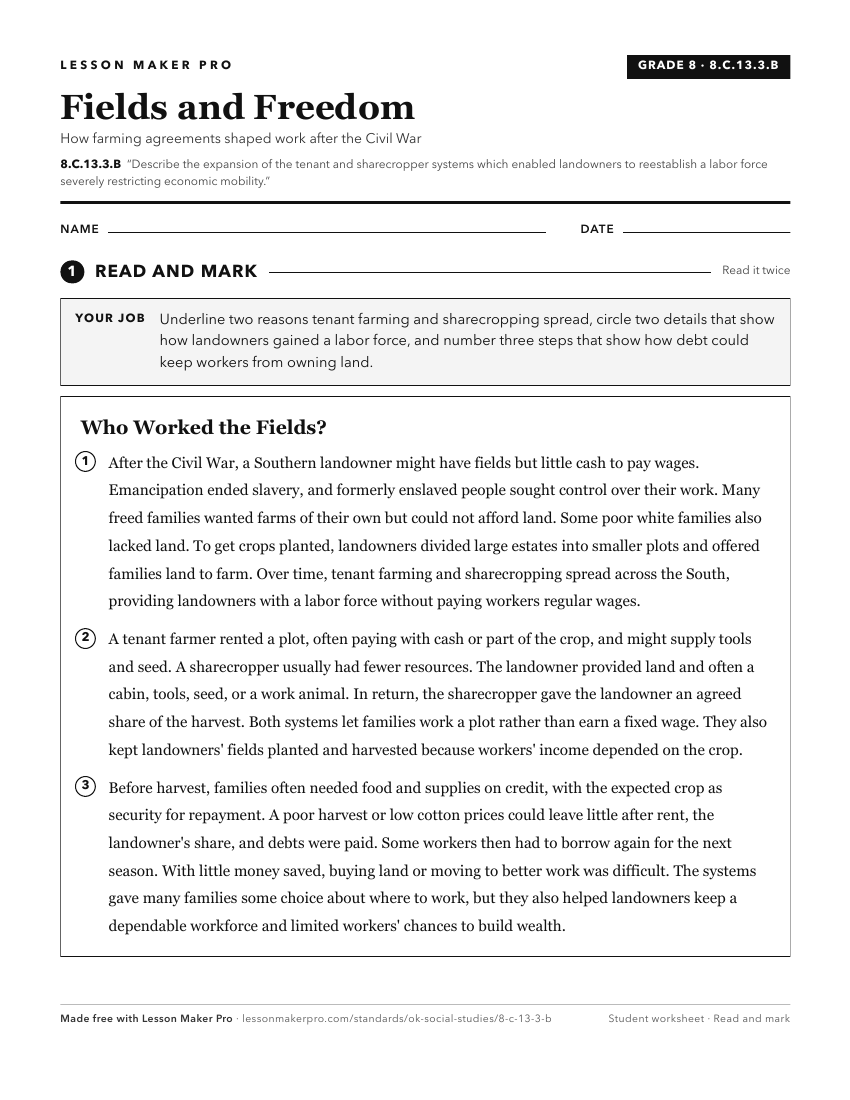
A ready-to-print activity worksheet aligned to 8.C.13.3.B, with an answer key for the teacher on its own page. No account needed.
PDF, US Letter, prints cleanly in black and white.
Download the worksheetKeep exploring
Related Standards
- 8.C.13.5.A
Describe how the Homestead Act of 1862 enabled more individuals to obtain land and partake in economic opportunities following the war.
- USH.C.1.2.B
Explain the reasons for adoption of Black Codes immediately following the Civil War and their limitations on economic opportunities and property ownership.
- 8.C.10.1.B
Explain how the invention of the cotton gin impacted Southern plantation economies by increasing the profitability of the crop and leading to the expansion of s...
- USH.C.2.1.B
Describe the changing role of the American farmer, including the establishment of the Granger movement.
Turn this exact standard into a lesson
Grade, subject, topic, and the complete standard are prefilled. Create one free, no account needed.
Also for this standard:Make a WorksheetMake a QuizMake a Sub Lesson