Oklahoma Social Studies 8.C.10.4
Standard Cluster
- 8.C.10
- Analyze the social and economic transformations of the early nineteenth century.
Evaluate the goals and efforts of the Women’s Suffrage Movement toward political equality. Trace the emergence of the women’s rights movement from the abolitionist movement. Describe the role of the movement’s primary leaders (e.g., Susan B. Anthony, Elizabeth Cady Stanton, Lucretia Mott, Grimké sisters). Identify the ideals, democratic principles, and demands expressed in the Declaration of Sentiments.
Oklahoma Academic Standards for Social Studies (2026) · 8.C.10
Cluster contents
Standards in This Cluster
8.C.10.4 is a cluster heading. These are the individual standards under it.
- 8.C.10.4.A
Trace the emergence of the women’s rights movement from the abolitionist movement.
- 8.C.10.4.B
Describe the role of the movement’s primary leaders (e.g., Susan B. Anthony, Elizabeth Cady Stanton, Lucretia Mott, Grimké sisters).
- 8.C.10.4.C
Identify the ideals, democratic principles, and demands expressed in the Declaration of Sentiments.
Teacher's field guide
What This Cluster Means
What Students Need to Do
- Students trace how work against slavery helped launch the women’s rights movement. They explain what Mott, Stanton, Anthony, and the Grimké sisters did and what the Declaration of Sentiments demanded. They weigh the movement’s efforts to gain voting rights.
What Mastery Looks Like
- A student links abolitionist work to Mott and Stanton’s 1848 convention. They explain demands for voting rights and legal equality, then judge how speeches, petitions, and conventions helped. They know the 1920 amendment did not end voting barriers for many Black women.
Common Misconceptions
- Students may think women gained the vote at the 1848 Seneca Falls convention. They may miss the movement’s roots in abolition or think the Declaration asked only for voting rights. Some assume the 1920 amendment removed voting barriers for every woman.
How to Assess It
- Exit ticket: The Declaration of Sentiments demanded voting rights. Name one leader’s action, explain its link to abolition or women’s rights, and judge how it helped or fell short of that demand.
Lesson moves
Ways to Teach It
Place four cards on a floor timeline: Grimké sisters’ 1837 speeches, the 1848 convention, Anthony’s 1872 vote, and the 1920 amendment.
Discuss why Mott and Stanton modeled their list of demands on the Declaration of Independence.
Match cards naming Mott, Stanton, Anthony, and the Grimké sisters to cards describing their actions, then explain one match.
Compare an Oklahoma voter registration form with the 1848 voting demand; circle eligibility rules and discuss how registration can limit access.
Free download
Printable 8.C.10.4 Worksheet
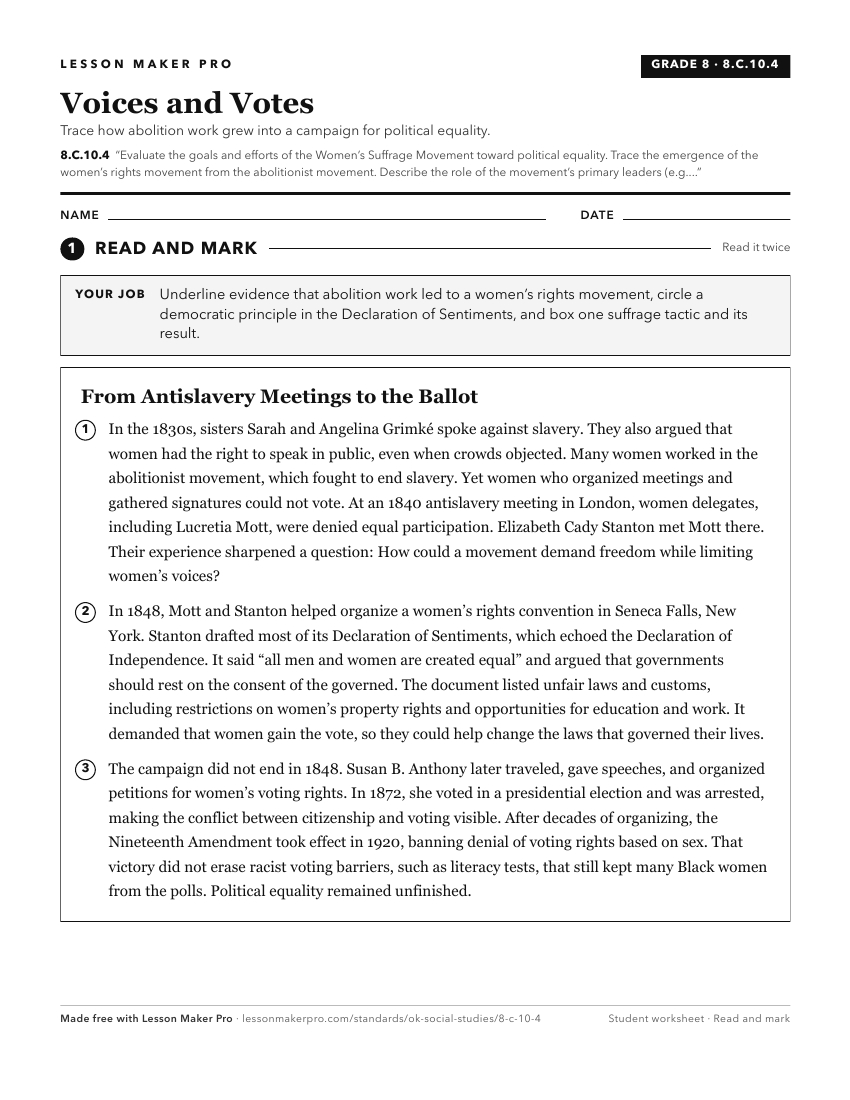
A ready-to-print activity worksheet aligned to 8.C.10.4, with an answer key for the teacher on its own page. No account needed.
PDF, US Letter, prints cleanly in black and white.
Download the worksheetKeep exploring
Related Standards
- USH.C.2.2.A
Describe the Women’s Suffrage Movement, focusing on the leadership of Susan B. Anthony and Elizabeth Cady Stanton, as well as strategies used to bring attention...
- USH.C.7.2.E
Compare the changing roles of women including the goals of the Women’s Liberation Movement and the National Organization of Women, comparing the views of Betty ...
- USH.C.2.2
Evaluate the efforts of major reform movements in addressing social issues.
Turn this cluster into a lesson
Grade, subject, topic, and the complete cluster are prefilled. Create one free, no account needed.
Also for this cluster:Make a WorksheetMake a QuizMake a Sub Lesson