Oklahoma Social Studies USH.C.2.2
Standard Cluster
- USH.C.2
- Analyze the social, economic, and political changes that occurred during the American Industrial Revolution, the Gilded Age, and reform movements.
Evaluate the efforts of major reform movements in addressing social issues. Describe the Women’s Suffrage Movement, focusing on the leadership of Susan B. Anthony and Elizabeth Cady Stanton, as well as strategies used to bring attention to the suffrage cause. Explain how the Social Gospel movement emphasized the application of Christian principles of social justice to societal problems, such as poverty, inequality, and injustice. Summarize changing race relations as a result of the Plessy v. Ferguson decision, establishing a doctrine that became known as "separate but equal.” Describe continued attempts to disenfranchise African Americans through the use of poll taxes and literacy tests by some state governments. Compare the viewpoints of early civil right leaders, such as Booker T. Washington, W.E.B. DuBois, and Ida B. Wells, in response to rising racial tensions. Evaluate the influence of the Niagara Movement and the National Association for the Advancement of Colored People (NAACP) on expanding opportunities for African Americans.
Oklahoma Academic Standards for Social Studies (2026) · USH.C.2
Cluster contents
Standards in This Cluster
USH.C.2.2 is a cluster heading. These are the individual standards under it.
- USH.C.2.2.A
Describe the Women’s Suffrage Movement, focusing on the leadership of Susan B. Anthony and Elizabeth Cady Stanton, as well as strategies used to bring attention...
- USH.C.2.2.B
Explain how the Social Gospel movement emphasized the application of Christian principles of social justice to societal problems, such as poverty, inequality, a...
- USH.C.2.2.C
Summarize changing race relations as a result of the Plessy v. Ferguson decision, establishing a doctrine that became known as "separate but equal.”
- USH.C.2.2.D
Describe continued attempts to disenfranchise African Americans through the use of poll taxes and literacy tests by some state governments.
- USH.C.2.2.E
Compare the viewpoints of early civil right leaders, such as Booker T. Washington, W.E.B. DuBois, and Ida B. Wells, in response to rising racial tensions.
- USH.C.2.2.F
Evaluate the influence of the Niagara Movement and the National Association for the Advancement of Colored People (NAACP) on expanding opportunities for African...
Teacher's field guide
What This Cluster Means
What Students Need to Do
- Students explain how Susan B. Anthony and Elizabeth Cady Stanton used speeches and petitions to build support for women's voting rights. They describe how Social Gospel reformers applied Christian teachings to poverty and inequality. They explain how segregation and voting barriers restricted Black Americans, then compare leaders and groups that challenged those barriers.
What Mastery Looks Like
- A student connects Plessy v. Ferguson to legalized segregation and explains how poll taxes and literacy tests blocked Black voters. They distinguish Booker T. Washington's economic focus, W.E.B. Du Bois's demand for equal rights, and Ida B. Wells's anti-lynching work. They use examples to judge the gains and limits of suffrage campaigns, Social Gospel programs, the Niagara Movement, and the NAACP.
Common Misconceptions
- Students may think Plessy guaranteed equally good facilities or that poll taxes and literacy tests affected all voters equally. They may treat Washington, Du Bois, and Wells as having the same approach. Some assume Anthony and Stanton lived to see nationwide women's suffrage, or that Social Gospel work meant only giving charity.
How to Assess It
- Give students a four-row exit ticket labeled suffrage, Social Gospel, segregation, and civil rights. In each row, have them name a person or policy, describe an action, and explain one effect.
Lesson moves
Ways to Teach It
Give pairs cards with suffrage petition excerpts, Social Gospel sermons, and NAACP court cases; have them sort the cards by problem and tactic.
Ask students to write why Washington favored economic advancement, Du Bois demanded immediate rights, and Wells investigated lynchings.
Play a matching game: teams pair Plessy, poll taxes, literacy tests, the Niagara Movement, and the NAACP with their effects, then defend their choices.
Compare a historical poll tax receipt with your state's current voter registration instructions; ask which costs or steps could keep someone from voting.
Free download
Printable USH.C.2.2 Worksheet
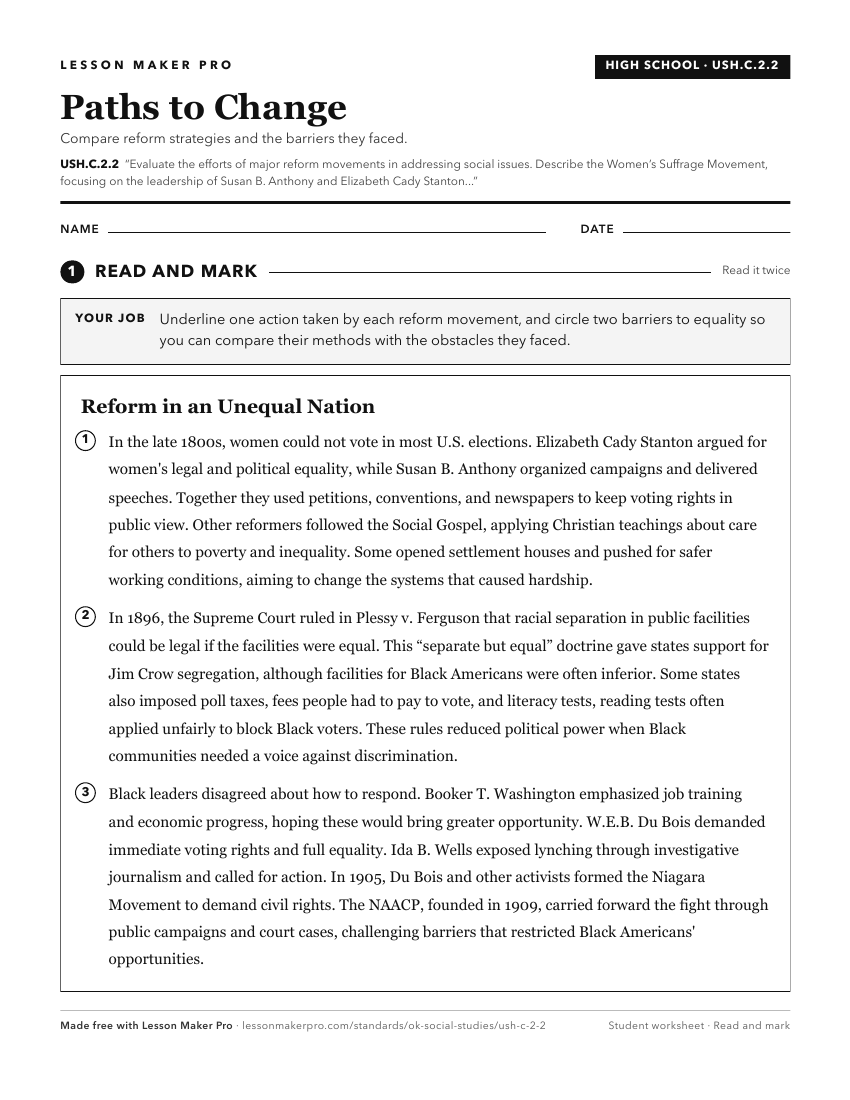
A ready-to-print activity worksheet aligned to USH.C.2.2, with an answer key for the teacher on its own page. No account needed.
PDF, US Letter, prints cleanly in black and white.
Download the worksheetKeep exploring
Related Standards
- S.5.6
Examine the extent to which individual and group responses influence potential resolutions to social problems.
- USH.C.2.3
Evaluate the rise and reforms of Populism and the Progressive Movement.
- USH.C.2
Analyze the social, economic, and political changes that occurred during the American Industrial Revolution, the Gilded Age, and reform movements.
- 8.C.10.5
Evaluate the significance and key leaders of the Second Great Awakening including how it sparked a number of reform movements, such as temperance and abolitioni...
Turn this cluster into a lesson
Grade, subject, topic, and the complete cluster are prefilled. Create one free, no account needed.
Also for this cluster:Make a WorksheetMake a QuizMake a Sub Lesson