Oklahoma Social Studies S.5.6
The Standard
- S.5
- Analyze social problems that affect large numbers of people within a social system.
Examine the extent to which individual and group responses influence potential resolutions to social problems.
Oklahoma Academic Standards for Social Studies (2026) · S.5
Teacher's field guide
What This Standard Means
What Students Need to Do
- Students compare how one person's actions and organized group efforts might address a social problem. They use evidence to judge who benefits, how much changes, and what remains unsolved.
What Mastery Looks Like
- A student can explain why a one-time food drive helps some families but may not reduce hunger long term. They can compare it with a school meal campaign, using reach, duration, and limits to support a claim.
Common Misconceptions
- Students may assume a large group always has more impact than one person. They may mistake awareness, donations, or a proposed policy for proof that the problem is solved.
How to Assess It
- Exit ticket: A student donates 40 meals once, and a group secures 100 free breakfasts daily. Which action has a wider effect, and what need remains?
Lesson moves
Ways to Teach It
Give pairs cards labeled “student shares pantry hours,” “club collects groceries,” and “coalition requests school meals”; sort them by reach and likely limits.
Ask students: Which would reach more families, a one-day food drive or a school breakfast campaign, and what evidence would change your answer?
Run a budget game: teams allocate $200 to pantry bags, meal vouchers, and outreach flyers using cost and reach cards, then explain limits.
Have students check the school meal program's posted rules and a local pantry's hours, then list who each might miss.
Free download
Printable S.5.6 Worksheet
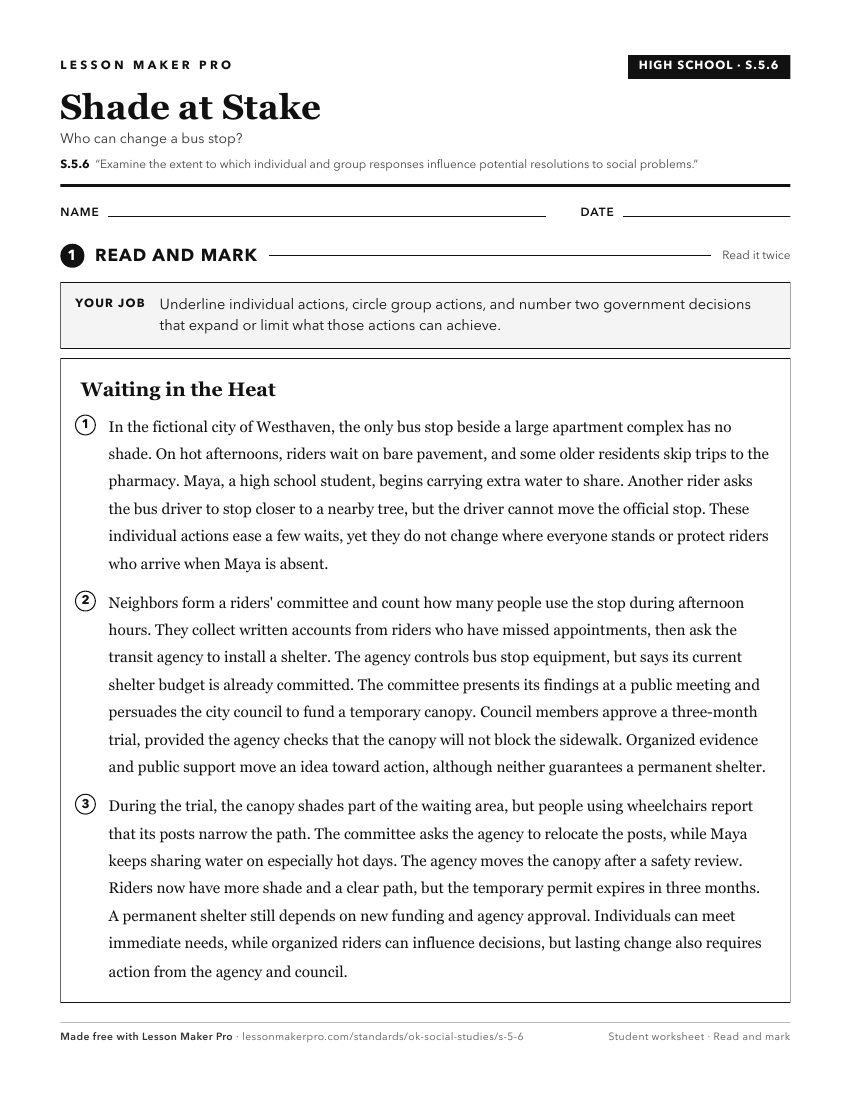
A ready-to-print activity worksheet aligned to S.5.6, with an answer key for the teacher on its own page. No account needed.
PDF, US Letter, prints cleanly in black and white.
Download the worksheetKeep exploring
Related Standards
- S.4.4
Examine the benefits of belonging to social groups, as well as the power of social groups over behavior and attitudes.
- PS.6.4
Examine the influence of the social situation on individual behavior and mental processes, including persuasion, conformity and obedience.
- S.5.3
Analyze effects of stratification and social inequality on individuals and groups, including life outcomes, social problems, and group conflict.
- S.3
Examine the social construction of groups and their impact on individuals.
Turn this exact standard into a lesson
Grade, subject, topic, and the complete standard are prefilled. Create one free, no account needed.
Also for this standard:Make a WorksheetMake a QuizMake a Sub Lesson