Oklahoma Social Studies S.3
Standard Cluster
Examine the social construction of groups and their impact on individuals. Describe the process of socialization, examining how social groups are composed and why individuals become members of or associate with different social groups. Describe various subcultures and countercultures and explain their influence according to sociological perspectives. Analyze how culture influences individuals, including the mechanisms of ethnocentrism, cultural relativity, and culture shock. Identify aspects of social structure, including social class, social status and roles, as well as their influences on individuals and groups. Describe status as a component of social structure, including status sets, ascribed and achieved statuses, status symbols and master status.
Oklahoma Academic Standards for Social Studies (2026)
Cluster contents
Standards in This Cluster
S.3 is a cluster heading. These are the individual standards under it.
- S.3.1
Describe the process of socialization, examining how social groups are composed and why individuals become members of or associate with different social groups.
- S.3.2
Describe various subcultures and countercultures and explain their influence according to sociological perspectives.
- S.3.3
Analyze how culture influences individuals, including the mechanisms of ethnocentrism, cultural relativity, and culture shock.
- S.3.4
Identify aspects of social structure, including social class, social status and roles, as well as their influences on individuals and groups.
- S.3.5
Describe status as a component of social structure, including status sets, ascribed and achieved statuses, status symbols and master status.
Teacher's field guide
What This Cluster Means
What Students Need to Do
- Students explain how shared labels and rules form groups, and how family, peers, and school teach people to join them. They compare subcultures and countercultures through different sociological lenses. They connect cultural judgments, class, status, and roles to everyday choices.
What Mastery Looks Like
- Given a school club example, students explain how its rules shape membership and how fees might keep someone out. They can map a person's status set, sort ascribed and achieved statuses, and identify role expectations, status symbols, and a master status. In a culture shock scenario, they can distinguish ethnocentrism from cultural relativity.
Common Misconceptions
- Students may treat groups as natural categories rather than labels and norms people maintain. They may call any unfamiliar custom a counterculture or think cultural relativity means approving every practice. They may confuse a status with the behavior expected of someone who holds it.
How to Assess It
- Exit ticket: A student joins a skate club after friends teach its rules, wears its badge, and cannot afford the required gear. Name the socializing group, an achieved status, a status symbol, and a class barrier.
Lesson moves
Ways to Teach It
Give pairs cards labeled student, sibling, cashier, and team captain; have them build a status-set chart with roles and possible conflicts.
Ask: When a newcomer mistakes a local greeting for rudeness, how would ethnocentrism and cultural relativity explain their reaction?
Sort cards about a chess club and an anti-consumerist collective into subculture or counterculture, then explain one using a conflict lens.
Compare school club flyers and sign-up fees; ask who can join, whose interests shape the rules, and which labels define insiders.
Free download
Printable S.3 Worksheet
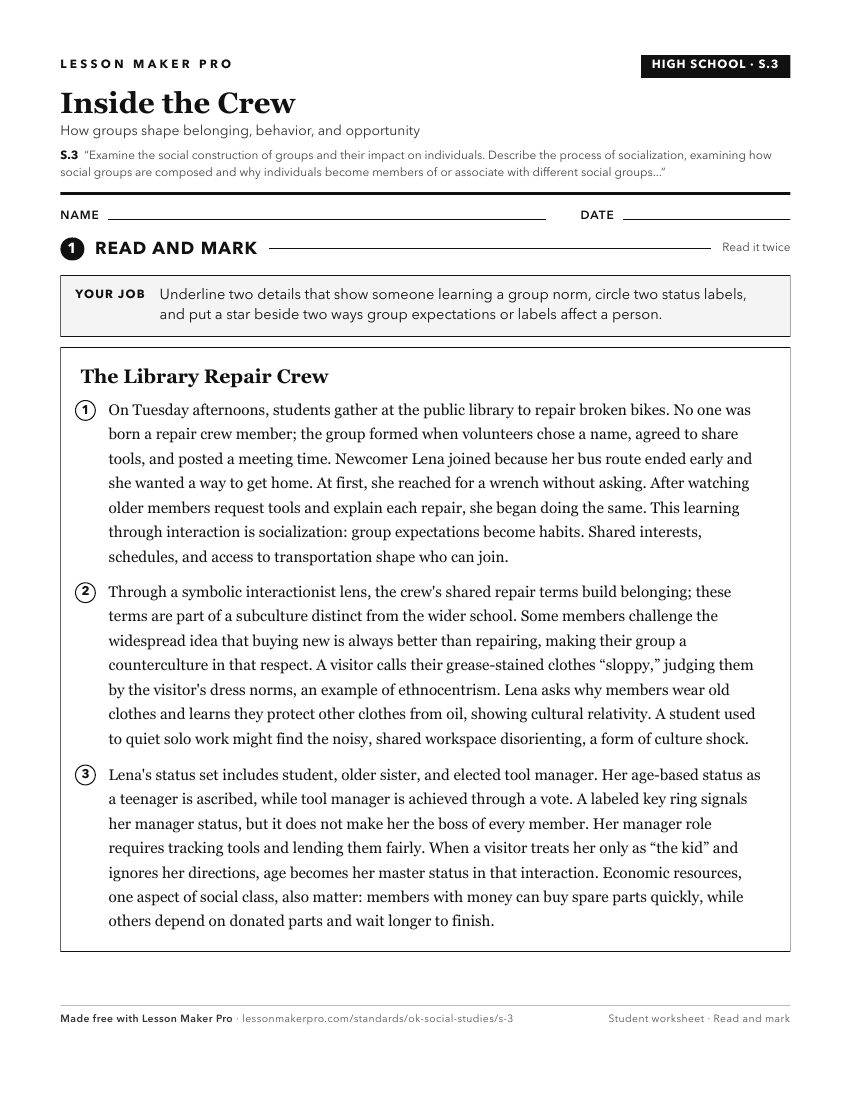
A ready-to-print activity worksheet aligned to S.3, with an answer key for the teacher on its own page. No account needed.
PDF, US Letter, prints cleanly in black and white.
Download the worksheetKeep exploring
Related Standards
- S.4.4
Examine the benefits of belonging to social groups, as well as the power of social groups over behavior and attitudes.
- S.5.1
Analyze patterns of social stratification and their effects on individuals and groups.
- S.5.3
Analyze effects of stratification and social inequality on individuals and groups, including life outcomes, social problems, and group conflict.
Turn this cluster into a lesson
Grade, subject, topic, and the complete cluster are prefilled. Create one free, no account needed.
Also for this cluster:Make a WorksheetMake a QuizMake a Sub Lesson