Oklahoma Social Studies 8.C.10.1
Standard Cluster
- 8.C.10
- Analyze the social and economic transformations of the early nineteenth century.
Explain the impact of the Industrial Revolution on American culture and its economy. Describe major technological improvements and inventions that contributed to industrial growth in the North, resulting in heavily populated manufacturing and transportation centers. Explain how the invention of the cotton gin impacted Southern plantation economies by increasing the profitability of the crop and leading to the expansion of slavery. Analyze the connection between cotton production in the South to the economic success of Northern textile industries. Examine the role of women as the primary workforce in New England textile factories and leaders in the reform of working conditions. Examine the rise of nativist movements in response to increased immigration during industrialization, including debates over assimilation, labor competition, and political influence.
Oklahoma Academic Standards for Social Studies (2026) · 8.C.10
Cluster contents
Standards in This Cluster
8.C.10.1 is a cluster heading. These are the individual standards under it.
- 8.C.10.1.A
Describe major technological improvements and inventions that contributed to industrial growth in the North, resulting in heavily populated manufacturing and tr...
- 8.C.10.1.B
Explain how the invention of the cotton gin impacted Southern plantation economies by increasing the profitability of the crop and leading to the expansion of s...
- 8.C.10.1.C
Analyze the connection between cotton production in the South to the economic success of Northern textile industries.
- 8.C.10.1.D
Examine the role of women as the primary workforce in New England textile factories and leaders in the reform of working conditions.
- 8.C.10.1.E
Examine the rise of nativist movements in response to increased immigration during industrialization, including debates over assimilation, labor competition, an...
Teacher's field guide
What This Cluster Means
What Students Need to Do
- Students explain how the cotton gin increased cotton profits and expanded slavery in the South. They trace cotton to Northern mills and show how powered looms, steam engines, canals, and railroads grew factory cities. They describe women's mill work and reform efforts, then explain nativist arguments about immigrant jobs, assimilation, and political power.
What Mastery Looks Like
- A student can trace cotton from a Southern plantation to a Northern mill and explain why both regions profited while slavery expanded. They can use a map to explain why factories grew near canals and railroads. They can name a change mill women sought and identify nativist claims about immigrants without treating those claims as facts.
Common Misconceptions
- Students may think the cotton gin reduced slavery because it made processing faster. They may miss that Northern mills depended on cotton grown by enslaved people, or assume women did not work in factories. Some repeat nativist claims about immigrants taking jobs or controlling elections as proven facts.
How to Assess It
- Ask on an exit ticket: "How did the cotton gin affect slavery and Northern mills, and how did railroads help mill towns grow?" Then ask students to name one change mill women sought and one claim nativists made about immigrants.
Lesson moves
Ways to Teach It
Place cotton gin, plantation, mill, canal, and railroad cards on a map; connect them with yarn and label each economic link.
Read a Lowell mill worker's petition for shorter hours; write two sentences on her demand and how factory work changed women's roles.
Sort immigrant job ads and nativist flyers into evidence and claims; discuss which claims concern jobs, assimilation, or political power.
Check a shirt's "Made in" tag; ask who supplied its cotton, then compare that question with Northern mills' dependence on Southern cotton.
Free download
Printable 8.C.10.1 Worksheet
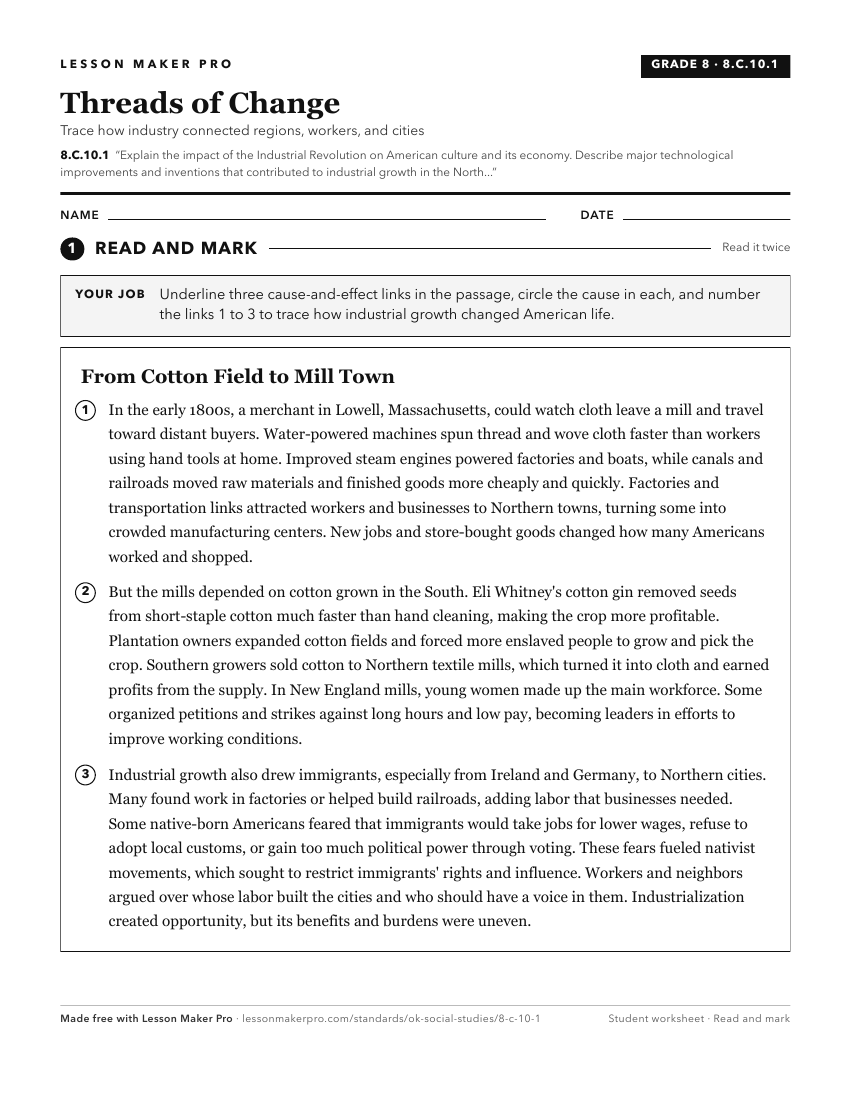
A ready-to-print activity worksheet aligned to 8.C.10.1, with an answer key for the teacher on its own page. No account needed.
PDF, US Letter, prints cleanly in black and white.
Download the worksheetKeep exploring
Related Standards
- USH.C.2.1
Evaluate the transformation of American society, economy, politics, and culture during the American Industrial Revolution.
- MWH.C.5
Analyze the massive social, economic, and cultural change brought about by the Industrial Revolution.
- USH.C.2.1.D
Identify the impact of new inventions and industrial production methods on the growth of the American economy and standard of living (e.g., technologies develop...
- WG.C.6
Analyze the impact of industrialization on economic development.
Turn this cluster into a lesson
Grade, subject, topic, and the complete cluster are prefilled. Create one free, no account needed.
Also for this cluster:Make a WorksheetMake a QuizMake a Sub Lesson