Oklahoma Social Studies USH.C.2.1.C
The Standard
- USH.C.2
- Analyze the social, economic, and political changes that occurred during the American Industrial Revolution, the Gilded Age, and reform movements.
- USH.C.2.1
- Evaluate the transformation of American society, economy, politics, and culture during the American Industrial Revolution.
Analyze the impact of capitalism and laissez-faire policy on business practices, such as monopolies, the characterization of “robber barons” and the role of industrialists in economic growth, as well as philanthropy (e.g., Cornelius Vanderbilt, J.P. Morgan, John D. Rockefeller, and Andrew Carnegie, including his Gospel of Wealth essay on society).
Oklahoma Academic Standards for Social Studies (2026) · USH.C.2.1
Teacher's field guide
What This Standard Means
What Students Need to Do
- Students explain how private investment and limited government regulation shaped large businesses. They weigh gains such as connected railroads against problems such as reduced competition. They explain why industrialists drew both praise and criticism.
What Mastery Looks Like
- A student can use Rockefeller's oil trust to show how a firm gained market power and Vanderbilt's railroads to show economic growth. They can weigh Carnegie's library donations against criticism of low steelworker wages.
Common Misconceptions
- Students may think laissez-faire meant no government help for businesses, overlooking railroad land grants. They may call every large firm a monopoly or assume charitable gifts erased harm to workers and competitors.
How to Assess It
- Exit ticket: In three sentences, explain how limited regulation helped Rockefeller's oil trust, name one cost of its market power, and explain why Carnegie funded libraries.
Lesson moves
Ways to Teach It
Give pairs index cards showing Vanderbilt's railroads, Rockefeller's oil trust, Morgan's mergers, and Carnegie's libraries; sort each under growth, market power, or philanthropy.
Read a paragraph from Carnegie's Gospel of Wealth; write whether his library donations outweigh criticism of low steelworker wages.
Play a three-column relay: sort cards labeled 'limited regulation,' 'oil trust,' and 'library donation' under policy, business practice, or philanthropy.
Compare two grocery store flyers; predict what might happen to prices if one company bought both stores and faced no competitors.
Free download
Printable USH.C.2.1.C Worksheet
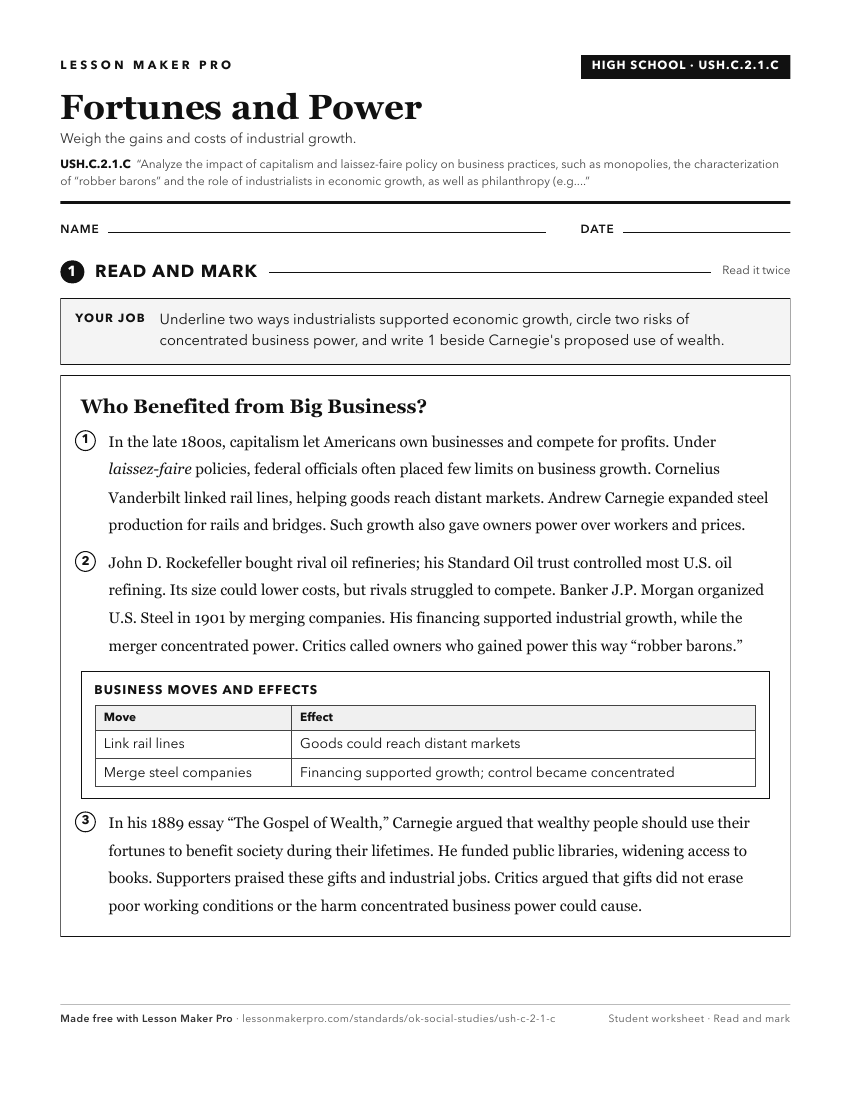
A ready-to-print activity worksheet aligned to USH.C.2.1.C, with an answer key for the teacher on its own page. No account needed.
PDF, US Letter, prints cleanly in black and white.
Download the worksheetKeep exploring
Related Standards
- MWH.C.3.3.C
Examine the impact of Adam Smith’s theories, as presented in The Wealth of Nations, on modern economic thought and free enterprise.
- USH.C.2.1.E
Examine the complex conditions that characterized the Gilded Age (e.g., rapidly expanding economy, concentration of wealth, corrupt politics, poverty).
- USG.C.6.4.B
Examine how liberty and private property have contributed to economic opportunity and prosperity in the United States of America.
- USH.C.2.1.F
Evaluate the role of muckrakers and social reformers (e.g., Jane Addams, Ida Tarbell, Jacob Riis, Upton Sinclair) on increased awareness of business practices a...
Turn this exact standard into a lesson
Grade, subject, topic, and the complete standard are prefilled. Create one free, no account needed.
Also for this standard:Make a WorksheetMake a QuizMake a Sub Lesson