Oklahoma Social Studies USH.C.4.2
Standard Cluster
- USH.C.4
- Analyze the cycles of economic boom and bust of the 1920s and 1930s on the transformation of the United States of America’s government and society.
Analyze the prosperity of the Roaring Twenties and the collapse of the United States of America’s economy, leading to the Great Depression. Describe the booming economy based upon access to easy credit through installment buying and a return to laissez-faire economics during the Harding and Coolidge Administrations. Examine the various factors contributing to and exacerbating the global depression, including German reparations, Allied war debts, United States of America loans to Europe, and the Smoot-Hawley Tariff’s strain on international trade. Identify causes contributing to an unstable economy including the overproduction of agriculture products, greater speculation in the stock market and buying on margin, and laissez faire policies. Examine the role of monetary policy and the expansion of credit in the 1920’s including the creation and actions of the Federal Reserve System and their relationship to speculation, investment, and economic instability. Examine the role of the Stock Market Crash and bank failures in weakening both the agricultural and manufacturing sectors of the economy as well as decimating the savings of middle class families. Explain growing labor unrest and industry’s reactions by describing the use of sit-down strikes and court injunctions and examining why socialism and communism appealed to labor. Analyze points of view regarding the economic and social impact of the Great Depression on individuals, families, and the nation. Analyze how President Herbert Hoover’s philosophy of “rugged individualism,” public works projects, and restrictive monetary policies attempted to address massive unemployment; describe examples of public reaction to such measures (e.g., Bonus Army March, Hoovervilles, presidential election of 1932).
Oklahoma Academic Standards for Social Studies (2026) · USH.C.4
Cluster contents
Standards in This Cluster
USH.C.4.2 is a cluster heading. These are the individual standards under it.
- USH.C.4.2.A
Describe the booming economy based upon access to easy credit through installment buying and a return to laissez-faire economics during the Harding and Coolidge...
- USH.C.4.2.B
Examine the various factors contributing to and exacerbating the global depression, including German reparations, Allied war debts, United States of America loa...
- USH.C.4.2.C
Identify causes contributing to an unstable economy including the overproduction of agriculture products, greater speculation in the stock market and buying on ...
- USH.C.4.2.D
Examine the role of monetary policy and the expansion of credit in the 1920’s including the creation and actions of the Federal Reserve System and their relatio...
- USH.C.4.2.E
Examine the role of the Stock Market Crash and bank failures in weakening both the agricultural and manufacturing sectors of the economy as well as decimating t...
- USH.C.4.2.F
Explain growing labor unrest and industry’s reactions by describing the use of sit-down strikes and court injunctions and examining why socialism and communism ...
- USH.C.4.2.G
Analyze points of view regarding the economic and social impact of the Great Depression on individuals, families, and the nation.
- USH.C.4.2.H
Analyze how President Herbert Hoover’s philosophy of “rugged individualism,” public works projects, and restrictive monetary policies attempted to address massi...
Teacher's field guide
What This Cluster Means
What Students Need to Do
- Students explain how installment buying, stock purchases on margin, farm surpluses, and hands-off policies made the 1920s boom fragile. They trace how Federal Reserve decisions, the crash, bank failures, and tariffs spread losses across the U.S. and Europe. They compare how families, workers, businesses, and Hoover responded.
What Mastery Looks Like
- Students can map U.S. loans, German reparations, and Allied war debts, then show what happened when lending slowed. They explain how failed banks wiped out savings and cut credit to farms and factories. They use Hoovervilles, the Bonus Army, and the 1932 election to judge Hoover's public works and limited direct aid.
Common Misconceptions
- Students may blame only the crash and ignore farm overproduction, bank failures, and restrictive monetary policy. They may confuse buying on margin with paying cash or think the Federal Reserve began after the crash. Some think Hoover did nothing or that a sit-down strike took workers out of the factory.
How to Assess It
- Exit ticket: Draw arrows linking margin loans, falling stock prices, a bank failure, and one family loss. Label each link, then explain how Hoover's public works or the Smoot-Hawley Tariff affected the crisis.
Lesson moves
Ways to Teach It
Hand out a 1928 installment ad and wage slips; pairs calculate payments, then cut wages and check what remains for food.
Show a sit-down strike photo and a court injunction excerpt; ask why socialist or communist ideas appealed to workers and why owners objected.
Use country cards to pass tokens from U.S. lenders to Germany, then to Allied debtors; stop loans and track who cannot pay.
Show a bank's FDIC sign and a 1930s bank-run photo; ask students why depositors might react differently today.
Free download
Printable USH.C.4.2 Worksheet
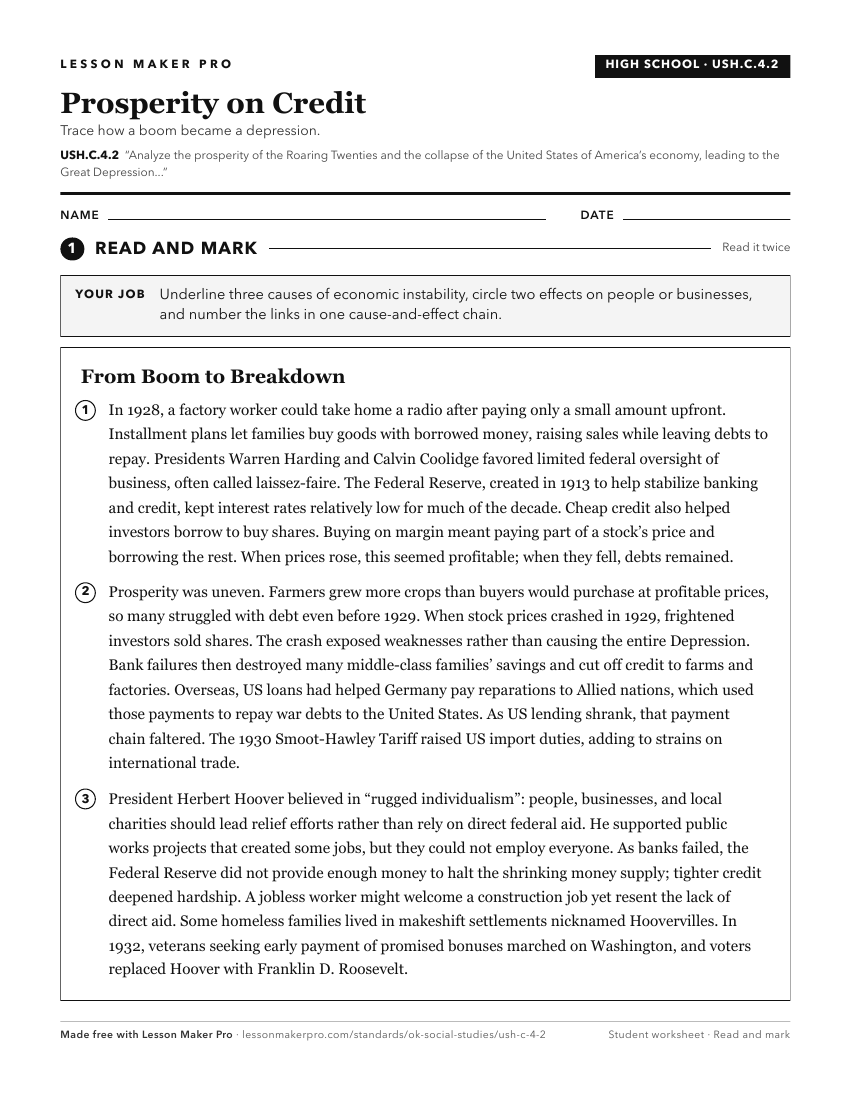
A ready-to-print activity worksheet aligned to USH.C.4.2, with an answer key for the teacher on its own page. No account needed.
PDF, US Letter, prints cleanly in black and white.
Download the worksheetKeep exploring
Related Standards
- MWH.C.6.4.A
Describe the various causes and consequences of the global economic collapse and evaluate how democratic and authoritarian governments responded to the Great De...
- OKH.C.7.1
Identify local and national economic conditions which contributed to the Great Depression and were characterized by mass unemployment and human suffering.
- USH.C.4
Analyze the cycles of economic boom and bust of the 1920s and 1930s on the transformation of the United States of America’s government and society.
Turn this cluster into a lesson
Grade, subject, topic, and the complete cluster are prefilled. Create one free, no account needed.
Also for this cluster:Make a WorksheetMake a QuizMake a Sub Lesson