Oklahoma Social Studies USH.C.4.1
Standard Cluster
- USH.C.4
- Analyze the cycles of economic boom and bust of the 1920s and 1930s on the transformation of the United States of America’s government and society.
Examine the transformations between the World Wars. Explain how the era reflected change, characterized by clashes between modern and traditional values, exemplified by the passage of the 18th and 21st Amendments, the Scopes Trial, issues of women’s rights, and the efforts of Carrie Chapman Catt and Alice Paul resulting in the ratification of the 19th Amendment. Describe the transition from wartime to peace under the Harding Administration, including the demobilization of drafted soldiers, federal budget cuts, and amnesty for political prisoners. Examine the presidency of President Calvin Coolidge and his philosophy of limited government and debates over immigration policy, including the impact of the Immigration Act of 1924, which established national quotas related to origin. Describe Calvin Coolidge’s reflections in his 1926 address on the 150th anniversary of the United States of America’s independence regarding the principles of the Declaration of Independence, natural rights, equality, and the moral foundations of American self-government. Identify new forms of cultural expression (e.g., radio, Hollywood films, comic books), including the significant impact of African American culture as exhibited by the Harlem Renaissance and the Jazz Age. Describe the rising racial tensions in American society, resulting in the resurgence of the Ku Klux Klan, lynchings, violence typified by the Tulsa Race Massacre, and the continued efforts to disenfranchise African Americans, including responses by African American leadership, such as Marcus Garvey. Describe the purpose of the Anti-Defamation League in response to antisemitism in the early 20th Century. Assess the effects of the Indian Citizenship Act of 1924 on the status of Tribal citizens with regards to dual citizenship, the divided Tribal reaction regarding sovereignty concerns, and efforts by some states to deny voting rights.
Oklahoma Academic Standards for Social Studies (2026) · USH.C.4
Cluster contents
Standards in This Cluster
USH.C.4.1 is a cluster heading. These are the individual standards under it.
- USH.C.4.1.A
Explain how the era reflected change, characterized by clashes between modern and traditional values, exemplified by the passage of the 18th and 21st Amendments...
- USH.C.4.1.B
Describe the transition from wartime to peace under the Harding Administration, including the demobilization of drafted soldiers, federal budget cuts, and amnes...
- USH.C.4.1.C
Examine the presidency of President Calvin Coolidge and his philosophy of limited government and debates over immigration policy, including the impact of the Im...
- USH.C.4.1.D
Describe Calvin Coolidge’s reflections in his 1926 address on the 150th anniversary of the United States of America’s independence regarding the principles of t...
- USH.C.4.1.E
Identify new forms of cultural expression (e.g., radio, Hollywood films, comic books), including the significant impact of African American culture as exhibited...
- USH.C.4.1.F
Describe the rising racial tensions in American society, resulting in the resurgence of the Ku Klux Klan, lynchings, violence typified by the Tulsa Race Massacr...
- USH.C.4.1.G
Describe the purpose of the Anti-Defamation League in response to antisemitism in the early 20th Century.
- USH.C.4.1.H
Assess the effects of the Indian Citizenship Act of 1924 on the status of Tribal citizens with regards to dual citizenship, the divided Tribal reaction regardin...
Teacher's field guide
What This Cluster Means
What Students Need to Do
- Students trace Harding's shift to peacetime and Coolidge's views on government. They explain how amendments, immigration quotas, radio, films, and jazz changed life. They compare new rights with Klan violence, antisemitism, and barriers to Tribal voting.
What Mastery Looks Like
- They explain Catt's and Paul's suffrage tactics, Prohibition's start and repeal, and the Scopes Trial's dispute over teaching evolution. They link Harding's demobilization, budget cuts, and amnesty to Coolidge's limited government, 1926 speech on equality, and immigration quotas. They contrast Harlem Renaissance art with the Tulsa Race Massacre, Garvey's organizing, the ADL's response to antisemitism, and limits on Tribal voting after federal citizenship.
Common Misconceptions
- Students may think the 19th Amendment gave every woman the same access to voting, or that the 21st Amendment began Prohibition. They may assume federal citizenship guaranteed Tribal citizens a vote, or that immigration quotas treated every country alike. They may mistake the popularity of jazz for an end to racial violence.
How to Assess It
- Exit ticket: How did 1924 immigration quotas or state barriers to Tribal voting conflict with Coolidge's 1926 words about equality? Answer in two sentences using one specific policy or voting restriction.
Lesson moves
Ways to Teach It
Give pairs a 1924 immigration quota table and a state voting restriction excerpt; have them circle who could enter or vote.
Ask: How did Coolidge's 1926 words about equality fit with immigration quotas and states denying Tribal citizens the vote?
Play a card match with the 18th, 19th, and 21st Amendments, Catt, Paul, Harding's amnesty, and their effects.
Play a 1920s jazz recording and a current playlist track; have students compare how radio and streaming spread Black musicians' work.
Free download
Printable USH.C.4.1 Worksheet
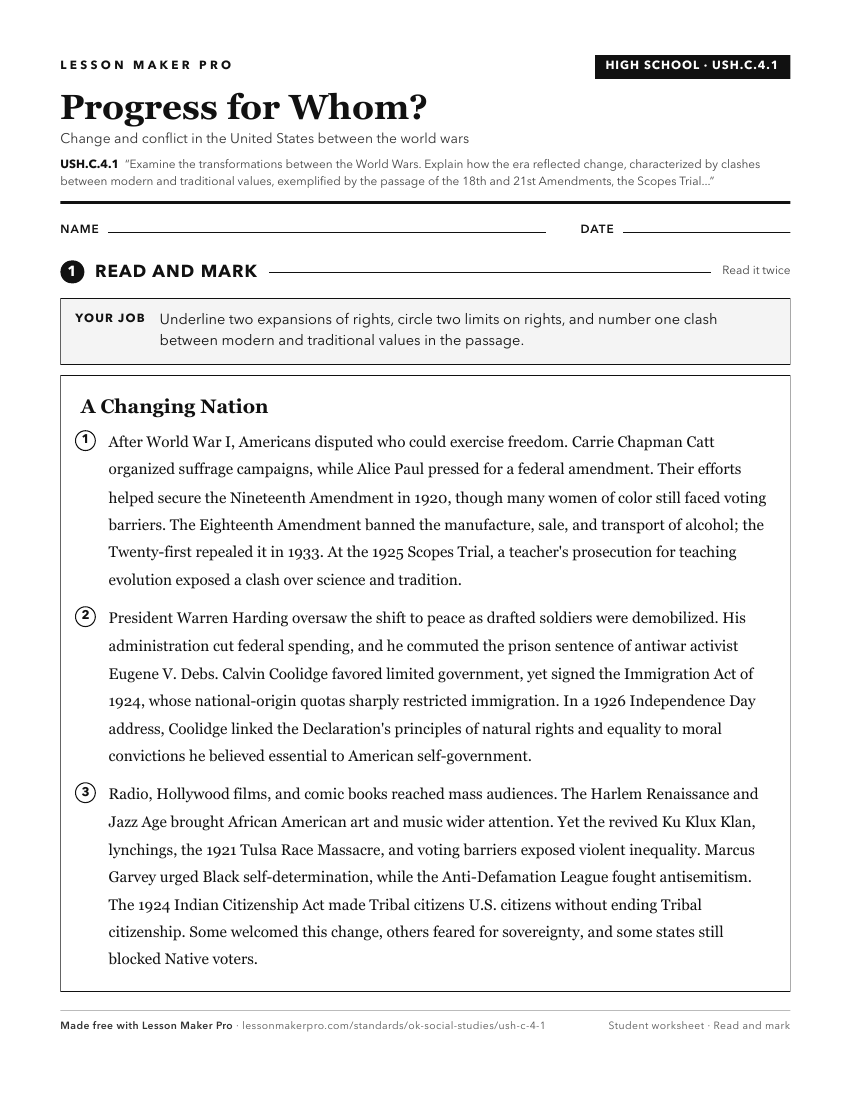
A ready-to-print activity worksheet aligned to USH.C.4.1, with an answer key for the teacher on its own page. No account needed.
PDF, US Letter, prints cleanly in black and white.
Download the worksheetKeep exploring
Related Standards
- MWH.C.6.5
Examine the significant events of World War II from a global perspective.
- MWH.C.6.2
Evaluate the lasting effects of World War I.
- MWH.C.6
Evaluate the global transformation created by the World Wars.
- MWH.C.7
Evaluate post-World War II regional events leading to the transformations of the modern world.
Turn this cluster into a lesson
Grade, subject, topic, and the complete cluster are prefilled. Create one free, no account needed.
Also for this cluster:Make a WorksheetMake a QuizMake a Sub Lesson