Oklahoma Social Studies MWH.C.6
Standard Cluster
Evaluate the global transformation created by the World Wars. Analyze the underlying causes and significant events of World War I. Describe complex and multiple causes of World War I, including militarism, nationalism, industrial and colonial competition, Europe’s alliance system, and the instability created by the declining Austro-Hungarian and Ottoman Empires. Summarize the significant events of World War I and why the conflict was considered a total war (e.g., use of industrial and chemical weapons, prolonged trench warfare, expansion into a global conflict) with a focus on the war’s significant turning points (e.g., Battles of the Marne, Verdun, the Somme). Evaluate the lasting effects of World War I. Describe the economic destruction and unprecedented loss of life, including the Armenian genocide. Explain post-war political instability (e.g., collapse of the Russian, Ottoman, and Austro-Hungarian Empires). Examine the immediate consequences of the Treaty of Versailles, including the “war guilt” clause, the establishment of European mandates and the effects of the mandate system on Zionism and other regional nationalist movements. Analyze the causes and consequences of the Russian Revolution on global politics, social structures, human rights, and economic systems. Describe the growing political and social unrest under Czar Nicholas II and the collapse of the Romanov dynasty, exemplified by the emergence of the Bolshevik Movement and the Russian Civil War. Summarize the consequences of Soviet communism, including the establishment of a one-party dictatorship under Lenin, government seizure of private property, and the persecution of religious believers. Describe Stalin’s rise to power and establishment of a totalitarian regime, the use of mass terror during the Great Purge, the suppression of political opposition, and the state policies that led to the Holodomor famine in Ukraine. Analyze the economic, social, and political conditions that resulted in World War II. Describe the various causes and consequences of the global economic collapse and evaluate how democratic and authoritarian governments responded to the Great Depression, including the growth of social welfare legislation and mixed economies. Explain how violations of the Treaty of Versailles and failure of the League of Nations, including unrealistic reparations demands and failed efforts at international disarmament, fueled a second global conflict. Evaluate the economic, social, and political conditions that allowed the rise of Fascist militarist regimes in Germany, Italy, Spain, and Japan. Identify the characteristics of fascism, including how such totalitarian regimes utilized propaganda, repressed dissention, and instigated antisemitism (e.g., Nuremberg Laws in Germany). Examine the significant events of World War II from a global perspective. Describe aggression by the Axis powers (e.g., Italy's invasion of Ethiopia; Germany’s militarization, the Stalin-Hitler Pact of 1939, annexation of Austria, and attack on Poland; Japanese invasion of China, the Nanking Massacre) including the initial responses by the Allied nations. Compare military campaigns in Africa, Asia, and the Pacific (e.g., Battle of the Atlantic, Battle of Britain, siege of Leningrad, Operation Torch, Operation Overlord), identifying Allied military leadership, major strategies, and sacrifices made by soldiers, as well as civilians. Examine the background, causes, series of events, and effects of the Shoah (Holocaust), the state-sponsored systematic persecution and annihilation of European Jews by Nazi Germany and its collaborators. Trace the historical roots of antisemitism in Europe, including prejudice and the emergence of the 19th-century racial theories, and analyze how these ideas contributed to Nazi ideology. Describe the National Socialist Party’s (Nazi) seizure of unchecked power, its dehumanization of the Jews and other victims (e.g., people with physical disabilities and homosexuals), and the mass genocide of Jews and the Roma. Examine the effects of the Shoah through eyewitness accounts from victims, survivors, liberators, and perpetrators. Summarize world responses including religious, political, and humanitarian resistance movements to the Shoah resulting in the Nuremberg Trials and the increased support for the establishment of a Jewish state in the Jewish people’s historical homeland. Describe efforts to avoid the abuse of human rights by examining the intent of the Universal Declaration of Human Rights and the expansion of the Geneva Conventions.
Oklahoma Academic Standards for Social Studies (2026)
Cluster contents
Standards in This Cluster
MWH.C.6 is a cluster heading. These are the individual standards under it.
- MWH.C.6.1
Analyze the underlying causes and significant events of World War I.
- MWH.C.6.1.A
Describe complex and multiple causes of World War I, including militarism, nationalism, industrial and colonial competition, Europe’s alliance system, and the i...
- MWH.C.6.1.B
Summarize the significant events of World War I and why the conflict was considered a total war (e.g., use of industrial and chemical weapons, prolonged trench ...
- MWH.C.6.2
Evaluate the lasting effects of World War I.
- MWH.C.6.2.A
Describe the economic destruction and unprecedented loss of life, including the Armenian genocide.
- MWH.C.6.2.B
Explain post-war political instability (e.g., collapse of the Russian, Ottoman, and Austro-Hungarian Empires).
- MWH.C.6.2.C
Examine the immediate consequences of the Treaty of Versailles, including the “war guilt” clause, the establishment of European mandates and the effects of the ...
- MWH.C.6.3
Analyze the causes and consequences of the Russian Revolution on global politics, social structures, human rights, and economic systems.
- MWH.C.6.3.A
Describe the growing political and social unrest under Czar Nicholas II and the collapse of the Romanov dynasty, exemplified by the emergence of the Bolshevik M...
- MWH.C.6.3.B
Summarize the consequences of Soviet communism, including the establishment of a one-party dictatorship under Lenin, government seizure of private property, and...
- MWH.C.6.3.C
Describe Stalin’s rise to power and establishment of a totalitarian regime, the use of mass terror during the Great Purge, the suppression of political oppositi...
- MWH.C.6.4
Analyze the economic, social, and political conditions that resulted in World War II.
- MWH.C.6.4.A
Describe the various causes and consequences of the global economic collapse and evaluate how democratic and authoritarian governments responded to the Great De...
- MWH.C.6.4.B
Explain how violations of the Treaty of Versailles and failure of the League of Nations, including unrealistic reparations demands and failed efforts at interna...
- MWH.C.6.4.C
Evaluate the economic, social, and political conditions that allowed the rise of Fascist militarist regimes in Germany, Italy, Spain, and Japan.
- MWH.C.6.4.D
Identify the characteristics of fascism, including how such totalitarian regimes utilized propaganda, repressed dissention, and instigated antisemitism (e.g., N...
- MWH.C.6.5
Examine the significant events of World War II from a global perspective.
- MWH.C.6.5.A
Describe aggression by the Axis powers (e.g., Italy's invasion of Ethiopia; Germany’s militarization, the Stalin-Hitler Pact of 1939, annexation of Austria, and...
- MWH.C.6.5.B
Compare military campaigns in Africa, Asia, and the Pacific (e.g., Battle of the Atlantic, Battle of Britain, siege of Leningrad, Operation Torch, Operation Ove...
- MWH.C.6.6
Examine the background, causes, series of events, and effects of the Shoah (Holocaust), the state-sponsored systematic persecution and annihilation of European ...
- MWH.C.6.6.A
Trace the historical roots of antisemitism in Europe, including prejudice and the emergence of the 19th-century racial theories, and analyze how these ideas con...
- MWH.C.6.6.B
Describe the National Socialist Party’s (Nazi) seizure of unchecked power, its dehumanization of the Jews and other victims (e.g., people with physical disabili...
- MWH.C.6.6.C
Examine the effects of the Shoah through eyewitness accounts from victims, survivors, liberators, and perpetrators.
- MWH.C.6.6.D
Summarize world responses including religious, political, and humanitarian resistance movements to the Shoah resulting in the Nuremberg Trials and the increased...
- MWH.C.6.6.E
Describe efforts to avoid the abuse of human rights by examining the intent of the Universal Declaration of Human Rights and the expansion of the Geneva Convent...
Teacher's field guide
What This Cluster Means
What Students Need to Do
- Students explain how a Balkan crisis spread into world war and how total war affected soldiers and civilians. They compare the Russian Revolution and Soviet rule with the Depression and the rise of fascist regimes. They examine global fighting, the Armenian genocide, the Shoah, and efforts to protect rights after World War II.
What Mastery Looks Like
- Using a 1914 alliance map, students explain how a local crisis spread and why the Battle of the Marne mattered. They explain how the peace settlement and mandates fueled disputes, and distinguish Lenin's rule from Stalin's mass terror and famine policies. They use survivor testimony to explain the Shoah as planned genocide and identify a postwar response.
Common Misconceptions
- Students may say one assassination alone caused World War I or that the fighting stayed in Europe. They may assume the Depression made dictatorship inevitable everywhere. Some describe the Shoah as an unintended result of war or confuse it with the Armenian genocide.
How to Assess It
- Exit ticket: In three sentences, explain one cause of World War I, one change after the war, and one separate cause of World War II. Give a specific example for each.
Lesson moves
Ways to Teach It
Give pairs a 1914 alliance map and colored pencils; have them trace how a Balkan crisis could draw in distant states.
Ask: Did the Depression alone bring dictators to power? Have students use one fact about Versailles and one example of propaganda.
Hand out event cards for the Russian Revolution, Great Purge, and Holodomor; students sort causes, state policies, and consequences with a partner.
Pair a USHMM survivor account with Article 3 of the Universal Declaration of Human Rights; have students name an abuse the article addresses.
Free download
Printable MWH.C.6 Worksheet
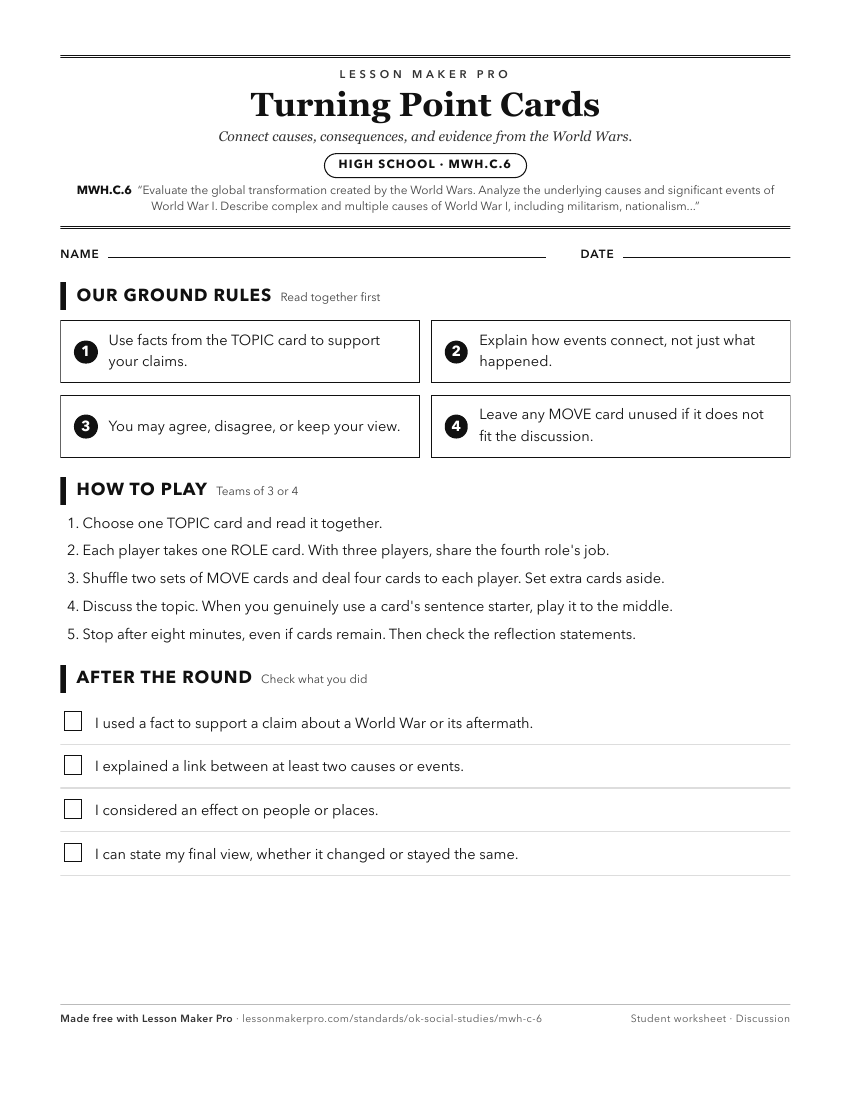
A ready-to-print activity worksheet aligned to MWH.C.6, with an answer key for the teacher on its own page. No account needed.
PDF, US Letter, prints cleanly in black and white.
Download the worksheetKeep exploring
Related Standards
Turn this cluster into a lesson
Grade, subject, topic, and the complete cluster are prefilled. Create one free, no account needed.
Also for this cluster:Make a WorksheetMake a QuizMake a Sub Lesson