Oklahoma Social Studies MWH.C.6.6
Standard Cluster
- MWH.C.6
- Evaluate the global transformation created by the World Wars.
Examine the background, causes, series of events, and effects of the Shoah (Holocaust), the state-sponsored systematic persecution and annihilation of European Jews by Nazi Germany and its collaborators. Trace the historical roots of antisemitism in Europe, including prejudice and the emergence of the 19th-century racial theories, and analyze how these ideas contributed to Nazi ideology. Describe the National Socialist Party’s (Nazi) seizure of unchecked power, its dehumanization of the Jews and other victims (e.g., people with physical disabilities and homosexuals), and the mass genocide of Jews and the Roma. Examine the effects of the Shoah through eyewitness accounts from victims, survivors, liberators, and perpetrators. Summarize world responses including religious, political, and humanitarian resistance movements to the Shoah resulting in the Nuremberg Trials and the increased support for the establishment of a Jewish state in the Jewish people’s historical homeland. Describe efforts to avoid the abuse of human rights by examining the intent of the Universal Declaration of Human Rights and the expansion of the Geneva Conventions.
Oklahoma Academic Standards for Social Studies (2026) · MWH.C.6
Cluster contents
Standards in This Cluster
MWH.C.6.6 is a cluster heading. These are the individual standards under it.
- MWH.C.6.6.A
Trace the historical roots of antisemitism in Europe, including prejudice and the emergence of the 19th-century racial theories, and analyze how these ideas con...
- MWH.C.6.6.B
Describe the National Socialist Party’s (Nazi) seizure of unchecked power, its dehumanization of the Jews and other victims (e.g., people with physical disabili...
- MWH.C.6.6.C
Examine the effects of the Shoah through eyewitness accounts from victims, survivors, liberators, and perpetrators.
- MWH.C.6.6.D
Summarize world responses including religious, political, and humanitarian resistance movements to the Shoah resulting in the Nuremberg Trials and the increased...
- MWH.C.6.6.E
Describe efforts to avoid the abuse of human rights by examining the intent of the Universal Declaration of Human Rights and the expansion of the Geneva Convent...
Teacher's field guide
What This Cluster Means
What Students Need to Do
- Students trace how European antisemitism and racial theories shaped Nazi ideas. They explain how Nazi rule and war enabled the genocide of Jews and Roma, alongside the persecution and killing of other groups. They use eyewitness accounts to study resistance and postwar responses.
What Mastery Looks Like
- A student can explain how older prejudice fed Nazi policies, then sequence the Enabling Act, Nuremberg Laws, ghettos, mass shootings, and killing centers. They can compare accounts from victims, survivors, liberators, and perpetrators, and describe a rescue effort or uprising. They can explain the purposes of the Nuremberg Trials and postwar rights protections, and why support grew for a Jewish state.
Common Misconceptions
- Students may think the killing began in camps, missing earlier laws, ghettos, and mass shootings. They may assume every targeted group faced the same policies. They may confuse the Nuremberg Laws with the later Nuremberg Trials.
How to Assess It
- Give students three cards: Enabling Act, Nuremberg Laws, and mass shootings. Ask them to put the cards in order and write how each step made further persecution or killing possible.
Lesson moves
Ways to Teach It
Give pairs dated event cards from 1933 to 1945; have them build a timeline and mark each shift from exclusion to murder.
Read two short USHMM eyewitness excerpts, one survivor and one liberator; ask students to write what each person witnessed firsthand.
Play a matching round with cards for the Enabling Act, Nuremberg Laws, 1948 rights declaration, and 1949 Geneva Conventions; pair each with its effect.
Use an ICRC summary of the Geneva Conventions; list two protections for civilians and connect each to a wartime abuse studied.
Free download
Printable MWH.C.6.6 Worksheet
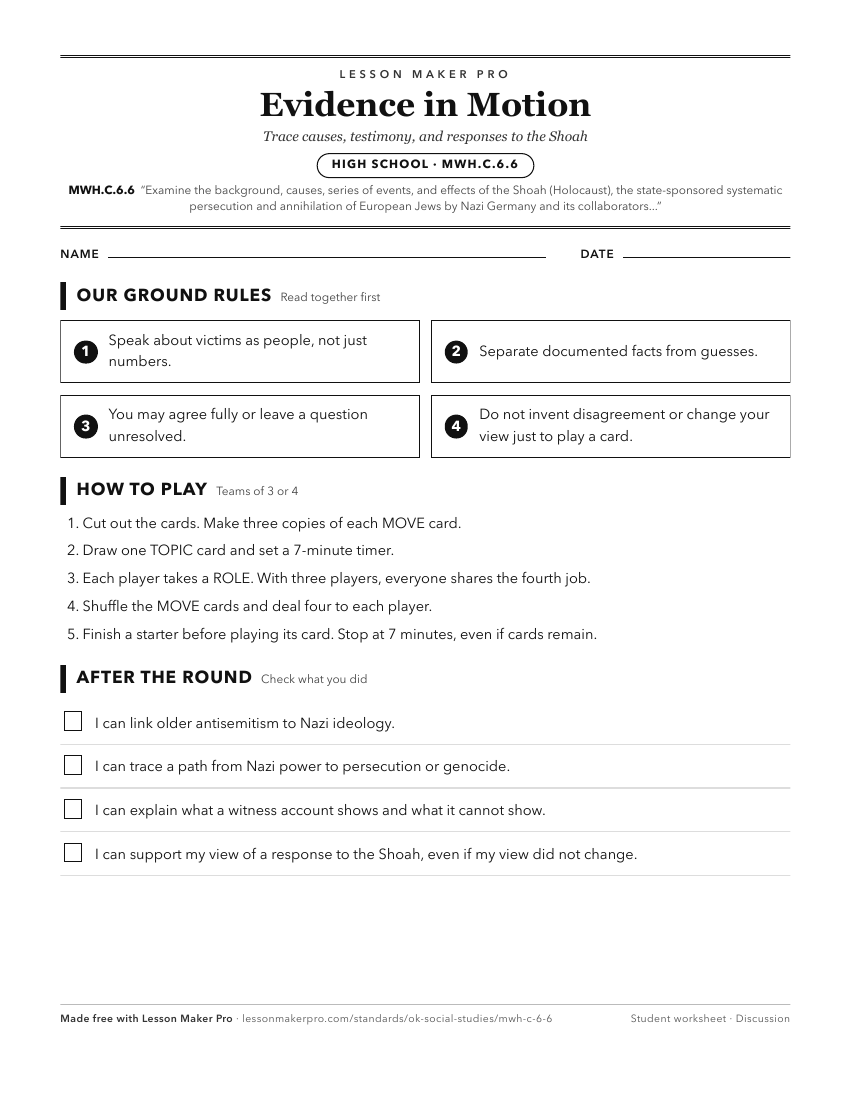
A ready-to-print activity worksheet aligned to MWH.C.6.6, with an answer key for the teacher on its own page. No account needed.
PDF, US Letter, prints cleanly in black and white.
Download the worksheetKeep exploring
Related Standards
- TOT.C.7.3
Examine the role that bystanders, collaborators and perpetrators played in the implementation of Nazi policies against Jewish people and other targeted groups.
- TOT.C.7.1
Explain the Shoah (Holocaust) as the planned and systematic state-sponsored persecution and murder of European Jews by Nazi Germany and its collaborators.
- TOT.C.7.9
Examine the settlement patterns of Shoah (Holocaust) survivors after World War II, including immigration to the United States of America and other countries and...
Turn this cluster into a lesson
Grade, subject, topic, and the complete cluster are prefilled. Create one free, no account needed.
Also for this cluster:Make a WorksheetMake a QuizMake a Sub Lesson