Oklahoma Social Studies MWH.C.6.1
Standard Cluster
- MWH.C.6
- Evaluate the global transformation created by the World Wars.
Analyze the underlying causes and significant events of World War I. Describe complex and multiple causes of World War I, including militarism, nationalism, industrial and colonial competition, Europe’s alliance system, and the instability created by the declining Austro-Hungarian and Ottoman Empires. Summarize the significant events of World War I and why the conflict was considered a total war (e.g., use of industrial and chemical weapons, prolonged trench warfare, expansion into a global conflict) with a focus on the war’s significant turning points (e.g., Battles of the Marne, Verdun, the Somme).
Oklahoma Academic Standards for Social Studies (2026) · MWH.C.6
Cluster contents
Standards in This Cluster
MWH.C.6.1 is a cluster heading. These are the individual standards under it.
- MWH.C.6.1.A
Describe complex and multiple causes of World War I, including militarism, nationalism, industrial and colonial competition, Europe’s alliance system, and the i...
- MWH.C.6.1.B
Summarize the significant events of World War I and why the conflict was considered a total war (e.g., use of industrial and chemical weapons, prolonged trench ...
Teacher's field guide
What This Cluster Means
What Students Need to Do
- Students explain how nationalism, militarism, alliances, industrial and colonial competition, and the weakening Austro-Hungarian and Ottoman Empires helped turn a regional crisis into war. They describe what happened at the Marne, Verdun, and the Somme. They use trenches, industrial weapons, poison gas, civilian work, and fighting beyond Europe to explain total war.
What Mastery Looks Like
- A student connects several long-term causes to the outbreak of war, rather than blaming the assassination alone. They explain that the Marne stopped a quick German victory, while Verdun and the Somme showed the cost of prolonged fighting. They use evidence from battlefields and civilian life to explain the war's reach.
Common Misconceptions
- Students may treat the assassination as the only cause or assume alliances left leaders no choices. They may call Verdun and the Somme clear victories rather than long, costly battles. Some think total war means every country fought, overlooking civilians and industry.
How to Assess It
- On an exit ticket, ask: "How did two long-term causes widen the 1914 crisis? What changed at the Marne, and how do trenches and rationing show total war?"
Lesson moves
Ways to Teach It
Give groups cause cards and string; have them connect nationalism, militarism, alliances, industrial and colonial rivalry, and weakening empires to war.
Using a 1914 alliance map, ask: How could a dispute between Austria-Hungary and Serbia pull Russia, Germany, and France into war?
Have pairs match Marne, Verdun, and Somme to outcome cards, then explain why each battle mattered.
Compare a wartime food ration poster with a local emergency preparedness flyer; ask how governments call on civilians during major crises.
Free download
Printable MWH.C.6.1 Worksheet
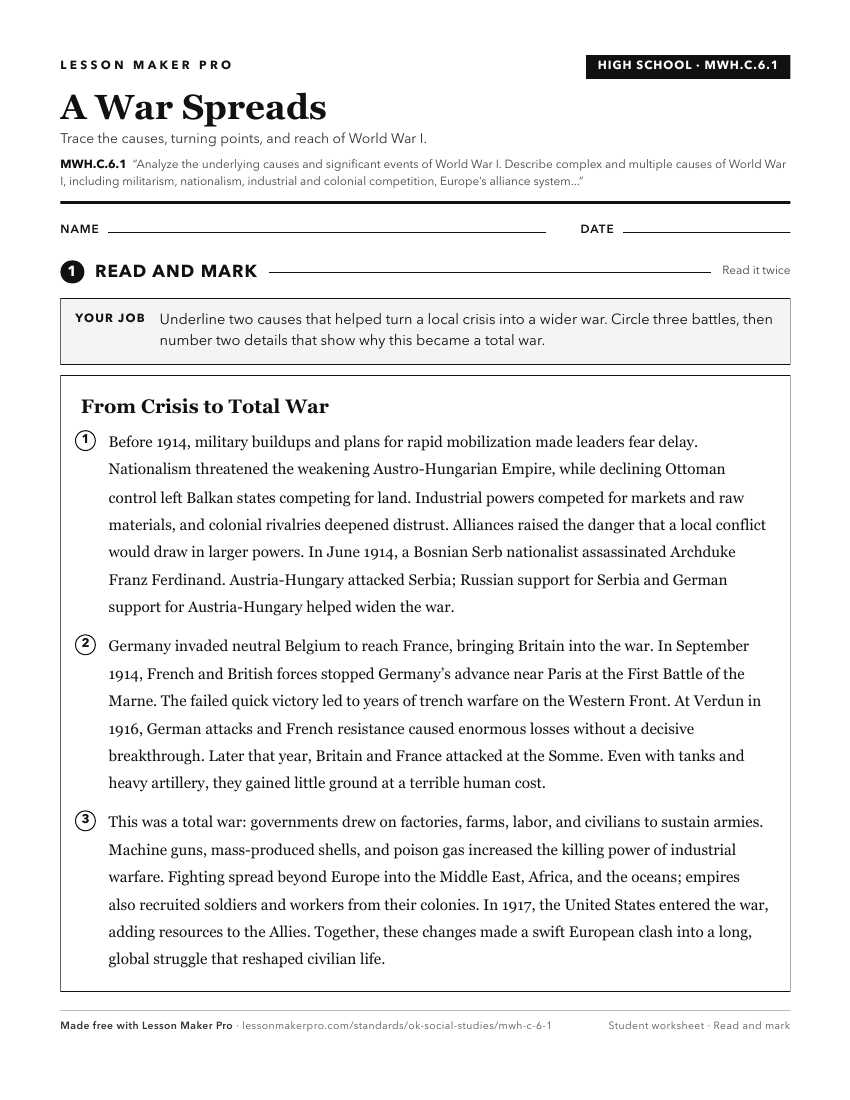
A ready-to-print activity worksheet aligned to MWH.C.6.1, with an answer key for the teacher on its own page. No account needed.
PDF, US Letter, prints cleanly in black and white.
Download the worksheetKeep exploring
Related Standards
Turn this cluster into a lesson
Grade, subject, topic, and the complete cluster are prefilled. Create one free, no account needed.
Also for this cluster:Make a WorksheetMake a QuizMake a Sub Lesson