Oklahoma Social Studies MWH.C.6.2
Standard Cluster
- MWH.C.6
- Evaluate the global transformation created by the World Wars.
Evaluate the lasting effects of World War I. Describe the economic destruction and unprecedented loss of life, including the Armenian genocide. Explain post-war political instability (e.g., collapse of the Russian, Ottoman, and Austro-Hungarian Empires). Examine the immediate consequences of the Treaty of Versailles, including the “war guilt” clause, the establishment of European mandates and the effects of the mandate system on Zionism and other regional nationalist movements.
Oklahoma Academic Standards for Social Studies (2026) · MWH.C.6
Cluster contents
Standards in This Cluster
MWH.C.6.2 is a cluster heading. These are the individual standards under it.
- MWH.C.6.2.A
Describe the economic destruction and unprecedented loss of life, including the Armenian genocide.
- MWH.C.6.2.B
Explain post-war political instability (e.g., collapse of the Russian, Ottoman, and Austro-Hungarian Empires).
- MWH.C.6.2.C
Examine the immediate consequences of the Treaty of Versailles, including the “war guilt” clause, the establishment of European mandates and the effects of the ...
Teacher's field guide
What This Cluster Means
What Students Need to Do
- Students describe wartime deaths, including the Armenian genocide, and the economic damage left behind. They trace the collapse of the Russian, Ottoman, and Austro-Hungarian Empires. They explain how Article 231 affected Germany and how mandates affected Zionist and Arab nationalist goals.
What Mastery Looks Like
- A student distinguishes the Armenian genocide from battlefield deaths and uses war debt as evidence of economic damage. They use a map to show political changes after three empires fell. They link Article 231 to German resentment and British rule in Palestine to competing nationalist claims.
Common Misconceptions
- Students may mistake the Armenian genocide for battlefield deaths rather than targeted killing and deportation by Ottoman authorities. Some think the three empires kept their borders and only changed leaders. Others confuse Article 231 with the mandate system or assume British rule satisfied both Zionist and Arab nationalist demands.
How to Assess It
- On an exit ticket, ask: Name one human or economic loss from the war, one change caused by an empire's collapse, and one political dispute tied to Article 231 or a mandate. Explain each in a sentence.
Lesson moves
Ways to Teach It
Give pairs 1914 and 1923 maps and sticky notes; mark the three collapsed empires, then label British Palestine and French Syria mandates.
Read the Balfour Declaration and a Palestinian Arab petition from 1921; write how British rule affected each group's goals.
Match event cards to outcomes: Armenian genocide to mass displacement, imperial collapse to new states, Article 231 to reparations, mandates to disputed rule.
Place maps of today's Syria and Lebanon beside a 1922 French mandate map; trace their shared border and name the power that drew it.
Free download
Printable MWH.C.6.2 Worksheet
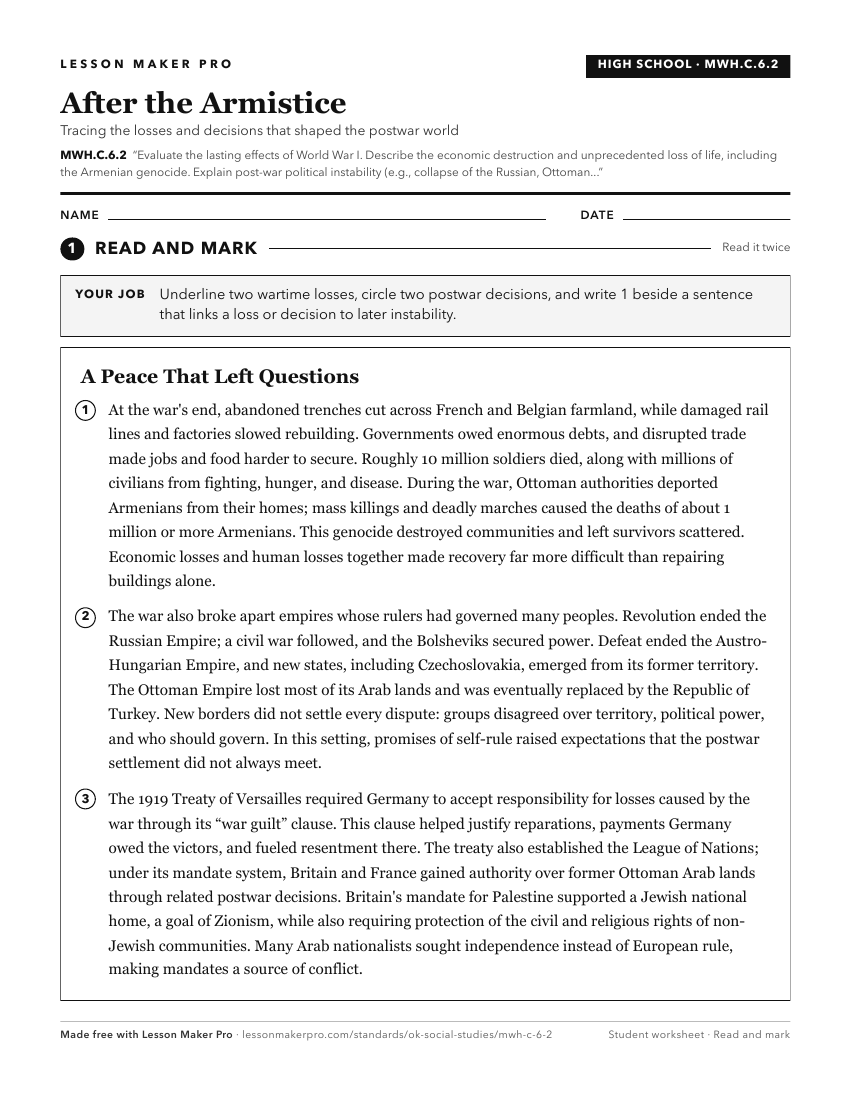
A ready-to-print activity worksheet aligned to MWH.C.6.2, with an answer key for the teacher on its own page. No account needed.
PDF, US Letter, prints cleanly in black and white.
Download the worksheetKeep exploring
Related Standards
- USH.C.3.2
Evaluate the long-term impact of the United States’ entry into World War I on national politics, the economy, and society.
- USH.C.4.1
Examine the transformations between the World Wars.
- MWH.C.6
Evaluate the global transformation created by the World Wars.
- MWH.C.6.1
Analyze the underlying causes and significant events of World War I.
Turn this cluster into a lesson
Grade, subject, topic, and the complete cluster are prefilled. Create one free, no account needed.
Also for this cluster:Make a WorksheetMake a QuizMake a Sub Lesson