Oklahoma Social Studies USH.C.3.2
Standard Cluster
- USH.C.3
- Analyze the expanding role of the United States of America in international affairs as the United States of America was transformed into a world power in the late 19th and early 20th centuries.
Evaluate the long-term impact of the United States’ entry into World War I on national politics, the economy, and society. Examine the justification for the United States of America’s movement from neutrality to engagement in World War I by explaining the intent and impact of the Zimmermann Telegram and threats to international trade caused by unrestricted submarine warfare. Identify the Selective Service Act as a means to mobilize armed forces to support allied nations of the Triple Entente during the First World War. Describe the purpose of the Espionage Act and Sedition Act within the context of the First Red Scare and its impact on individual liberties, such as the imprisonment of anti-war critics and activists, the Palmer Raids, and the Sacco-Vanzetti trials. Explain how the American Expeditionary Forces, economic support, and the production of armaments helped turn the tide of war, leading to an Allied victory. Analyze the impact of the war on the home front including the use of propaganda, women’s increased role in industry, the marshaling of industrial production, and the Great Migration. Examine Wilson’s foreign policy as proposed in his Fourteen Points and reasons for the nation’s return to isolationism highlighted by the Senate’s rejection of the terms of the Treaty of Versailles and the proposed League of Nations.
Oklahoma Academic Standards for Social Studies (2026) · USH.C.3
Cluster contents
Standards in This Cluster
USH.C.3.2 is a cluster heading. These are the individual standards under it.
- USH.C.3.2.A
Examine the justification for the United States of America’s movement from neutrality to engagement in World War I by explaining the intent and impact of the Zi...
- USH.C.3.2.B
Identify the Selective Service Act as a means to mobilize armed forces to support allied nations of the Triple Entente during the First World War.
- USH.C.3.2.C
Describe the purpose of the Espionage Act and Sedition Act within the context of the First Red Scare and its impact on individual liberties, such as the impriso...
- USH.C.3.2.D
Explain how the American Expeditionary Forces, economic support, and the production of armaments helped turn the tide of war, leading to an Allied victory.
- USH.C.3.2.E
Analyze the impact of the war on the home front including the use of propaganda, women’s increased role in industry, the marshaling of industrial production, an...
- USH.C.3.2.F
Examine Wilson’s foreign policy as proposed in his Fourteen Points and reasons for the nation’s return to isolationism highlighted by the Senate’s rejection of ...
Teacher's field guide
What This Cluster Means
What Students Need to Do
- Students explain why submarine attacks and the Zimmermann Telegram pushed the United States toward war. They connect the draft, American troops, loans, and weapons production to Allied victory and changes at home. They explain how the war shaped civil liberties and the debate over joining the League of Nations.
What Mastery Looks Like
- A student can use wartime evidence to explain why the United States entered the war and how its troops and supplies helped the Allies. They can describe propaganda, women’s factory work, and the Great Migration as home-front changes. They can explain limits on dissent and why the Senate rejected the treaty and League.
Common Misconceptions
- Students may think the Zimmermann Telegram was an attack on the United States, rather than a proposed alliance with Mexico. They may place the Palmer Raids and Sacco-Vanzetti trial during the war, though both came later. Some assume rejecting the League meant the United States stopped trading with other countries.
How to Assess It
- On an exit ticket, ask students to write four linked sentences: explain one reason for entering the war, one contribution to Allied victory, one home-front change, and one postwar dispute.
Lesson moves
Ways to Teach It
Give pairs cards for submarine attacks, the Zimmermann Telegram, the draft, U.S. armaments, and the armistice; build a timeline with cause notes.
Post short excerpts from the Espionage and Sedition Acts; ask, “Where should wartime limits on speech stop?”
Run a card sort with the draft, armaments, Great Migration, and League rejection; students match each to a political, economic, or social effect.
Show a 1918 war bond poster and a recent military recruiting ad; students underline two persuasion tactics and compare the audiences.
Free download
Printable USH.C.3.2 Worksheet
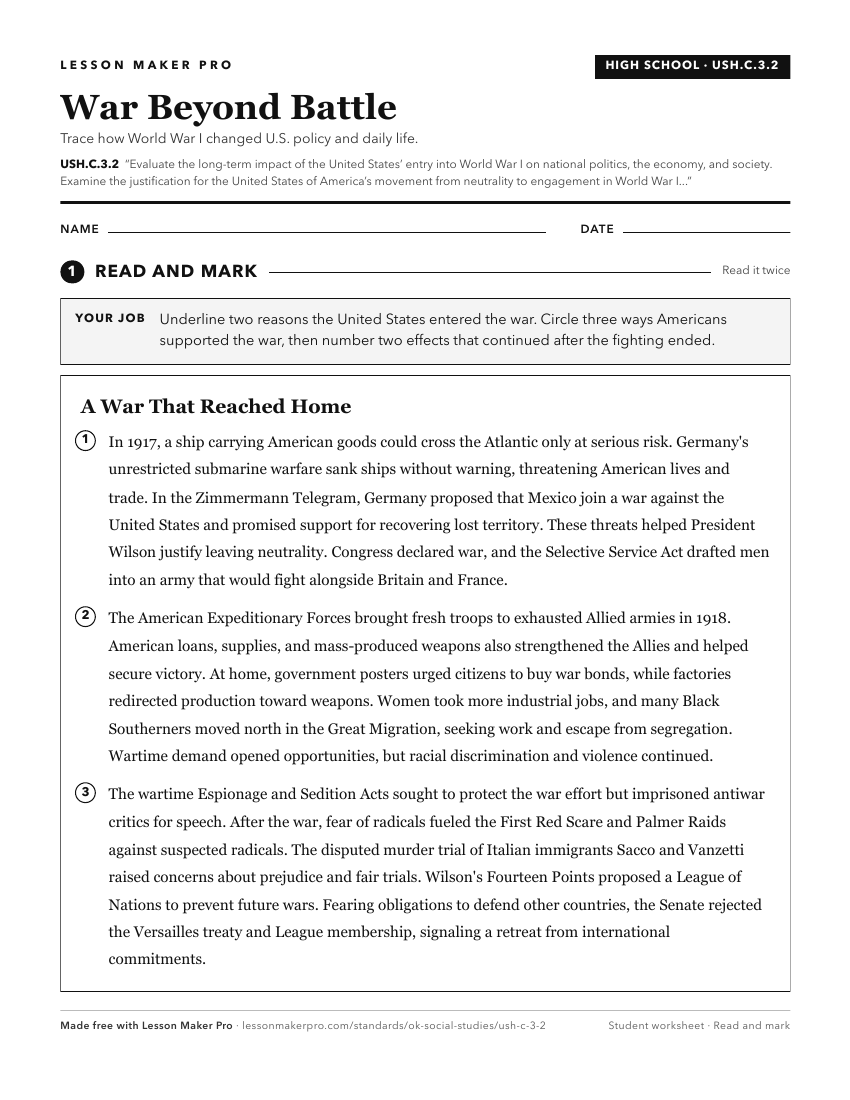
A ready-to-print activity worksheet aligned to USH.C.3.2, with an answer key for the teacher on its own page. No account needed.
PDF, US Letter, prints cleanly in black and white.
Download the worksheetKeep exploring
Related Standards
- USH.C.5.4
Examine the impact of World War II on the lives of American citizens.
- MWH.C.6.2
Evaluate the lasting effects of World War I.
- USH.C.5
Analyze the United States of America’s role in international affairs by examining the major causes, events, and effects of the nation’s involvement in World War...
Turn this cluster into a lesson
Grade, subject, topic, and the complete cluster are prefilled. Create one free, no account needed.
Also for this cluster:Make a WorksheetMake a QuizMake a Sub Lesson