Oklahoma Social Studies USH.C.3.2.C
The Standard
- USH.C.3
- Analyze the expanding role of the United States of America in international affairs as the United States of America was transformed into a world power in the late 19th and early 20th centuries.
- USH.C.3.2
- Evaluate the long-term impact of the United States’ entry into World War I on national politics, the economy, and society.
Describe the purpose of the Espionage Act and Sedition Act within the context of the First Red Scare and its impact on individual liberties, such as the imprisonment of anti-war critics and activists, the Palmer Raids, and the Sacco-Vanzetti trials.
Oklahoma Academic Standards for Social Studies (2026) · USH.C.3.2
Teacher's field guide
What This Standard Means
What Students Need to Do
- Students explain why the federal government restricted antiwar activity during World War I and how fear of radicalism grew after the war. They examine effects on speech and legal rights without treating every arrest and trial as the same kind of case.
What Mastery Looks Like
- A student can explain that the 1917 law targeted interference with the war effort and the 1918 law broadened restrictions on speech. They can distinguish jailed antiwar critics from people detained in the Palmer Raids and from Sacco and Vanzetti, who were tried for murder.
Common Misconceptions
- Students may think the Palmer Raids and the Sacco and Vanzetti trial were prosecutions under the wartime speech laws. They may also think Sacco and Vanzetti were tried for their political beliefs rather than for murder.
How to Assess It
- Exit ticket: What did the wartime laws restrict, what type of law was used in the Palmer Raids, and what were Sacco and Vanzetti tried for? Name one liberty at stake.
Lesson moves
Ways to Teach It
Give pairs four dated cards: the 1917 law, the 1918 law, the 1919 Palmer Raids, and the 1920 Sacco and Vanzetti arrests. Have them build a timeline.
Ask: Should urging people to refuse the draft be punishable during a war? Have students write two sentences explaining their answer.
Play a sorting game with cards describing an antiwar speech prosecution, an immigration raid, and a murder trial. Have students name the legal action in each.
Compare a city protest permit rule with a wartime speech restriction. Ask students which regulates where people gather and which regulates what they say.
Free download
Printable USH.C.3.2.C Worksheet
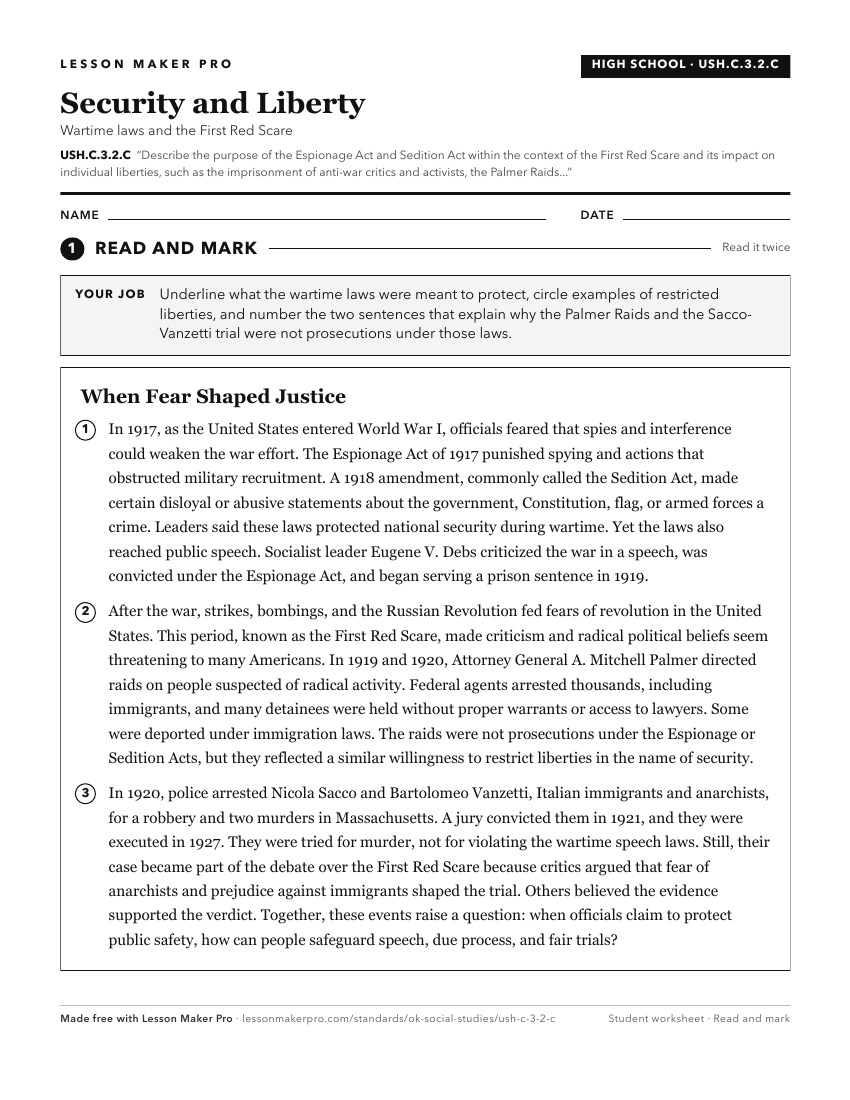
A ready-to-print activity worksheet aligned to USH.C.3.2.C, with an answer key for the teacher on its own page. No account needed.
PDF, US Letter, prints cleanly in black and white.
Download the worksheetKeep exploring
Related Standards
- 8.C.5.2
Evaluate the impact of the Alien and Sedition Acts on individual rights during the Adams Administration, including the responses of the Democratic-Republicans, ...
- USH.C.6.2.B
Explain the origins and consequences of McCarthyism and the Second Red Scare, including the Hollywood Blacklist and President Eisenhower’s reaction.
- USH.C.6.2.C
Describe the Army-McCarthy hearings and examine controversies related to Alger Hiss and the Rosenberg spy trials, explaining the role of the Federal Bureau of I...
- TOT.C.3.1
Examine the response of communist and socialist leaders and parties in Europe and the United States of America to changing conditions created by the First World...
Turn this exact standard into a lesson
Grade, subject, topic, and the complete standard are prefilled. Create one free, no account needed.
Also for this standard:Make a WorksheetMake a QuizMake a Sub Lesson