Oklahoma Social Studies USH.C.3.2.A
The Standard
- USH.C.3
- Analyze the expanding role of the United States of America in international affairs as the United States of America was transformed into a world power in the late 19th and early 20th centuries.
- USH.C.3.2
- Evaluate the long-term impact of the United States’ entry into World War I on national politics, the economy, and society.
Examine the justification for the United States of America’s movement from neutrality to engagement in World War I by explaining the intent and impact of the Zimmermann Telegram and threats to international trade caused by unrestricted submarine warfare.
Oklahoma Academic Standards for Social Studies (2026) · USH.C.3.2
Teacher's field guide
What This Standard Means
What Students Need to Do
- Explain why German submarine attacks and the Zimmermann Telegram weakened the case for U.S. neutrality. Connect threats to American ships and trade with Germany's proposed alliance with Mexico.
What Mastery Looks Like
- A student explains that Germany offered Mexico an alliance and promised to help it regain lost territory if the U.S. entered the war. They explain how submarine attacks endangered ships, lives, and trade, then weigh both as reasons for U.S. entry.
Common Misconceptions
- Students may think Mexico accepted Germany's offer or attacked the United States. Some think submarines targeted only warships, or that the telegram alone caused the U.S. to enter the war.
How to Assess It
- Exit ticket: How did submarine attacks and the Zimmermann Telegram each challenge U.S. neutrality? Use one fact about each, then say which gave stronger grounds for entering the war.
Lesson moves
Ways to Teach It
Give pairs a printed telegram excerpt and a shipping map; have them mark Germany's offer and trace trade routes threatened by submarines.
Ask: Which gave stronger grounds for war, submarine attacks or Germany's offer to Mexico? Defend your answer with one fact about each.
Play a card sort: students place submarine attack and telegram fact cards under trade threat or security threat, then explain one choice.
Show a map of ships detouring around the Red Sea; students name two trade costs and compare them with U.S. risks in 1917.
Free download
Printable USH.C.3.2.A Worksheet
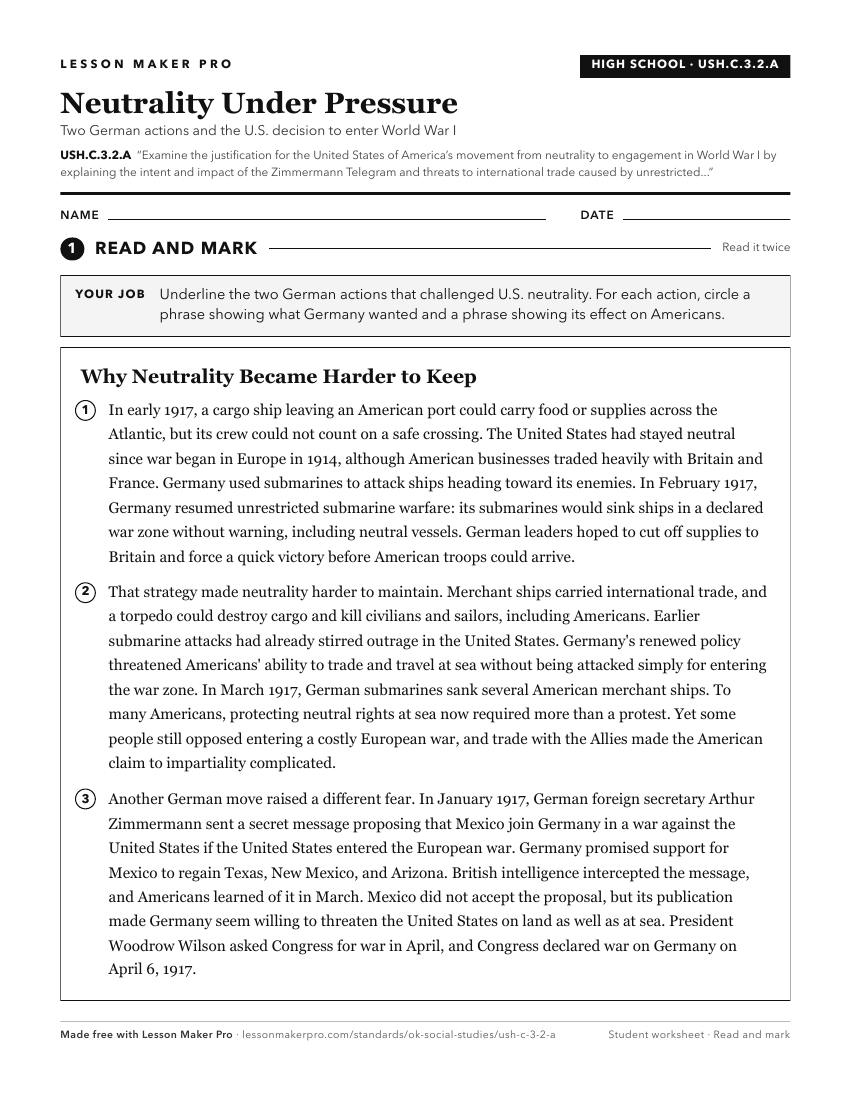
A ready-to-print activity worksheet aligned to USH.C.3.2.A, with an answer key for the teacher on its own page. No account needed.
PDF, US Letter, prints cleanly in black and white.
Download the worksheetKeep exploring
Related Standards
- USH.C.3.2
Evaluate the long-term impact of the United States’ entry into World War I on national politics, the economy, and society.
- USH.C.5
Analyze the United States of America’s role in international affairs by examining the major causes, events, and effects of the nation’s involvement in World War...
- USH.C.5.1.B
Examine the roles of appeasement and isolationism in the United States of /America’s reluctance to respond to Fascist military aggression in Europe and Asia inc...
- USH.C.3.2.F
Examine Wilson’s foreign policy as proposed in his Fourteen Points and reasons for the nation’s return to isolationism highlighted by the Senate’s rejection of ...
Turn this exact standard into a lesson
Grade, subject, topic, and the complete standard are prefilled. Create one free, no account needed.
Also for this standard:Make a WorksheetMake a QuizMake a Sub Lesson