Oklahoma Social Studies USH.C.5
Standard Cluster
Analyze the United States of America’s role in international affairs by examining the major causes, events, and effects of the nation’s involvement in World War II. Describe the transformations in American society and government policy as the nation entered World War II. Examine fascism in Germany and Italy, including its roots in economic depression, effects of the Versailles Treaty, and ideology, culminating in German rearmament and militarization of the Rhineland. Examine the roles of appeasement and isolationism in the United States of /America’s reluctance to respond to Fascist military aggression in Europe and Asia including the Neutrality Acts. Evaluate the industrial mobilization and psychological preparation for war as reflected in President Franklin Roosevelt’s Four Freedoms speech. Describe programs initiated to support Great Britain, including Lend-Lease, Destroyers for Bases and Cash and Carry. Examine President Franklin Roosevelt’s leadership, including how he motivated Americans with the Day Which Will Live in Infamy speech, his role as commander in chief, and his diplomatic efforts to maintain the Grand Alliance. Explain the reasons for President Roosevelt’s executive order for the incarceration of Americans of Japanese descent, the experiences of Japanese families, and the Supreme Court’s decision in Korematsu v. United States of America. Describe the war’s impact on the home front (e.g., rationing, the Bracero program, bond drives, conversion of factories for wartime, federal regulation of production and labor, the entry of large numbers of women and minorities into the workforce, prisoner of war camps, and the treatment of Americans of German and Italian descent). Analyze the series of events affecting the outcome of World War II. Identify major battles, military turning points, and key strategic decisions in both the European and Pacific Theaters of Operations (e.g., Pearl Harbor, the D-day Invasion, Stalingrad, Midway, Okinawa, Battle of the Bulge, Iwo Jima, and the island-hopping strategy). Describe the roles of individual American leaders, including Generals MacArthur and Eisenhower, as well as the unique contributions of special fighting forces (e.g., Tuskegee Airmen, 442nd Regimental Combat team, Indian Code Talkers). Explain the purpose of the Allied conferences at Yalta and Potsdam and how such negotiations would affect post-war Europe. Analyze President Truman’s decision to use the atomic bomb and describe the legacy of the development and use of atomic weapons. Summarize the United States of America’s reactions to the events of the Shoah (Holocaust). Describe the United States of America government’s reactions to news of the Shoah during the war including condemnation of Nazi genocide of Jews and creation of the War Refugee Board. Describe the liberation of concentration and death camps and the immigration of Shoah (Holocaust) survivors. Examine the United States of America’s participation in the Nuremberg Trials which held Nazi leaders accountable for war crimes. Examine the impact of World War II on the lives of American citizens. Examine how wartime employment in the civilian economy and the armed services contributed to an end of the Great Depression’s unemployment. Explain changes in society during the postwar era (e.g., urban population migration to the suburbs, the baby boom, growth of the middle class, home ownership, development of mass media, consumerism). Describe the goals and effects of the G.I. Bill of Rights and Truman’s “Fair Deal” on the average citizen. Assess the influence of Phillip Randolph regarding efforts to eliminate employment discrimination and the impact of President Truman’s decision to desegregate the United States of America’s armed forces.
Oklahoma Academic Standards for Social Studies (2026)
Cluster contents
Standards in This Cluster
USH.C.5 is a cluster heading. These are the individual standards under it.
- USH.C.5.1
Describe the transformations in American society and government policy as the nation entered World War II.
- USH.C.5.1.A
Examine fascism in Germany and Italy, including its roots in economic depression, effects of the Versailles Treaty, and ideology, culminating in German rearmame...
- USH.C.5.1.B
Examine the roles of appeasement and isolationism in the United States of /America’s reluctance to respond to Fascist military aggression in Europe and Asia inc...
- USH.C.5.1.C
Evaluate the industrial mobilization and psychological preparation for war as reflected in President Franklin Roosevelt’s Four Freedoms speech.
- USH.C.5.1.D
Describe programs initiated to support Great Britain, including Lend-Lease, Destroyers for Bases, and Cash and Carry.
- USH.C.5.1.E
Examine President Franklin Roosevelt’s leadership, including how he motivated Americans with the Day Which Will Live in Infamy speech, his role as commander in ...
- USH.C.5.1.F
Explain the reasons for President Roosevelt’s executive order for the incarceration of Americans of Japanese descent, the experiences of Japanese families, and ...
- USH.C.5.1.G
Describe the war’s impact on the home front (e.g., rationing, the Bracero program, bond drives, conversion of factories for wartime, federal regulation of produ...
- USH.C.5.2
Analyze the series of events affecting the outcome of World War II.
- USH.C.5.2.A
Identify major battles, military turning points, and key strategic decisions in both the European and Pacific Theaters of Operations (e.g., Pearl Harbor, the D-...
- USH.C.5.2.B
Describe the roles of individual American leaders, including Generals MacArthur and Eisenhower, as well as the unique contributions of special fighting forces (...
- USH.C.5.2.C
Explain the purpose of the Allied conferences at Yalta and Potsdam and how such negotiations would affect post-war Europe.
- USH.C.5.2.D
Analyze President Truman’s decision to use the atomic bomb and describe the legacy of the development and use of atomic weapons.
- USH.C.5.3
Summarize the United States of America’s reactions to the events of the Shoah (Holocaust).
- USH.C.5.3.A
Describe the United States of America government’s reactions to news of the Shoah during the war including condemnation of Nazi genocide of Jews and creation of...
- USH.C.5.3.B
Describe the liberation of concentration and death camps and the immigration of Shoah (Holocaust) survivors.
- USH.C.5.3.C
Examine the United States of America’s participation in the Nuremberg Trials which held Nazi leaders accountable for war crimes.
- USH.C.5.4
Examine the impact of World War II on the lives of American citizens.
- USH.C.5.4.A
Examine how wartime employment in the civilian economy and the armed services contributed to an end of the Great Depression’s unemployment.
- USH.C.5.4.B
Explain changes in society during the postwar era (e.g., urban population migration to the suburbs, the baby boom, growth of the middle class, home ownership, d...
- USH.C.5.4.C
Describe the goals and effects of the G. I. Bill of Rights and Truman’s “Fair Deal” on the average citizen.
- USH.C.5.4.D
Assess the influence of Phillip Randolph regarding efforts to eliminate employment discrimination and the impact of President Truman’s decision to desegregate t...
Teacher's field guide
What This Cluster Means
What Students Need to Do
- Trace why the United States moved from neutrality to war. Explain how leaders, battles, and alliances shaped the outcome. Use evidence to assess wartime choices and changes in American life during and after the war.
What Mastery Looks Like
- A student can connect fascist expansion, U.S. neutrality, and aid to Britain to the shift toward war. They can explain why Midway and D-Day mattered and assess Japanese American incarceration, the U.S. response to the Holocaust, and the atomic bomb with evidence. They can explain how war jobs and the G.I. Bill changed lives, and where discrimination persisted.
Common Misconceptions
- Students may think the United States entered the war when Germany invaded Poland. They may assume the Supreme Court's ruling meant Japanese American incarceration was fair. They may also mistake the liberation of camps for an early U.S. rescue policy, or think wartime jobs ended discrimination.
How to Assess It
- Exit ticket: Put the Neutrality Acts, Lend-Lease, and Pearl Harbor in order. In three sentences, explain what each shows about the changing U.S. role in the war.
Lesson moves
Ways to Teach It
Give pairs event cards for the Neutrality Acts, Lend-Lease, Pearl Harbor, Midway, D-Day, and the G.I. Bill; have them build a cause-and-effect timeline.
Give students excerpts from Executive Order 9066 and a Japanese American incarceration testimony, then ask whether wartime security justified the policy.
Play a four-round match with cards labeled Midway, Stalingrad, D-Day, and Okinawa; students pair each battle with its strategic effect.
Give students a WWII ration book image, a rationed-food list, and a grocery receipt; have them plan one week's shopping.
Free download
Printable USH.C.5 Worksheet
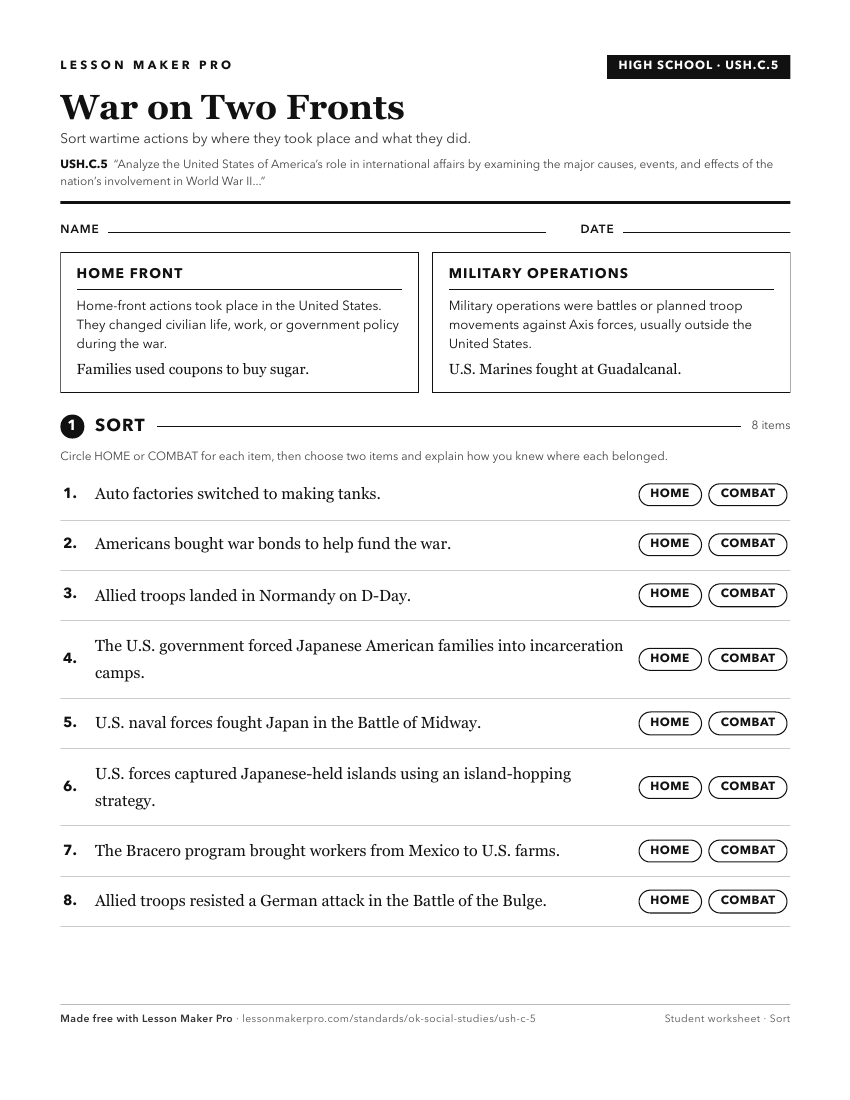
A ready-to-print activity worksheet aligned to USH.C.5, with an answer key for the teacher on its own page. No account needed.
PDF, US Letter, prints cleanly in black and white.
Download the worksheetKeep exploring
Related Standards
Turn this cluster into a lesson
Grade, subject, topic, and the complete cluster are prefilled. Create one free, no account needed.
Also for this cluster:Make a WorksheetMake a QuizMake a Sub Lesson