Oklahoma Social Studies USH.C.5.4
Standard Cluster
- USH.C.5
- Analyze the United States of America’s role in international affairs by examining the major causes, events, and effects of the nation’s involvement in World War II.
Examine the impact of World War II on the lives of American citizens. Examine how wartime employment in the civilian economy and the armed services contributed to an end of the Great Depression’s unemployment. Explain changes in society during the postwar era (e.g., urban population migration to the suburbs, the baby boom, growth of the middle class, home ownership, development of mass media, consumerism). Describe the goals and effects of the G.I. Bill of Rights and Truman’s “Fair Deal” on the average citizen. Assess the influence of Phillip Randolph regarding efforts to eliminate employment discrimination and the impact of President Truman’s decision to desegregate the United States of America’s armed forces.
Oklahoma Academic Standards for Social Studies (2026) · USH.C.5
Cluster contents
Standards in This Cluster
USH.C.5.4 is a cluster heading. These are the individual standards under it.
- USH.C.5.4.A
Examine how wartime employment in the civilian economy and the armed services contributed to an end of the Great Depression’s unemployment.
- USH.C.5.4.B
Explain changes in society during the postwar era (e.g., urban population migration to the suburbs, the baby boom, growth of the middle class, home ownership, d...
- USH.C.5.4.C
Describe the goals and effects of the G. I. Bill of Rights and Truman’s “Fair Deal” on the average citizen.
- USH.C.5.4.D
Assess the influence of Phillip Randolph regarding efforts to eliminate employment discrimination and the impact of President Truman’s decision to desegregate t...
Teacher's field guide
What This Cluster Means
What Students Need to Do
- Students explain how factory jobs and military service cut unemployment during World War II. They trace postwar changes in suburbs, homeownership, births, television, and spending. They explain how the G.I. Bill, the Fair Deal, A. Philip Randolph, and Truman's military desegregation order affected Americans.
What Mastery Looks Like
- A student can use unemployment data to explain the effect of wartime hiring and enlistment. They can connect postwar policies to choices about college, work, and housing. They can explain Randolph's push against job discrimination and why Truman's order did not end discrimination overnight.
Common Misconceptions
- Students may credit the G.I. Bill with ending Depression unemployment instead of wartime hiring and enlistment. They may assume all veterans had equal access to its benefits. They may think Truman's order immediately ended discrimination in civilian jobs.
How to Assess It
- Give students a 1940 and 1944 unemployment chart. Ask: "Why did unemployment fall, and how did the G.I. Bill affect veterans after the war?"
Lesson moves
Ways to Teach It
Give pairs 1940 and 1944 unemployment graphs and wartime job posters; have them annotate how factory hiring and enlistment changed employment.
Ask students to write: "How did the G.I. Bill and Fair Deal change family choices, and who still faced barriers?"
Match cards showing Randolph's campaign, Truman's desegregation order, suburban growth, and television to cards describing their effects.
Compare a 1950s suburban home ad with a current local listing; note prices, advertised features, and who appears in each image.
Free download
Printable USH.C.5.4 Worksheet
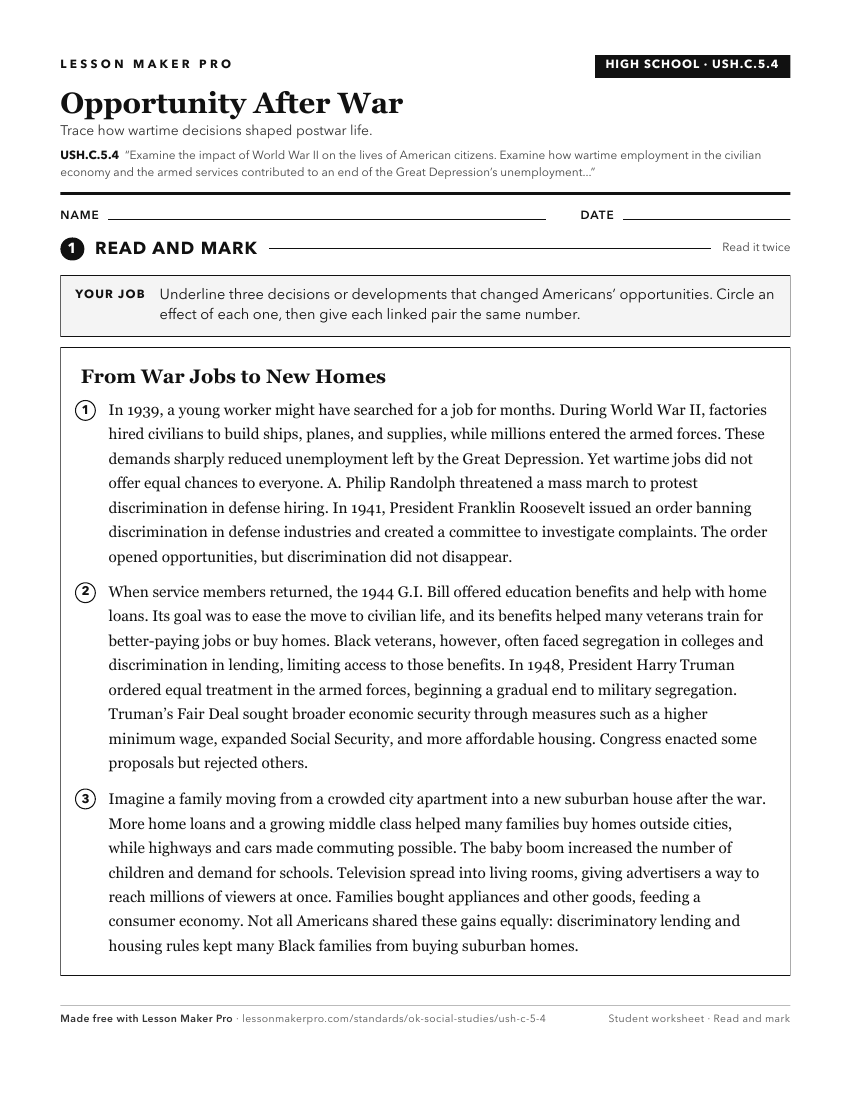
A ready-to-print activity worksheet aligned to USH.C.5.4, with an answer key for the teacher on its own page. No account needed.
PDF, US Letter, prints cleanly in black and white.
Download the worksheetKeep exploring
Related Standards
- MWH.C.6.5
Examine the significant events of World War II from a global perspective.
- MWH.C.6.4
Analyze the economic, social, and political conditions that resulted in World War II.
- USH.C.5.2
Analyze the series of events affecting the outcome of World War II.
- USH.C.5
Analyze the United States of America’s role in international affairs by examining the major causes, events, and effects of the nation’s involvement in World War...
Turn this cluster into a lesson
Grade, subject, topic, and the complete cluster are prefilled. Create one free, no account needed.
Also for this cluster:Make a WorksheetMake a QuizMake a Sub Lesson