Oklahoma Social Studies USH.C.5.3
Standard Cluster
- USH.C.5
- Analyze the United States of America’s role in international affairs by examining the major causes, events, and effects of the nation’s involvement in World War II.
Summarize the United States of America’s reactions to the events of the Shoah (Holocaust). Describe the United States of America government’s reactions to news of the Shoah during the war including condemnation of Nazi genocide of Jews and creation of the War Refugee Board. Describe the liberation of concentration and death camps and the immigration of Shoah (Holocaust) survivors. Examine the United States of America’s participation in the Nuremberg Trials which held Nazi leaders accountable for war crimes.
Oklahoma Academic Standards for Social Studies (2026) · USH.C.5
Cluster contents
Standards in This Cluster
USH.C.5.3 is a cluster heading. These are the individual standards under it.
- USH.C.5.3.A
Describe the United States of America government’s reactions to news of the Shoah during the war including condemnation of Nazi genocide of Jews and creation of...
- USH.C.5.3.B
Describe the liberation of concentration and death camps and the immigration of Shoah (Holocaust) survivors.
- USH.C.5.3.C
Examine the United States of America’s participation in the Nuremberg Trials which held Nazi leaders accountable for war crimes.
Teacher's field guide
What This Cluster Means
What Students Need to Do
- Students explain how the U.S. responded to reports of Nazi genocide, including public condemnation and the War Refugee Board. They describe camp liberation and the barriers survivors faced when seeking entry to the U.S. They explain the U.S. role in prosecuting Nazi leaders at Nuremberg.
What Mastery Looks Like
- A student can name the 1942 Allied condemnation and the 1944 War Refugee Board. They distinguish U.S. liberation of Dachau from Soviet liberation of Auschwitz. They explain immigration limits and the U.S. role in the Nuremberg Trials.
Common Misconceptions
- Students may assume the U.S. opened its borders as soon as news of the genocide arrived. Some think U.S. troops liberated Auschwitz, which Soviet forces liberated. Others think the U.S. ran the Nuremberg Trials alone.
How to Assess It
- Exit ticket: Name two wartime U.S. responses to genocide, identify one camp U.S. troops liberated, and explain one immigration barrier and one U.S. role at Nuremberg.
Lesson moves
Ways to Teach It
Have pairs arrange dated cards for the Allied declaration, War Refugee Board, Dachau liberation, Nuremberg Trials, and Displaced Persons Act.
Ask students to write two sentences answering: How did public condemnation differ from rescuing refugees during the war?
Play a matching game with action cards and dates, including the 1942 condemnation, 1944 War Refugee Board, and 1948 immigration law.
Give students a short excerpt from the 1948 Displaced Persons Act and ask how its entry rules might affect a survivor seeking refuge.
Free download
Printable USH.C.5.3 Worksheet
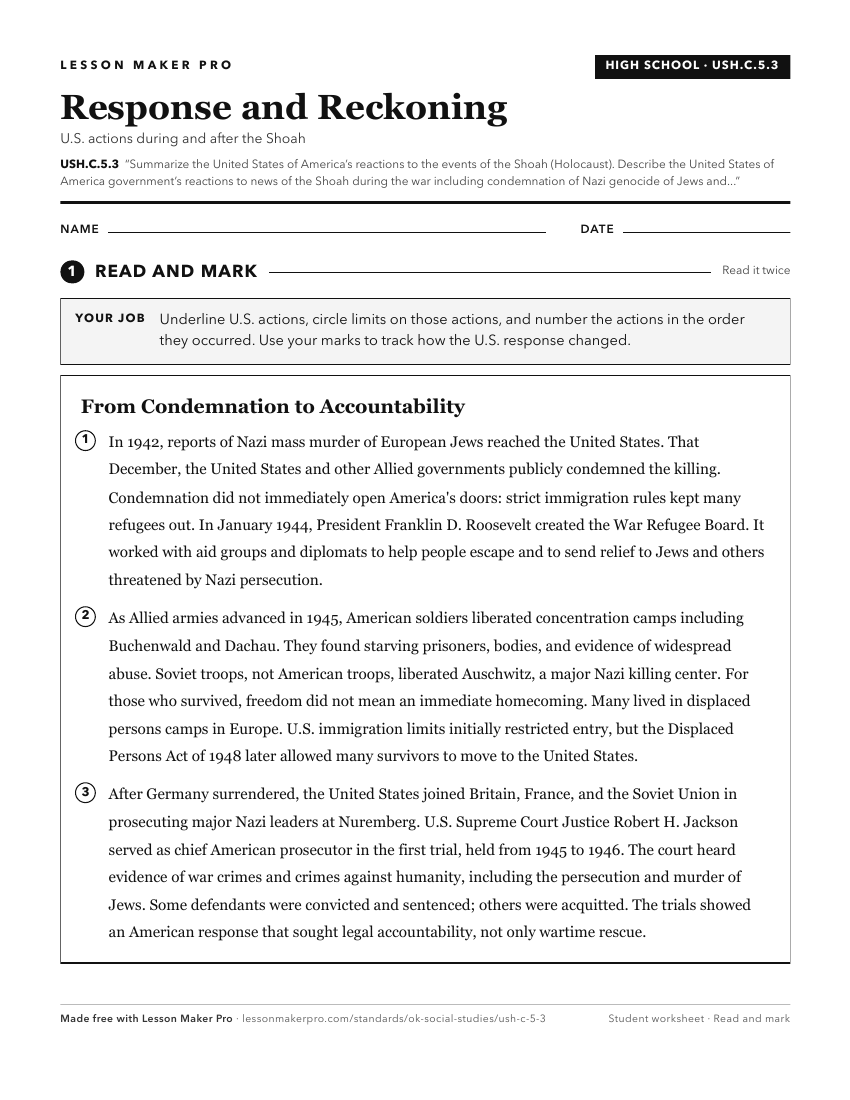
A ready-to-print activity worksheet aligned to USH.C.5.3, with an answer key for the teacher on its own page. No account needed.
PDF, US Letter, prints cleanly in black and white.
Download the worksheetKeep exploring
Related Standards
- MWH.C.6.6.D
Summarize world responses including religious, political, and humanitarian resistance movements to the Shoah resulting in the Nuremberg Trials and the increased...
- MWH.C.6.6
Examine the background, causes, series of events, and effects of the Shoah (Holocaust), the state-sponsored systematic persecution and annihilation of European ...
Turn this cluster into a lesson
Grade, subject, topic, and the complete cluster are prefilled. Create one free, no account needed.
Also for this cluster:Make a WorksheetMake a QuizMake a Sub Lesson