Oklahoma Social Studies USH.C.5.1
Standard Cluster
- USH.C.5
- Analyze the United States of America’s role in international affairs by examining the major causes, events, and effects of the nation’s involvement in World War II.
Describe the transformations in American society and government policy as the nation entered World War II. Examine fascism in Germany and Italy, including its roots in economic depression, effects of the Versailles Treaty, and ideology, culminating in German rearmament and militarization of the Rhineland. Examine the roles of appeasement and isolationism in the United States of /America’s reluctance to respond to Fascist military aggression in Europe and Asia including the Neutrality Acts. Evaluate the industrial mobilization and psychological preparation for war as reflected in President Franklin Roosevelt’s Four Freedoms speech. Describe programs initiated to support Great Britain, including Lend-Lease, Destroyers for Bases and Cash and Carry. Examine President Franklin Roosevelt’s leadership, including how he motivated Americans with the Day Which Will Live in Infamy speech, his role as commander in chief, and his diplomatic efforts to maintain the Grand Alliance. Explain the reasons for President Roosevelt’s executive order for the incarceration of Americans of Japanese descent, the experiences of Japanese families, and the Supreme Court’s decision in Korematsu v. United States of America. Describe the war’s impact on the home front (e.g., rationing, the Bracero program, bond drives, conversion of factories for wartime, federal regulation of production and labor, the entry of large numbers of women and minorities into the workforce, prisoner of war camps, and the treatment of Americans of German and Italian descent).
Oklahoma Academic Standards for Social Studies (2026) · USH.C.5
Cluster contents
Standards in This Cluster
USH.C.5.1 is a cluster heading. These are the individual standards under it.
- USH.C.5.1.A
Examine fascism in Germany and Italy, including its roots in economic depression, effects of the Versailles Treaty, and ideology, culminating in German rearmame...
- USH.C.5.1.B
Examine the roles of appeasement and isolationism in the United States of /America’s reluctance to respond to Fascist military aggression in Europe and Asia inc...
- USH.C.5.1.C
Evaluate the industrial mobilization and psychological preparation for war as reflected in President Franklin Roosevelt’s Four Freedoms speech.
- USH.C.5.1.D
Describe programs initiated to support Great Britain, including Lend-Lease, Destroyers for Bases, and Cash and Carry.
- USH.C.5.1.E
Examine President Franklin Roosevelt’s leadership, including how he motivated Americans with the Day Which Will Live in Infamy speech, his role as commander in ...
- USH.C.5.1.F
Explain the reasons for President Roosevelt’s executive order for the incarceration of Americans of Japanese descent, the experiences of Japanese families, and ...
- USH.C.5.1.G
Describe the war’s impact on the home front (e.g., rationing, the Bracero program, bond drives, conversion of factories for wartime, federal regulation of produ...
Teacher's field guide
What This Cluster Means
What Students Need to Do
- Students explain why fascism grew in Germany and Italy and why the United States held back as aggression spread. They trace the shift from neutrality to aid for Britain and then war. They describe how war changed work and daily life, including the incarceration of Japanese Americans.
What Mastery Looks Like
- They connect depression and Versailles to German rearmament and the occupation of the Rhineland, then explain appeasement and U.S. isolationism. They put the Neutrality Acts, Cash and Carry, Destroyers for Bases, and Lend-Lease in order, and explain how Roosevelt's speeches and diplomacy built support for war. They name changes at home, describe losses suffered by Japanese American families, and explain what the Court upheld in Korematsu.
Common Misconceptions
- Students may think the Neutrality Acts prevented any U.S. aid to Britain, even after later policies changed the rules. Some think Americans of German, Italian, and Japanese descent all faced the same mass incarceration. Others think Korematsu ruled on every part of the camp system, rather than upholding exclusion orders.
How to Assess It
- Exit ticket: In three sentences, explain why the United States shifted from neutrality toward helping Britain, name one home-front change, and describe one loss a Japanese American family faced.
Lesson moves
Ways to Teach It
Give pairs dated cards for the Neutrality Acts, Cash and Carry, Destroyers for Bases, and Lend-Lease; have them sort the cards by growing aid.
Read a paragraph from the Four Freedoms speech; write two sentences linking one freedom to Roosevelt's case for preparing for war.
Match five photo cards to rationing, bond drives, factory conversion, Bracero recruitment, and prisoner of war camps; defend two matches.
Compare a wartime bond poster from the Library of Congress with a current public service poster; circle one persuasive phrase in each.
Free download
Printable USH.C.5.1 Worksheet
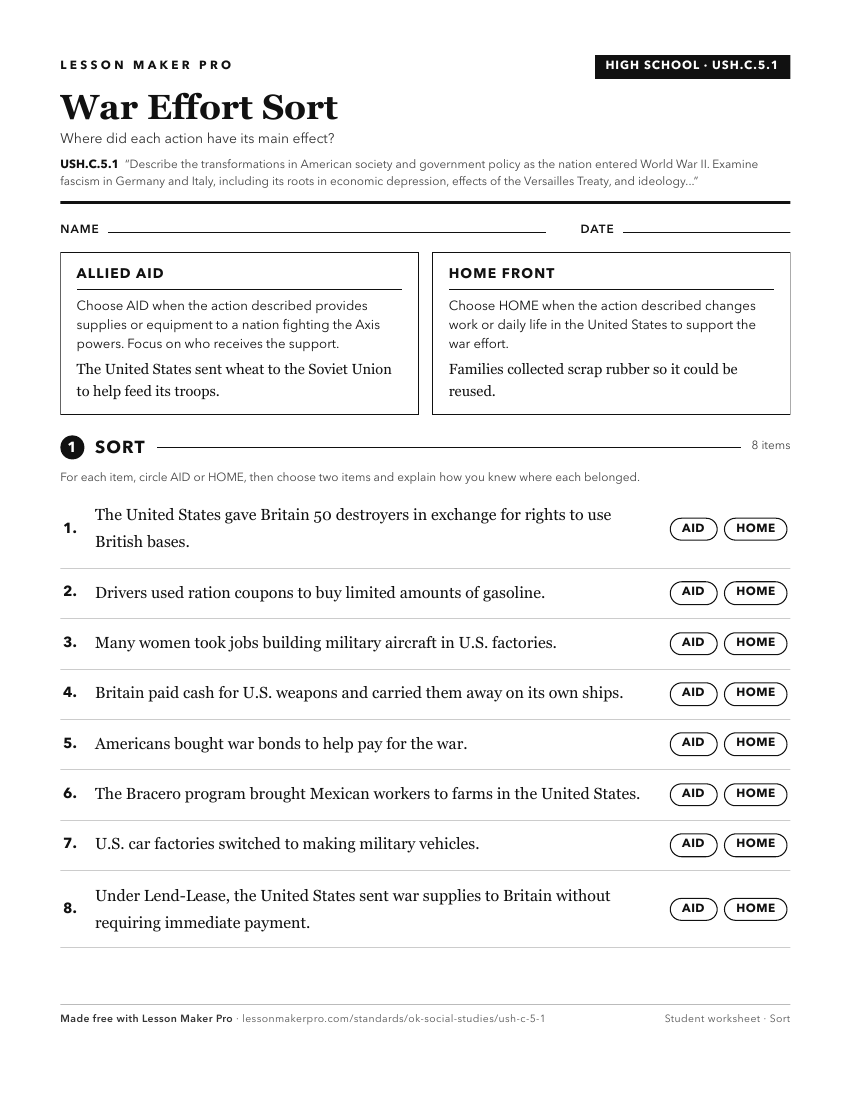
A ready-to-print activity worksheet aligned to USH.C.5.1, with an answer key for the teacher on its own page. No account needed.
PDF, US Letter, prints cleanly in black and white.
Download the worksheetKeep exploring
Related Standards
- MWH.C.6.4
Analyze the economic, social, and political conditions that resulted in World War II.
- USH.C.5.4
Examine the impact of World War II on the lives of American citizens.
- USH.C.5
Analyze the United States of America’s role in international affairs by examining the major causes, events, and effects of the nation’s involvement in World War...
Turn this cluster into a lesson
Grade, subject, topic, and the complete cluster are prefilled. Create one free, no account needed.
Also for this cluster:Make a WorksheetMake a QuizMake a Sub Lesson