Oklahoma Social Studies MWH.C.6.1.A
The Standard
- MWH.C.6
- Evaluate the global transformation created by the World Wars.
- MWH.C.6.1
- Analyze the underlying causes and significant events of World War I.
Describe complex and multiple causes of World War I, including militarism, nationalism, industrial and colonial competition, Europe’s alliance system, and the instability created by the declining Austro-Hungarian and Ottoman Empires.
Oklahoma Academic Standards for Social Studies (2026) · MWH.C.6.1
Teacher's field guide
What This Standard Means
What Students Need to Do
- Students explain how arms buildups, nationalism, and industrial and colonial rivalry raised tensions. They trace how alliances and the weakening Austro-Hungarian and Ottoman Empires made Balkan disputes harder to contain. They distinguish these pressures from the assassination in Sarajevo, which sparked the crisis.
What Mastery Looks Like
- A student uses a 1914 map to connect Balkan nationalism and imperial decline to conflict between Austria-Hungary and Serbia. They explain how alliances widened the crisis and how arms buildups and colonial competition increased tensions before it.
Common Misconceptions
- Students may blame the entire war on the Sarajevo assassination. Some think alliances forced every country to fight immediately, or that the Ottoman Empire had already disappeared by 1914. Others assume all Balkan nationalists wanted the same outcome.
How to Assess It
- Give students a 1914 alliance map. Ask them to name two long-term tensions and explain how the Sarajevo assassination could lead to a wider war.
Lesson moves
Ways to Teach It
Pairs place cause cards on a 1914 map, then draw arrows between Balkan disputes, overseas colonies, arms buildups, and alliance partners.
Ask students to write three sentences answering, 'Why did the Sarajevo assassination lead to a wider war instead of staying a local conflict?'
Play a cause-chain relay: teams draw three cards, such as nationalism, alliances, and militarism, and explain a plausible link between each.
Compare a 1914 Balkans map with today's borders; students locate modern Serbia and Bosnia and mark where Austria-Hungary once ruled.
Free download
Printable MWH.C.6.1.A Worksheet
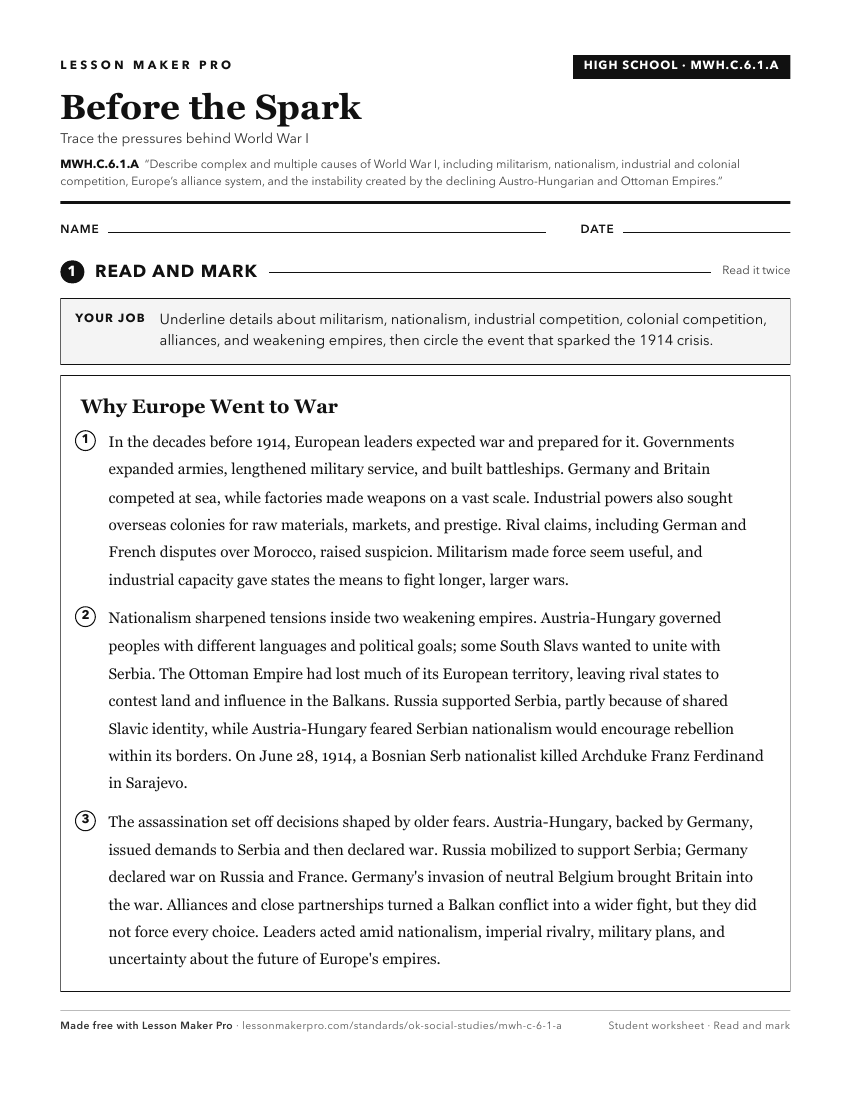
A ready-to-print activity worksheet aligned to MWH.C.6.1.A, with an answer key for the teacher on its own page. No account needed.
PDF, US Letter, prints cleanly in black and white.
Download the worksheetKeep exploring
Related Standards
- MWH.C.6.1.B
Summarize the significant events of World War I and why the conflict was considered a total war (e.g., use of industrial and chemical weapons, prolonged trench ...
- MWH.C.6.2.B
Explain post-war political instability (e.g., collapse of the Russian, Ottoman, and Austro-Hungarian Empires).
- MWH.C.6.2
Evaluate the lasting effects of World War I.
- MWH.C.6.1
Analyze the underlying causes and significant events of World War I.
Turn this exact standard into a lesson
Grade, subject, topic, and the complete standard are prefilled. Create one free, no account needed.
Also for this standard:Make a WorksheetMake a QuizMake a Sub Lesson