Oklahoma Social Studies MWH.C.6.3
Standard Cluster
- MWH.C.6
- Evaluate the global transformation created by the World Wars.
Analyze the causes and consequences of the Russian Revolution on global politics, social structures, human rights, and economic systems. Describe the growing political and social unrest under Czar Nicholas II and the collapse of the Romanov dynasty, exemplified by the emergence of the Bolshevik Movement and the Russian Civil War. Summarize the consequences of Soviet communism, including the establishment of a one-party dictatorship under Lenin, government seizure of private property, and the persecution of religious believers. Describe Stalin’s rise to power and establishment of a totalitarian regime, the use of mass terror during the Great Purge, the suppression of political opposition, and the state policies that led to the Holodomor famine in Ukraine.
Oklahoma Academic Standards for Social Studies (2026) · MWH.C.6
Cluster contents
Standards in This Cluster
MWH.C.6.3 is a cluster heading. These are the individual standards under it.
- MWH.C.6.3.A
Describe the growing political and social unrest under Czar Nicholas II and the collapse of the Romanov dynasty, exemplified by the emergence of the Bolshevik M...
- MWH.C.6.3.B
Summarize the consequences of Soviet communism, including the establishment of a one-party dictatorship under Lenin, government seizure of private property, and...
- MWH.C.6.3.C
Describe Stalin’s rise to power and establishment of a totalitarian regime, the use of mass terror during the Great Purge, the suppression of political oppositi...
Teacher's field guide
What This Cluster Means
What Students Need to Do
- Students trace how war losses, food shortages, and protests brought down Nicholas II and helped the Bolsheviks gain power. They explain how civil war and Lenin's rule changed political rights, property, and religious life. They connect Stalin's purges and grain policies to deaths in Ukraine and fear of Soviet rule abroad.
What Mastery Looks Like
- A student can put the Romanov collapse, Bolshevik takeover, and civil war in order and explain what drove each event. They can describe how Lenin's one-party rule and property seizures changed daily life and alarmed other governments. They can link Stalin's purges to the suppression of opponents and his grain seizures to the Holodomor.
Common Misconceptions
- Students often treat the Romanov collapse and Bolshevik takeover as one event, skipping the provisional government. Some assume Lenin and Stalin used the same policies, missing the scale of Stalin's purges and forced farm collectivization. Others mistake the Holodomor for a natural crop failure rather than a famine driven by state policies.
How to Assess It
- On an exit ticket, ask students to name one cause of the Romanov collapse and explain how one policy under Lenin and one under Stalin changed people's lives.
Lesson moves
Ways to Teach It
Give groups event cards and string to build a cause-and-effect wall from wartime food shortages through civil war to Stalin's grain seizures.
Read excerpts from the 1917 Decree on Land and a 1918 nationalization decree; ask students to write how ownership changed.
Play a match game: pair the February Revolution, civil war, Great Purge, and Holodomor with cause and impact cards.
Compare a 1922 Soviet map with a current map, then identify three former Soviet republics that are independent today.
Free download
Printable MWH.C.6.3 Worksheet
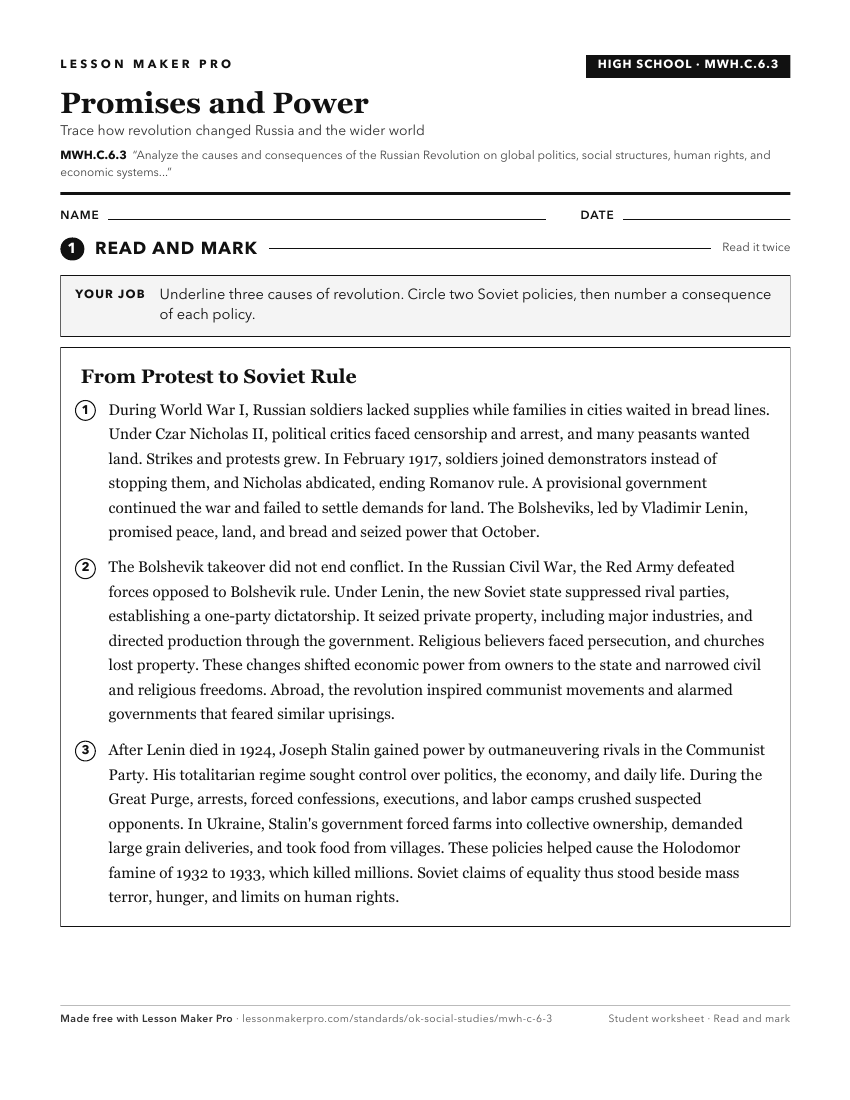
A ready-to-print activity worksheet aligned to MWH.C.6.3, with an answer key for the teacher on its own page. No account needed.
PDF, US Letter, prints cleanly in black and white.
Download the worksheetKeep exploring
Related Standards
- MWH.C.4
Analyze the political, economic, and social transformations brought about by the events of the age of revolutions.
- MWH.C.4.1
Analyze the complex political, social, and economic causes culminating in the French Revolution (e.g., influence of Enlightenment philosophy, taxation, developm...
- TOT.C.3.2
Trace the significant events of the Russian Revolution.
- MWH.C.7.6.D
Analyze the effect of the collapse of the Soviet Union on global power dynamics, including the emergence of new democracies in Eastern Europe.
Turn this cluster into a lesson
Grade, subject, topic, and the complete cluster are prefilled. Create one free, no account needed.
Also for this cluster:Make a WorksheetMake a QuizMake a Sub Lesson