Oklahoma Social Studies TOT.C.3.2
Standard Cluster
Trace the significant events of the Russian Revolution. February Revolution and the Provisional (Kerensky) government, October Revolution, the Bolshevik seizure of power, and the establishment of one-party dictatorship, Civil War, the Red Terror, and the Kronstadt Rebellion, brutal repression (e.g., expropriating private industry, banning private enterprise, requisitioning and rationing food, mass famine, suppression of strikes, expropriation of the Church, mass murder of priests) impact of the beliefs and policies of Vladimir Lenin, formal establishment of the Union of Soviet Socialist Republics (USSR).
Oklahoma Academic Standards for Social Studies (2026)
Cluster contents
Standards in This Cluster
TOT.C.3.2 is a cluster heading. These are the individual standards under it.
- TOT.C.3.2.A
February Revolution and the Provisional (Kerensky) government
- TOT.C.3.2.B
October Revolution, the Bolshevik seizure of power, and the establishment of one-party dictatorship
- TOT.C.3.2.C
Civil War, the Red Terror, and the Kronstadt Rebellion
- TOT.C.3.2.D
brutal repression (e.g., expropriating private industry, banning private enterprise, requisitioning and rationing food, mass famine, suppression of strikes, exp...
- TOT.C.3.2.E
impact of the beliefs and policies of Vladimir Lenin
- TOT.C.3.2.F
formal establishment of the Union of Soviet Socialist Republics (USSR).
Teacher's field guide
What This Cluster Means
What Students Need to Do
- Students order the tsar's fall, Kerensky's government, the Bolshevik takeover, civil war, Kronstadt revolt, and the USSR's founding. They link Lenin's beliefs to one-party rule, factory seizures, and food requisition. They describe how the Red Terror, famine, and attacks on clergy affected people.
What Mastery Looks Like
- A student places Kerensky's government between the two 1917 revolutions and puts Kronstadt before the USSR's founding. They explain how grain seizures and the Red Terror led people to resist Bolshevik rule.
Common Misconceptions
- Students may treat the February and October revolutions as one event or think Lenin replaced the tsar directly. Some place the Kronstadt revolt before the Bolshevik takeover. Others blame famine only on grain seizures, leaving out war and poor harvests.
How to Assess It
- On an exit ticket, have students order the tsar's fall, Kerensky's government, the Bolshevik takeover, Kronstadt, and the USSR's founding. Ask them to name one Bolshevik policy that sparked resistance.
Lesson moves
Ways to Teach It
Give pairs event cards for February, Kerensky, October, civil war, Red Terror, Kronstadt, and the USSR; have them arrange a desk timeline.
Ask, “Why did sailors at Kronstadt rebel against a government that claimed to represent workers?” Have students cite one Bolshevik policy.
Play policy match: teams pair grain requisition, factory seizures, and church confiscation with farmers, owners, or clergy, then explain each link.
Compare a grocery receipt with a Russian civil war ration card; ask students who controlled access to food in each case.
Free download
Printable TOT.C.3.2 Worksheet
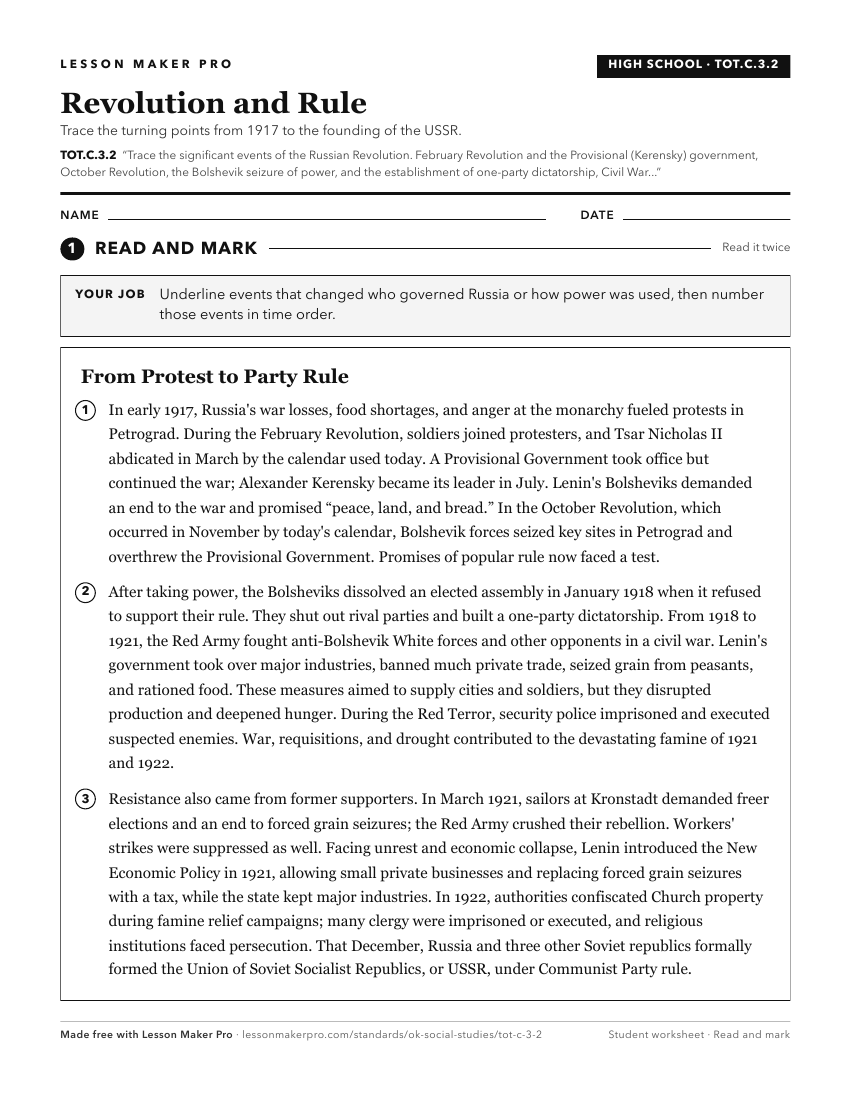
A ready-to-print activity worksheet aligned to TOT.C.3.2, with an answer key for the teacher on its own page. No account needed.
PDF, US Letter, prints cleanly in black and white.
Download the worksheetKeep exploring
Related Standards
- TOT.C.2.4
Explain the rise of the Mensheviks, Bolsheviks, and Socialist Revolutionaries in Tsarist Russia, the 1905 Revolution, and revolutionary terrorism.
- TOT.C.4.4
Trace the significant events that led to Adolf Hitler’s rise to power.
- MWH.C.4.1.B
Trace the significant events of the French Revolution (e.g., convening of the Estates General, Tennis Court Oath, storming of the Bastille, execution of Louis X...
- MWH.C.6.3
Analyze the causes and consequences of the Russian Revolution on global politics, social structures, human rights, and economic systems.
Turn this cluster into a lesson
Grade, subject, topic, and the complete cluster are prefilled. Create one free, no account needed.
Also for this cluster:Make a WorksheetMake a QuizMake a Sub Lesson