Oklahoma Social Studies TOT.C.2.4
The Standard
Explain the rise of the Mensheviks, Bolsheviks, and Socialist Revolutionaries in Tsarist Russia, the 1905 Revolution, and revolutionary terrorism.
Oklahoma Academic Standards for Social Studies (2026)
Teacher's field guide
What This Standard Means
What Students Need to Do
- Students trace how tsarist rule, land shortages, factory conditions, and war losses fed opposition. They distinguish the Mensheviks, Bolsheviks, and Socialist Revolutionaries by their goals and methods. They explain how protests grew in 1905 and why some revolutionaries used assassinations.
What Mastery Looks Like
- A student can put the 1903 party split, Bloody Sunday, and the October Manifesto in order. They can compare the Bolsheviks' disciplined party with the Mensheviks' broader party and the Socialist Revolutionaries' focus on peasant land. They can explain how targeted assassinations differed from mass strikes.
Common Misconceptions
- Students often mix up 1905 with 1917 and say the tsar was overthrown in 1905. They may treat the three groups as one party or assume all protesters supported assassinations.
How to Assess It
- Use this exit ticket: "Name one cause of the 1905 Revolution, one difference among the three groups, and one way an assassination differed from a strike."
Lesson moves
Ways to Teach It
Give groups four event cards: the 1903 party split, the 1904 assassination of Plehve, Bloody Sunday, and the October Manifesto; order and annotate them.
Ask students to write: "Would strikes or targeted assassinations be more likely to change tsarist policy in 1905? Use two events as evidence."
Give pairs three platform cards: broad worker party, disciplined revolutionary party, and peasant land reform; race to match each to a named group.
Read a recent labor-strike report beside a Bloody Sunday account; list each group's demands and the authorities' responses without treating the events as identical.
Free download
Printable TOT.C.2.4 Worksheet
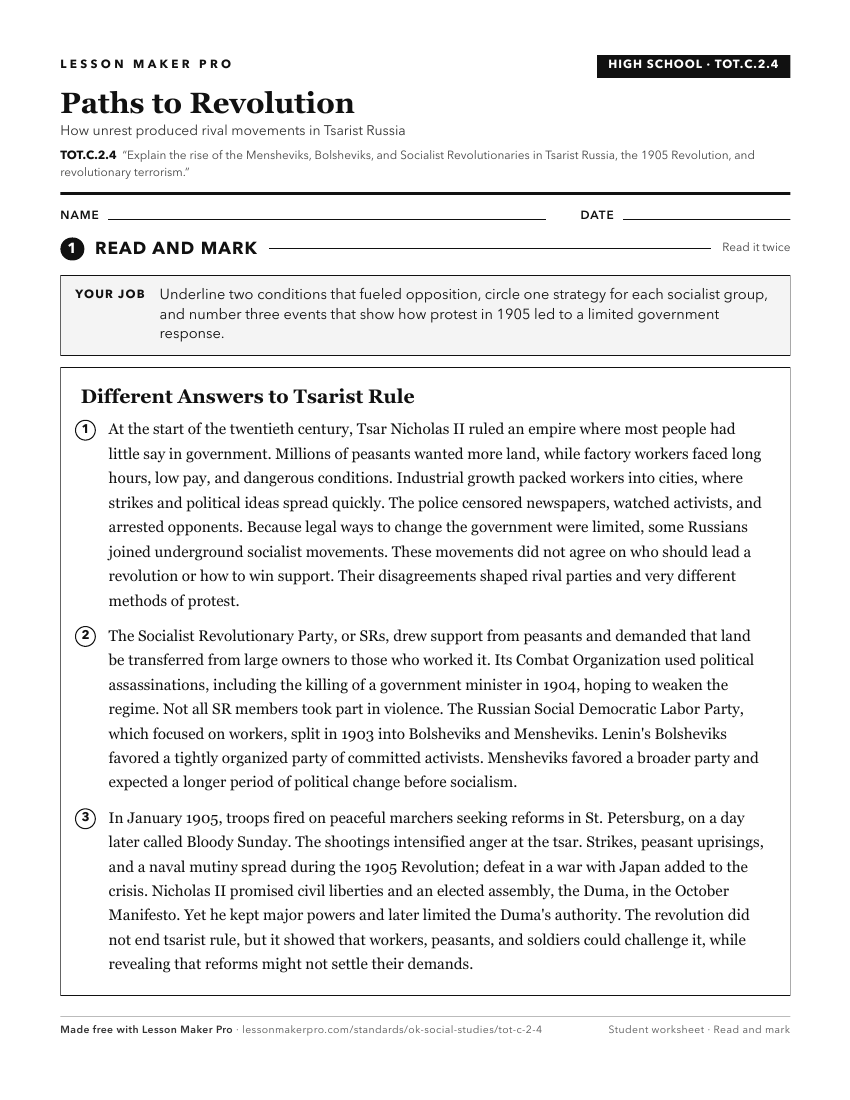
A ready-to-print activity worksheet aligned to TOT.C.2.4, with an answer key for the teacher on its own page. No account needed.
PDF, US Letter, prints cleanly in black and white.
Download the worksheetKeep exploring
Related Standards
- TOT.C.3.2.B
October Revolution, the Bolshevik seizure of power, and the establishment of one-party dictatorship
- TOT.C.3.2
Trace the significant events of the Russian Revolution.
- MWH.C.6.3.A
Describe the growing political and social unrest under Czar Nicholas II and the collapse of the Romanov dynasty, exemplified by the emergence of the Bolshevik M...
- MWH.C.6.3
Analyze the causes and consequences of the Russian Revolution on global politics, social structures, human rights, and economic systems.
Turn this exact standard into a lesson
Grade, subject, topic, and the complete standard are prefilled. Create one free, no account needed.
Also for this standard:Make a WorksheetMake a QuizMake a Sub Lesson