Oklahoma Social Studies 8.C.12.2
Standard Cluster
- 8.C.12
- Analyze the course and consequences of the Civil War.
Evaluate the advantages and disadvantages of the Union and the Confederacy. Compare natural resources, population, and industrialization. Describe the significance of military leadership and experience (e.g., Robert E. Lee, Ulysses S. Grant). Examine the contributions of free and enslaved persons, such as the 54th Massachusetts Regiment. Describe the value of immigrant troops drafted or recruited to fill Union ranks.
Oklahoma Academic Standards for Social Studies (2026) · 8.C.12
Cluster contents
Standards in This Cluster
8.C.12.2 is a cluster heading. These are the individual standards under it.
- 8.C.12.2.A
Compare natural resources, population, and industrialization.
- 8.C.12.2.B
Describe the significance of military leadership and experience (e.g., Robert E. Lee, Ulysses S. Grant).
- 8.C.12.2.C
Examine the contributions of free and enslaved persons, such as the 54th Massachusetts Regiment.
- 8.C.12.2.D
Describe the value of immigrant troops drafted or recruited to fill Union ranks.
Teacher's field guide
What This Cluster Means
What Students Need to Do
- Students compare each side's population, natural resources, and factories to explain its strengths and limits. They explain how Lee's and Grant's leadership affected the war. They describe how free Black soldiers, enslaved people, and immigrant troops contributed.
What Mastery Looks Like
- Students can explain why the Union's larger population and factories helped it, while Southern farmland and familiar terrain helped Confederate defense. They can explain how Lee's command helped at Chancellorsville and Grant's campaign helped take Vicksburg. They can describe the 54th Massachusetts at Fort Wagner, enslaved people's escapes, and immigrant enlistment.
Common Misconceptions
- Students may assume the Confederacy had more people because it had more farmland. They may confuse cotton production with factory output or think all Black Union soldiers had been enslaved. They may also assume every immigrant soldier was drafted.
How to Assess It
- Exit ticket: The Union had about 22 million people and most factories. The Confederacy had about 9 million people and produced most cotton. Name one advantage and one limit for each side, then explain how one leader or group affected the war.
Lesson moves
Ways to Teach It
Give pairs labeled cards for population, coal, iron, cotton, and factories; have them sort the cards into Union and Confederate strengths and limits.
Read short accounts of Lee at Chancellorsville and Grant at Vicksburg; ask which leader's choices mattered most, and why.
Play a matching game pairing the 54th at Fort Wagner, escaped enslaved guides, and Irish Union regiments with their wartime contributions.
Compare an Irish Union recruiting poster with a modern military recruiting ad; have students circle appeals to pay, belonging, or service.
Free download
Printable 8.C.12.2 Worksheet
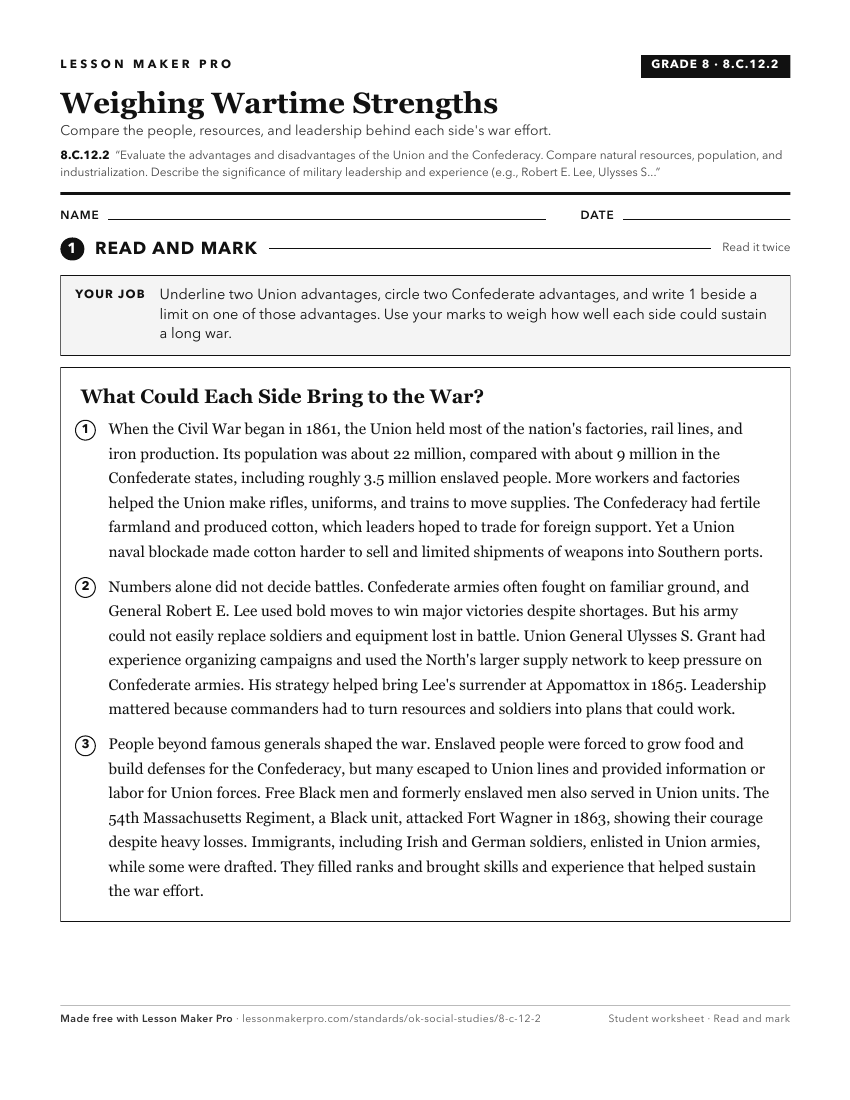
A ready-to-print activity worksheet aligned to 8.C.12.2, with an answer key for the teacher on its own page. No account needed.
PDF, US Letter, prints cleanly in black and white.
Download the worksheetKeep exploring
Related Standards
- 5.C.2.4.D
Evaluate the influence of the Haudenosaunee (Iroquois) Confederacy on colonial attempts to unite.
- 8.C.12
Analyze the course and consequences of the Civil War.
- 8.C.12.4.C
Describe how the Battle of Gettysburg ended the Confederate attempt to invade the North and analyze Lincoln’s Gettysburg Address clarifying the Union’s motivati...
- 5.C.4.2
Compare the advantages and disadvantages of the British and the American colonies during the Revolutionary War, including military leadership and strength, popu...
Turn this cluster into a lesson
Grade, subject, topic, and the complete cluster are prefilled. Create one free, no account needed.
Also for this cluster:Make a WorksheetMake a QuizMake a Sub Lesson