Oklahoma Social Studies 8.C.8
Standard Cluster
Examine the political, economic and social transformations of the Jacksonian Era. Describe the factors that led to the election of President Andrew Jackson, including state laws expanding white male suffrage and Jackson’s identification with the “common man.” Analyze the impact of the Nullification Crisis on the development of the states’ rights debate. Explain how provisions of the Constitution (Supremacy Clause; Article III) addressed the theoretical right to reject federal laws. Describe President Jackson’s reaction to the crisis, based on his fear of secession and destruction of the Union. Examine how the Nullification Crisis illustrated the growing tensions between sections of the nation and the public. Analyze the impact of President Andrew Jackson’s policies concerning American Indian Nations and their sovereignty during the early nineteenth century. Explain the federal government’s inconsistent adherence to treaties with Tribal Nations and the political pressures from states seeking control over Tribal lands. Examine the Supreme Court’s Decision in Worcester v. Georgia and analyze the constitutional conflict between federal authority, state governments, and Tribal Nations during the Jackson administration. Students should understand: Tribes were not originally considered states or foreign nations under the Constitution. In Cherokee Nation v. Georgia, the Supreme Court ruled the Cherokee Nation lacked standing as a foreign nation and described tribes as “domestic dependent Nations.” Analyze how President Andrew Jackson supported state authority in conflicts with Tribal governments and how this position influenced federal policy toward Indian removal. This allows teachers to explain Jackson’s famous response to Worcester, which reflected his broader states’ rights political philosophy and his view that he governed all states of the Union. Describe the resistance of Tribal Nations to removal policies and encroachment onto Tribal lands, including legal challenges and political advocacy. Explain the series of forced removals of Tribal citizens from their homelands to Indian Territory, often referred to as the Trail of Tears. Reference: Trail of Tears and Indian Removal Act Evaluate differing perspectives among Native and American leaders regarding removal policies, including the views of Cherokee leaders such as John Ross and Major Ridge, as well as opposition from politicians such as Davy Crockett and various Christian missionaries. Students should also understand that: Cherokee leaders such as Ross and Ridge had served alongside Americans in earlier conflicts, including the War of 1812. They later disagreed on how to respond to removal pressures, creating divisions within the Cherokee Nation.
Oklahoma Academic Standards for Social Studies (2026)
Cluster contents
Standards in This Cluster
8.C.8 is a cluster heading. These are the individual standards under it.
- 8.C.8.1
Describe the factors that led to the election of President Andrew Jackson, including state laws expanding white male suffrage and Jackson’s identification with ...
- 8.C.8.2
Analyze the impact of the Nullification Crisis on the development of the states’ rights debate.
- 8.C.8.2.A
Explain how provisions of the Constitution (Supremacy Clause; Article III) addressed the theoretical right to reject federal laws.
- 8.C.8.2.B
Describe President Jackson’s reaction to the crisis, based on his fear of secession and destruction of the Union.
- 8.C.8.2.C
Examine how the Nullification Crisis illustrated the growing tensions between sections of the nation and the public.
- 8.C.8.3
Analyze the impact of President Andrew Jackson’s policies concerning American Indian Nations and their sovereignty during the early nineteenth century.
- 8.C.8.3.A
Explain the federal government’s inconsistent adherence to treaties with Tribal Nations and the political pressures from states seeking control over Tribal land...
- 8.C.8.3.B
Examine the Supreme Court’s Decision in Worcester v. Georgia and analyze the constitutional conflict between federal authority, state governments, and Tribal Na...
- 8.C.8.3.C
Analyze how President Andrew Jackson supported state authority in conflicts with Tribal governments and how this position influenced federal policy toward India...
- 8.C.8.3.D
Describe the resistance of Tribal Nations to removal policies and encroachment onto Tribal lands, including legal challenges and political advocacy.
- 8.C.8.3.E
Explain the series of forced removals of Tribal citizens from their homelands to Indian Territory, often referred to as the Trail of Tears. Reference: Trail of ...
- 8.C.8.3.F
Evaluate differing perspectives among Native and American leaders regarding removal policies, including the views of Cherokee leaders such as John Ross and Majo...
Teacher's field guide
What This Cluster Means
What Students Need to Do
- Students explain how expanded voting rights for white men and Jackson’s common-man image helped elect him. They compare South Carolina’s attempt to reject a federal tariff with the Constitution’s rules for federal law and courts. They trace how state pressure, broken treaties, court rulings, and Cherokee resistance shaped forced removal.
What Mastery Looks Like
- A student can explain why the Supremacy Clause and Article III challenged South Carolina’s nullification claim, and why Jackson feared secession. They can use Worcester v. Georgia to explain why Georgia lacked authority over Cherokee land, even as Jackson backed Georgia and removal continued. They can explain why John Ross opposed a removal treaty while Major Ridge signed it.
Common Misconceptions
- Students may think expanded voting rights included women and Black Americans; the changes mainly benefited white men. They may think a state could cancel federal law on its own, or that the Worcester ruling stopped Georgia’s actions. They may describe removal as voluntary or assume all Cherokee leaders agreed on how to respond.
How to Assess It
- Exit ticket: In three sentences, explain who gained voting rights before Jackson’s election, why Jackson rejected South Carolina’s nullification claim, and why Georgia’s actions on Cherokee land conflicted with Worcester v. Georgia. Name one constitutional rule.
Lesson moves
Ways to Teach It
Give pairs cards with a voting law, Jackson’s nullification proclamation, a Worcester excerpt, and a Cherokee petition; sort them by who claimed power.
Read excerpts from John Ross’s petition against removal and Major Ridge’s argument for a removal treaty; write why they disagreed.
Give teams term and definition cards for the Supremacy Clause, Article III, Worcester, and Indian Removal Act; match them and explain each choice.
Use a map scale to estimate the distance from Cherokee homelands to Indian Territory, then mark the forced removal route.
Free download
Printable 8.C.8 Worksheet
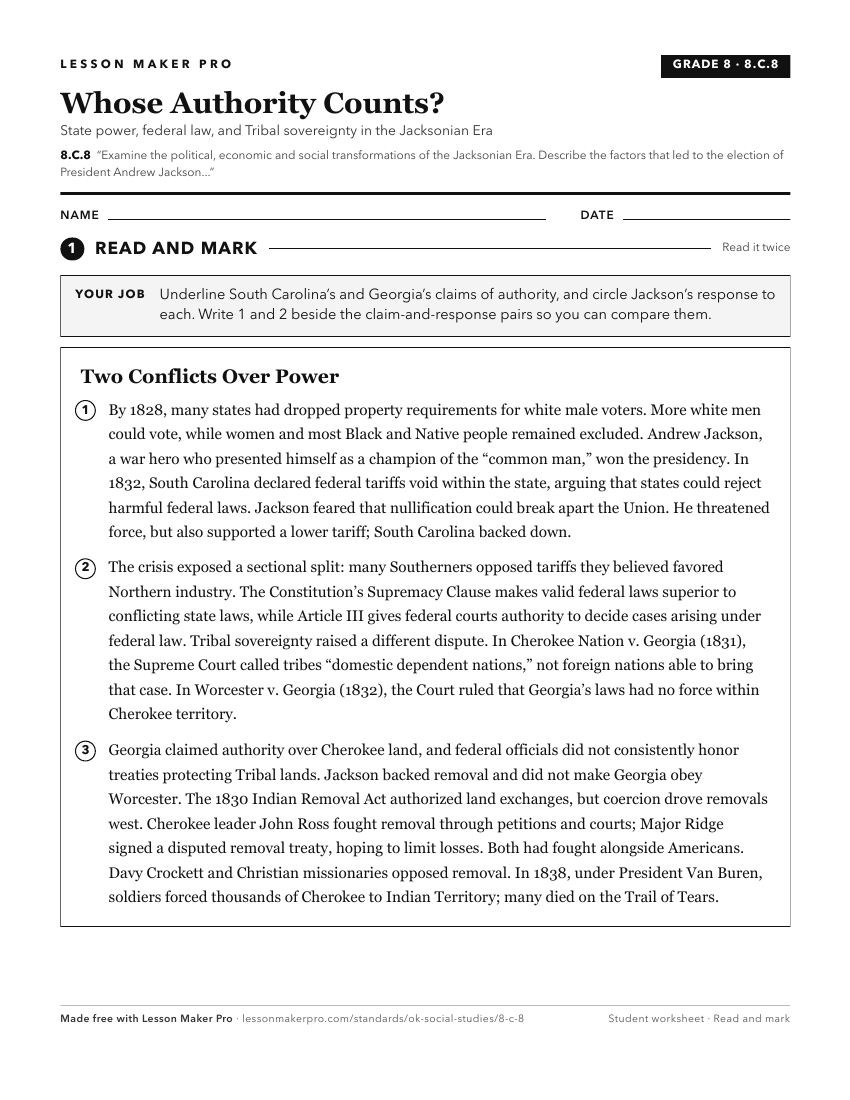
A ready-to-print activity worksheet aligned to 8.C.8, with an answer key for the teacher on its own page. No account needed.
PDF, US Letter, prints cleanly in black and white.
Download the worksheetKeep exploring
Related Standards
- 8.C.10
Analyze the social and economic transformations of the early nineteenth century.
- 8.C.6
Analyze the political, constitutional, and geographic changes that occurred during the Jeffersonian Era.
- 8.C.13
Analyze the political, social, and economic transformations during the Reconstruction Era.
- 8.C.7
Examine the political, economic and social transformations during the “Era of Good Feelings.”
Turn this cluster into a lesson
Grade, subject, topic, and the complete cluster are prefilled. Create one free, no account needed.
Also for this cluster:Make a WorksheetMake a QuizMake a Sub Lesson