Oklahoma Social Studies 8.C.8.2
Standard Cluster
- 8.C.8
- Examine the political, economic and social transformations of the Jacksonian Era.
Analyze the impact of the Nullification Crisis on the development of the states’ rights debate. Explain how provisions of the Constitution (Supremacy Clause; Article III) addressed the theoretical right to reject federal laws. Describe President Jackson’s reaction to the crisis, based on his fear of secession and destruction of the Union. Examine how the Nullification Crisis illustrated the growing tensions between sections of the nation and the public.
Oklahoma Academic Standards for Social Studies (2026) · 8.C.8
Cluster contents
Standards in This Cluster
8.C.8.2 is a cluster heading. These are the individual standards under it.
- 8.C.8.2.A
Explain how provisions of the Constitution (Supremacy Clause; Article III) addressed the theoretical right to reject federal laws.
- 8.C.8.2.B
Describe President Jackson’s reaction to the crisis, based on his fear of secession and destruction of the Union.
- 8.C.8.2.C
Examine how the Nullification Crisis illustrated the growing tensions between sections of the nation and the public.
Teacher's field guide
What This Cluster Means
What Students Need to Do
- Students explain why South Carolina tried to reject federal tariffs and why Jackson opposed it. They use the Supremacy Clause and Article III to explain why a state could not settle the legal question alone. They describe how the crisis sharpened divisions between regions and among the public.
What Mastery Looks Like
- Students can put South Carolina’s ordinance, Jackson’s response, and the compromise tariff in order. They can explain that federal law takes priority when it follows the Constitution and that federal courts hear disputes about federal law. They can name groups that disagreed over tariffs and nullification, including a split within South Carolina.
Common Misconceptions
- Students may think the Supremacy Clause makes every federal law constitutional, or that Article III lets a state veto federal law. They may assume Jackson backed nullification because he was a southerner, or that all South Carolinians supported it.
How to Assess It
- Exit ticket: South Carolina declares the 1832 tariff void. In four sentences, explain how the Supremacy Clause and Article III address that claim, why Jackson feared it, and who disagreed over it.
Lesson moves
Ways to Teach It
Give pairs cards showing South Carolina’s ordinance, the Supremacy Clause, Article III, and Jackson’s proclamation; have them arrange the cards into a cause-and-response chain.
Read two short 1832 newspaper excerpts, one backing nullification and one opposing it; write what each side feared.
Run a matching game with cards for the ordinance, Jackson’s proclamation, the Force Bill, and the compromise tariff; students pair each event with its effect.
Give students a short summary of Arizona v. United States (2012); ask who resolved the conflict between state and federal law.
Free download
Printable 8.C.8.2 Worksheet
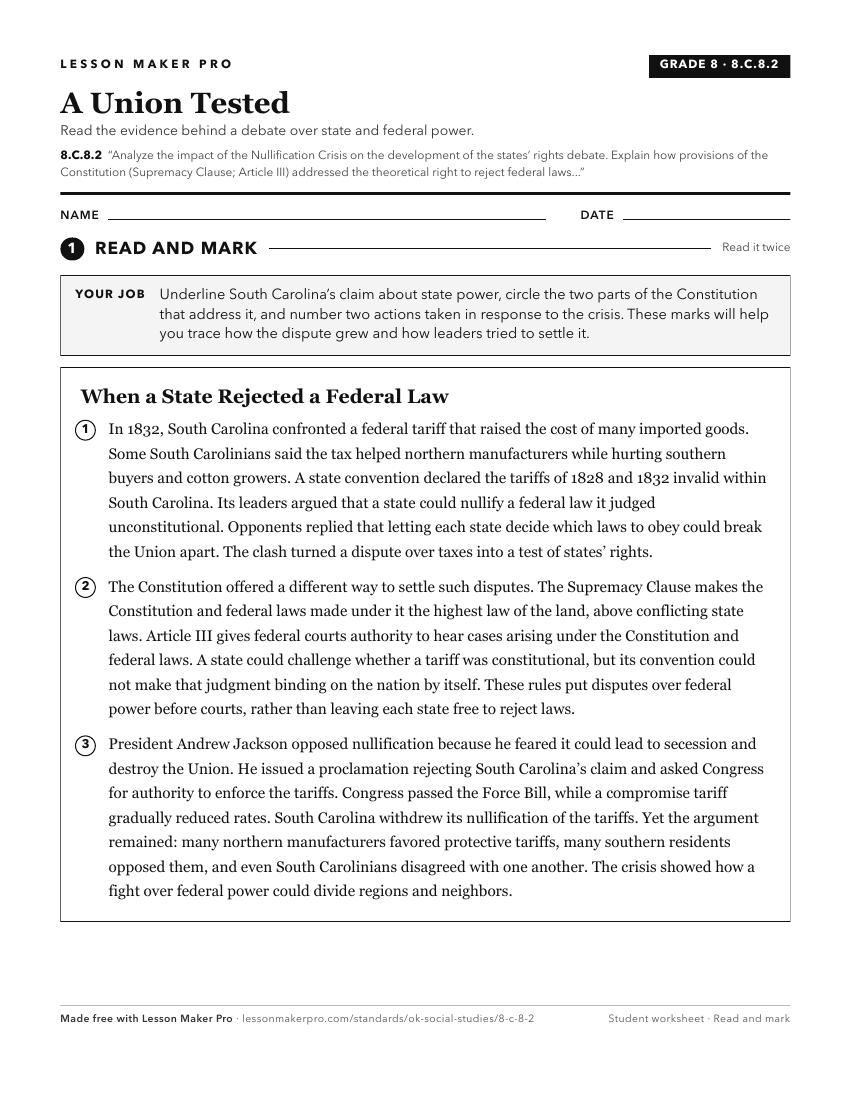
A ready-to-print activity worksheet aligned to 8.C.8.2, with an answer key for the teacher on its own page. No account needed.
PDF, US Letter, prints cleanly in black and white.
Download the worksheetKeep exploring
Related Standards
- 8.C.5.1.B
Analyze the impact of the Whiskey Rebellion and the presidential authority to enforce federal law.
- 8.C.11.2
Analyze the impact of the Kansas-Nebraska Act, the growing tension, and inevitability of a civil war.
- 8.C.13.2
Analyze the impact of state and federal legislation following the Civil War.
Turn this cluster into a lesson
Grade, subject, topic, and the complete cluster are prefilled. Create one free, no account needed.
Also for this cluster:Make a WorksheetMake a QuizMake a Sub Lesson