Oklahoma Social Studies 8.C.8.3.F
The Standard
- 8.C.8
- Examine the political, economic and social transformations of the Jacksonian Era.
- 8.C.8.3
- Analyze the impact of President Andrew Jackson’s policies concerning American Indian Nations and their sovereignty during the early nineteenth century.
Evaluate differing perspectives among Native and American leaders regarding removal policies, including the views of Cherokee leaders such as John Ross and Major Ridge, as well as opposition from politicians such as Davy Crockett and various Christian missionaries. Students should also understand that: Cherokee leaders such as Ross and Ridge had served alongside Americans in earlier conflicts, including the War of 1812. They later disagreed on how to respond to removal pressures, creating divisions within the Cherokee Nation.
Oklahoma Academic Standards for Social Studies (2026) · 8.C.8.3
Teacher's field guide
What This Standard Means
What Students Need to Do
- Students compare why John Ross resisted removal while Major Ridge backed a treaty under pressure. They use evidence to explain why Davy Crockett and some missionaries opposed removal.
What Mastery Looks Like
- A student can explain each leader's position using a detail from a source. They can explain that Ross and Ridge served with U.S. forces earlier but later split over how to respond to removal. They know Ridge's treaty lacked approval from the Cherokee government.
Common Misconceptions
- Students may think all Cherokee leaders agreed, or that Ridge's signature meant the Cherokee Nation approved the treaty. They may also think every American supported removal.
How to Assess It
- Exit ticket: Why did Ross and Ridge respond differently to removal? Give one reason for each, then explain why Crockett or a missionary objected.
Lesson moves
Ways to Teach It
Give pairs short source cards for Ross, Ridge, Crockett, a missionary, and Jackson; sort them by proposed response and underline each reason.
Ask, 'Why might Ross and Ridge choose different responses after both served with U.S. troops?' Require one fact about each leader.
Play a match game with leader, position, and reason cards; have partners find and fix one deliberately mismatched set.
Mark a Cherokee removal route on a current U.S. map; list the states it crosses and estimate the distance to Oklahoma.
Free download
Printable 8.C.8.3.F Worksheet
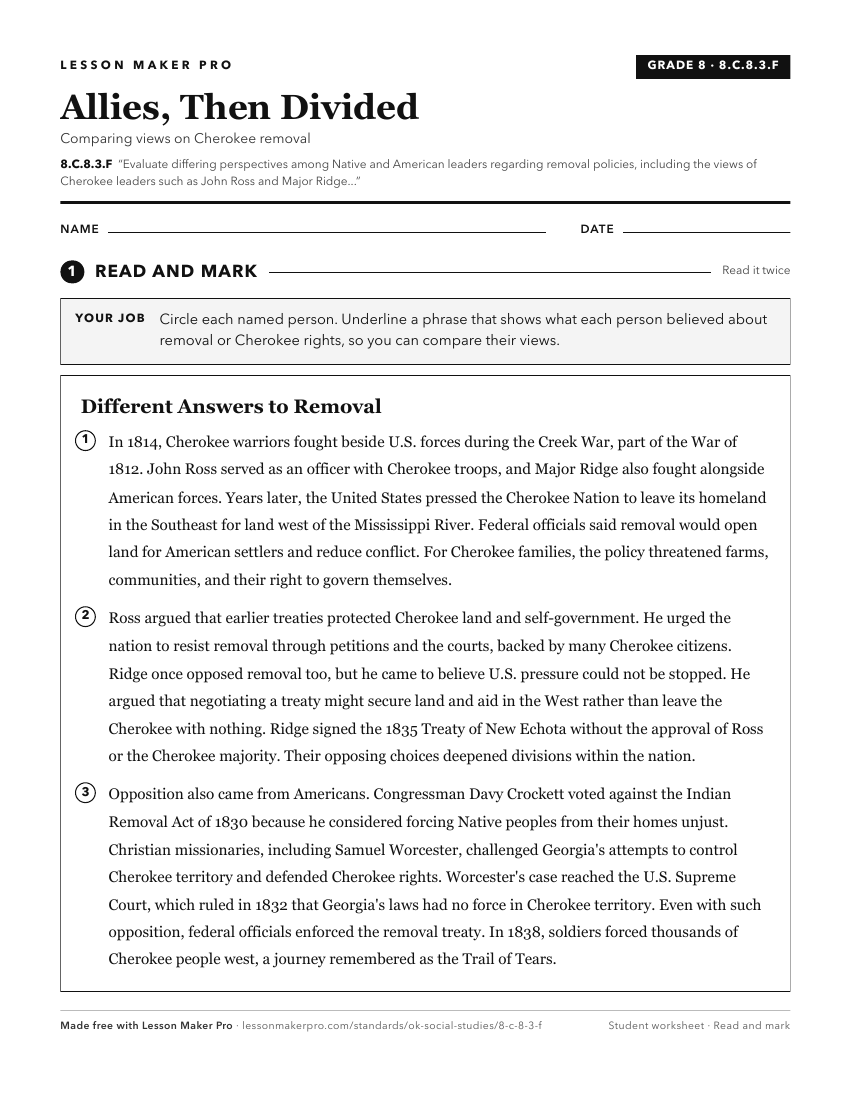
A ready-to-print activity worksheet aligned to 8.C.8.3.F, with an answer key for the teacher on its own page. No account needed.
PDF, US Letter, prints cleanly in black and white.
Download the worksheetKeep exploring
Related Standards
- OKH.C.2.2.A
Explain the motivations which prompted the passage and terms of the Indian Removal Act of 1830 and describe efforts of Tribal resistance, including appeals to t...
- OKH.C.2.2.C
Examine the consequences of Indian Removal on intertribal relationships among Tribal groups historically residing in Indian Territory and those relocated there.
- 8.C.8.3.C
Analyze how President Andrew Jackson supported state authority in conflicts with Tribal governments and how this position influenced federal policy toward India...
- OKH.C.2.2
Analyze the consequences of American Indian removals to present-day Oklahoma.
Turn this exact standard into a lesson
Grade, subject, topic, and the complete standard are prefilled. Create one free, no account needed.
Also for this standard:Make a WorksheetMake a QuizMake a Sub Lesson