Oklahoma Social Studies OKH.C.2.2
Standard Cluster
- OKH.C.2
- Evaluate the major political and economic events that transformed the land and its people from early contact through Indian Removal and its aftermath.
Analyze the consequences of American Indian removals to present-day Oklahoma. Explain the motivations which prompted the passage and terms of the Indian Removal Act of 1830 and describe efforts of Tribal resistance, including appeals to the Supreme Court (e.g., Marshall Trilogy), the advocacy of Samuel Worcester, and the positions of Cherokee leadership (e.g., Elias Boudinot, John Ross). Summarize and describe the process and experiences of the forced removal of southeastern Tribes from their homelands, including the establishment of Indian Territory. Examine the consequences of Indian Removal on intertribal relationships among Tribal groups historically residing in Indian Territory and those relocated there.
Oklahoma Academic Standards for Social Studies (2026) · OKH.C.2
Cluster contents
Standards in This Cluster
OKH.C.2.2 is a cluster heading. These are the individual standards under it.
- OKH.C.2.2.A
Explain the motivations which prompted the passage and terms of the Indian Removal Act of 1830 and describe efforts of Tribal resistance, including appeals to t...
- OKH.C.2.2.B
Summarize and describe the process and experiences of the forced removal of southeastern Tribes from their homelands, including the establishment of Indian Terr...
- OKH.C.2.2.C
Examine the consequences of Indian Removal on intertribal relationships among Tribal groups historically residing in Indian Territory and those relocated there.
Teacher's field guide
What This Cluster Means
What Students Need to Do
- Students explain how settlers' demand for southeastern land shaped a law authorizing land exchanges and removal aid. They trace forced removals into Indian Territory and compare court challenges with Cherokee leaders' choices. They describe effects on nations already living there.
What Mastery Looks Like
- Students distinguish what the 1830 law authorized from the forced removals that followed. They explain why the Worcester ruling did not stop removal and why John Ross opposed the 1835 treaty while Elias Boudinot supported it. They trace a removal route and describe land pressure on nations already in Indian Territory.
Common Misconceptions
- Students may mistake the 1830 law for a direct order that every Tribe had to march west. They may think the Worcester ruling stopped removal or that Ross and Boudinot agreed. Others assume Indian Territory was empty before southeastern Tribes arrived.
How to Assess It
- Exit ticket: What did the 1830 law authorize, and why did Worcester v. Georgia not stop Cherokee removal? Name one consequence for a nation already living in Indian Territory.
Lesson moves
Ways to Teach It
Give pairs a reference map and a blank map; have them label Cherokee homelands, a removal route, Indian Territory, and Osage homelands.
Read excerpts from John Ross opposing removal and Elias Boudinot supporting the 1835 treaty; ask students to compare their reasons.
Give pairs cards for the 1830 law, Worcester ruling, 1835 treaty, and 1838 Cherokee removal; have them sequence and explain each link.
Compare a current map of Oklahoma Tribal nations with an 1830s map; locate Cherokee and Osage lands, then note one change.
Free download
Printable OKH.C.2.2 Worksheet
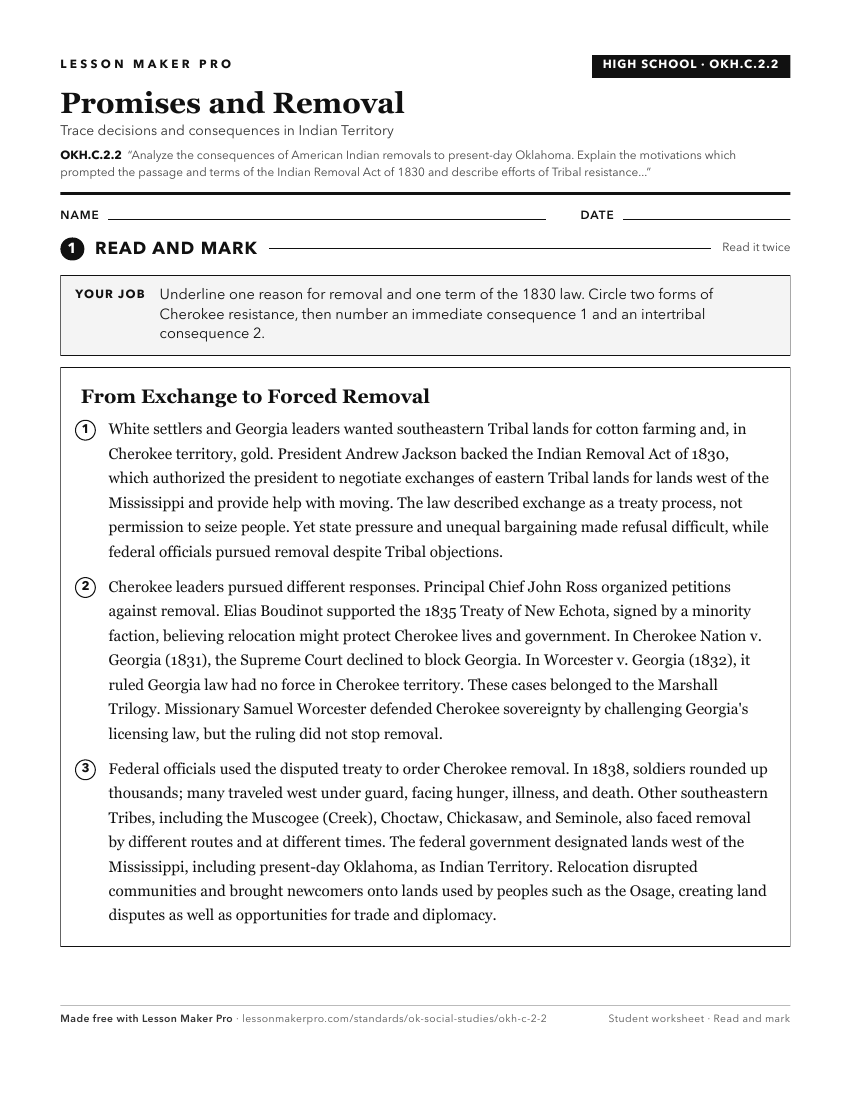
A ready-to-print activity worksheet aligned to OKH.C.2.2, with an answer key for the teacher on its own page. No account needed.
PDF, US Letter, prints cleanly in black and white.
Download the worksheetKeep exploring
Related Standards
- OKH.C.3.3
Analyze the influence of the idea of Manifest Destiny on migrations into present-day Oklahoma.
- OKH.C.6.3
Examine the evolution of race relations in Oklahoma.
- 3.C.3.1.D
Describe the experiences of forced removals and relocation of American Indians to Indian Territory, explaining significant changes to American Indian cultures a...
Turn this cluster into a lesson
Grade, subject, topic, and the complete cluster are prefilled. Create one free, no account needed.
Also for this cluster:Make a WorksheetMake a QuizMake a Sub Lesson