Oklahoma Social Studies 8.C.13.4
Standard Cluster
- 8.C.13
- Analyze the political, social, and economic transformations during the Reconstruction Era.
Assess the lasting impact of factors leading to the end of Reconstruction. Describe the result of a lack of enforcement of the 14th and 15th Amendments. Examine the development of segregated societies in the South as a result of social norms and legal statutes such as Black Codes. Explain the effects of the presidential election of 1876 and the Compromise of 1877 on Reconstruction.
Oklahoma Academic Standards for Social Studies (2026) · 8.C.13
Cluster contents
Standards in This Cluster
8.C.13.4 is a cluster heading. These are the individual standards under it.
- 8.C.13.4.A
Describe the result of a lack of enforcement of the 14th and 15th Amendments.
- 8.C.13.4.B
Examine the development of segregated societies in the South as a result of social norms and legal statutes such as Black Codes.
- 8.C.13.4.C
Explain the effects of the presidential election of 1876 and the Compromise of 1877 on Reconstruction.
Teacher's field guide
What This Cluster Means
What Students Need to Do
- Students trace how violence, fading federal support, and the disputed 1876 election helped end Reconstruction. They explain how weak enforcement of voting and equal protection rights allowed restrictions and segregation to spread. They distinguish early Black Codes from later Jim Crow laws.
What Mastery Looks Like
- A student puts the 1876 election, the 1877 troop withdrawal, and later segregation laws in order. They explain how weak enforcement left Black citizens facing voting barriers and unequal treatment in public places. They can say why Black Codes belong earlier in the timeline.
Common Misconceptions
- Students may think the 1876 election was a direct vote to end Reconstruction. They may place Black Codes after 1877 or think the amendments disappeared when federal troops left. Some mix up voting barriers with laws that separated people in public places.
How to Assess It
- Exit ticket: Put Black Codes, the disputed 1876 election, federal troop withdrawal, and Jim Crow rail laws in order. Explain how the withdrawal affected enforcement of one amendment.
Lesson moves
Ways to Teach It
Give pairs dated cards for Black Codes, the amendments, the election, troop withdrawal, and a rail law; have them build a timeline.
Ask: How could removing federal troops affect voting rights? Write a claim using two timeline cards as evidence.
Play a card match pairing poll taxes, literacy tests, and separate railcars with the right each restricted; explain one match.
Compare an 1890 Louisiana railcar rule with today's train seating rules; list who could choose a seat under each rule.
Free download
Printable 8.C.13.4 Worksheet
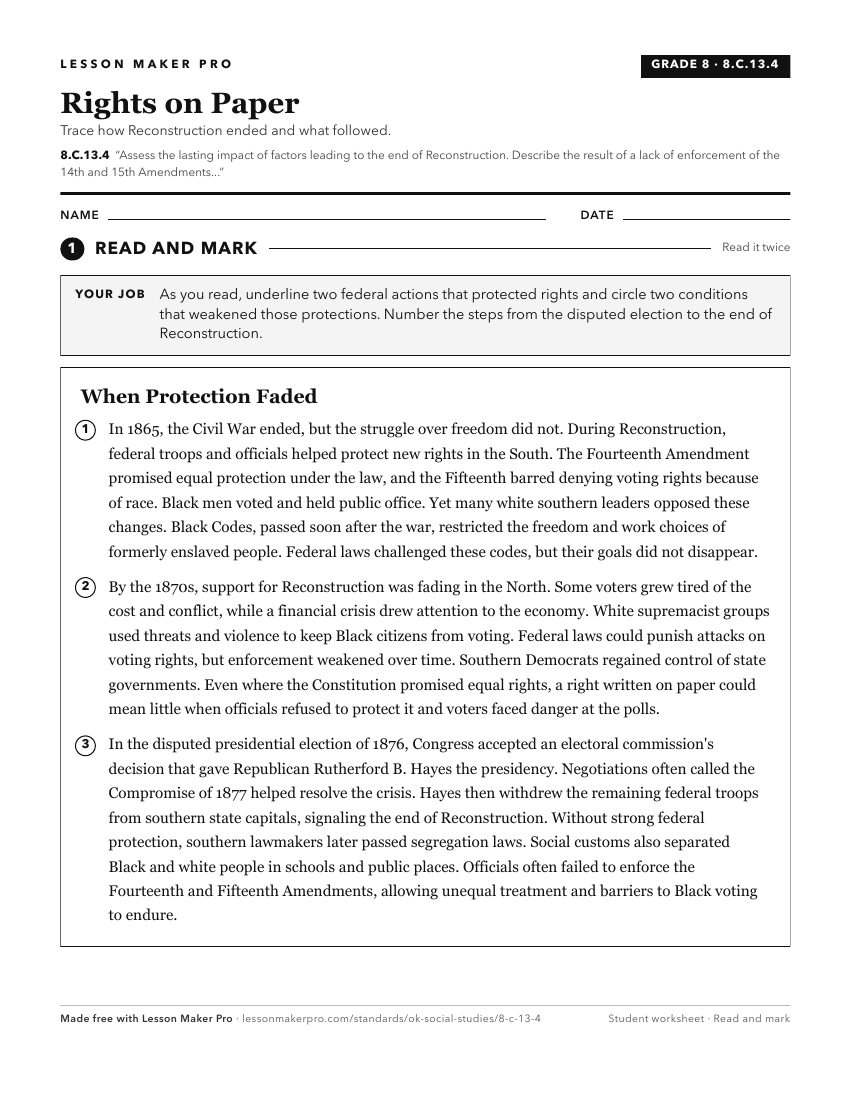
A ready-to-print activity worksheet aligned to 8.C.13.4, with an answer key for the teacher on its own page. No account needed.
PDF, US Letter, prints cleanly in black and white.
Download the worksheetKeep exploring
Related Standards
- USH.C.1.2
Analyze the post-Reconstruction civil rights struggles of African Americans.
- 8.C.13
Analyze the political, social, and economic transformations during the Reconstruction Era.
- 8.C.13.1.B
Compare the plans and policies proposed for Reconstruction (e.g., President Andrew Johnson, the Congressional Republicans) assessing their intended goals and po...
- 8.C.13.1
Examine the challenges of rebuilding the nation following the end of the Civil War.
Turn this cluster into a lesson
Grade, subject, topic, and the complete cluster are prefilled. Create one free, no account needed.
Also for this cluster:Make a WorksheetMake a QuizMake a Sub Lesson