Oklahoma Social Studies MWH.C.2.4.A
The Standard
- MWH.C.2
- Analyze patterns of social, economic, political, and cultural changes during the Late Middle Ages to the Age of Exploration.
- MWH.C.2.4
- Evaluate the legacy of the Scientific Revolution on society, focusing on major theories and discoveries.
Explain how the scientific method and new technologies, such as the telescope and microscope, led to new theories of the universe.
Oklahoma Academic Standards for Social Studies (2026) · MWH.C.2.4
Teacher's field guide
What This Standard Means
What Students Need to Do
- Students explain how observations from new tools challenged old ideas about the universe. They connect telescope findings to debates about Earth's place in the solar system. They distinguish that evidence from microscope findings, which revealed things people could not see before.
What Mastery Looks Like
- A student can explain why moons orbiting Jupiter challenged the claim that everything orbits Earth. They can describe how scientists used observations to test ideas, and why seeing cells through a microscope did not prove that Earth orbits the Sun.
Common Misconceptions
- Students may think Galileo invented the telescope or that one sighting proved the Sun-centered model. Some treat microscope images of cells as direct evidence about Earth's orbit.
How to Assess It
- Exit ticket: Jupiter has moons, and a microscope reveals cells. Which finding challenges the claim that everything orbits Earth? Explain why the other does not.
Lesson moves
Ways to Teach It
Fix an Earth marker on a desk, then move a foam-ball Venus around a lamp Sun; sketch its changing phases from Earth.
Ask, 'If Jupiter has moons, what happens to the claim that everything orbits Earth?' Require a labeled sketch.
Hand out cards showing Venus's phases, Jupiter's moons, and microscope cells; students sort claims each observation can and cannot support.
Show a recent telescope photo of Jupiter's moons beside Galileo's sketch; ask what new detail better equipment reveals and what stays the same.
Free download
Printable MWH.C.2.4.A Worksheet
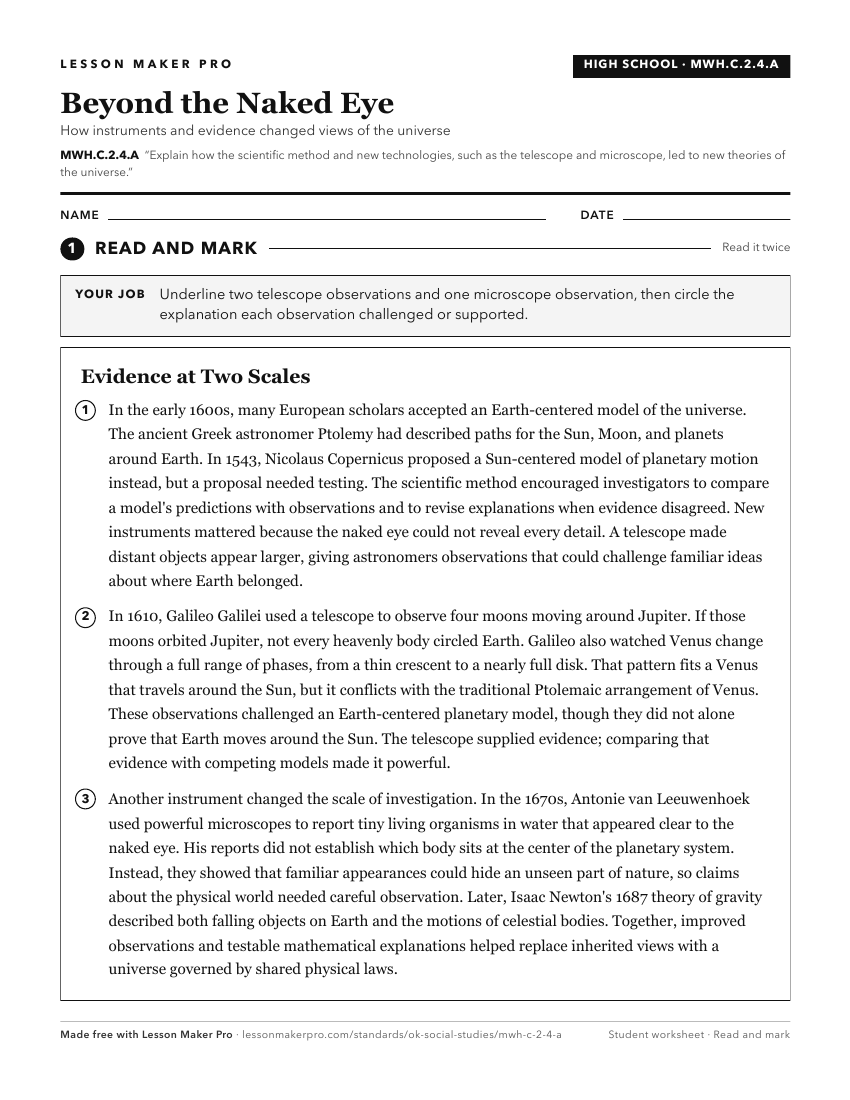
A ready-to-print activity worksheet aligned to MWH.C.2.4.A, with an answer key for the teacher on its own page. No account needed.
PDF, US Letter, prints cleanly in black and white.
Download the worksheetKeep exploring
Related Standards
- MWH.C.2.4.B
Describe the accomplishments of major figures of the Scientific Revolution (e.g., Nicolaus Copernicus, Galileo Galilei, Isaac Newton) as well as the impact of I...
- MWH.C.2.4
Evaluate the legacy of the Scientific Revolution on society, focusing on major theories and discoveries.
- S.1.1
Describe the development of the field of sociology as a social science, including the contributions of leading theorists within sociology.
- MWH.C.2.3.B
Explain new ways of disseminating information, such as Gutenberg’s invention of the printing press and the translation of the Bible into the vernacular.
Turn this exact standard into a lesson
Grade, subject, topic, and the complete standard are prefilled. Create one free, no account needed.
Also for this standard:Make a WorksheetMake a QuizMake a Sub Lesson