Oklahoma Social Studies MWH.C.2.3
Standard Cluster
- MWH.C.2
- Analyze patterns of social, economic, political, and cultural changes during the Late Middle Ages to the Age of Exploration.
Summarize the causes of and influence of the theological movements of the Reformation and how those movements subsequently transformed society. Explain reasons for the growing discontent with the Catholic Church, including the main ideas of Martin Luther and John Calvin, and the role of William Tyndale. Explain new ways of disseminating information, such as Gutenberg’s invention of the printing press and the translation of the Bible into the vernacular. Describe tensions between religious and secular authorities contributing to the English Reformation. Trace the spread of Protestantism across Europe, including Lutherans, Reformed (Calvinist) Church of England, Anabaptists, and the effects on European society (e.g., idea and practice of religious tolerance, Calvinist work ethic). Explain the purposes and policies of the Catholic Counter-Reformation.
Oklahoma Academic Standards for Social Studies (2026) · MWH.C.2
Cluster contents
Standards in This Cluster
MWH.C.2.3 is a cluster heading. These are the individual standards under it.
- MWH.C.2.3.A
Explain reasons for the growing discontent with the Catholic Church, including the main ideas of Martin Luther and John Calvin, and the role of William Tyndale.
- MWH.C.2.3.B
Explain new ways of disseminating information, such as Gutenberg’s invention of the printing press and the translation of the Bible into the vernacular.
- MWH.C.2.3.C
Describe tensions between religious and secular authorities contributing to the English Reformation.
- MWH.C.2.3.D
Trace the spread of Protestantism across Europe, including Lutherans, Reformed (Calvinist) Church of England, Anabaptists, and the effects on European society (...
- MWH.C.2.3.E
Explain the purposes and policies of the Catholic Counter-Reformation.
Teacher's field guide
What This Cluster Means
What Students Need to Do
- Students explain why criticism of Catholic Church practices grew and compare Luther's and Calvin's ideas. They connect Tyndale's English Bible and printed books to the spread of Protestant groups. They explain how disputes over royal power and Catholic reforms changed European society.
What Mastery Looks Like
- A student can explain how indulgence sales prompted Luther's protest and how print spread his arguments. They can distinguish Calvin's predestination from Luther's emphasis on faith and explain Henry VIII's break with Rome. They can describe a Catholic response, such as the Council of Trent, and explain why religious toleration varied across Europe.
Common Misconceptions
- Students may think Luther wanted to end Christianity rather than challenge Church practices and teachings. They may confuse Calvin's predestination with Luther's emphasis on faith. They may assume England broke with Rome only over theology, or that Protestant rulers immediately allowed religious freedom.
How to Assess It
- Ask students to write three sentences: What prompted Luther's protest? How did print or translation spread reform ideas? Name one political or social change that followed.
Lesson moves
Ways to Teach It
Give pairs a blank Europe map and denomination cards; have them place Lutheran, Reformed, Anglican, and Anabaptist groups and draw arrows showing spread.
Put 'salvation through faith' and 'predestination' on the board; ask students to write how Luther's and Calvin's ideas differed.
Hand out name, idea, and effect cards for Luther, Calvin, Tyndale, Henry VIII, and the Council of Trent; pairs match and explain them.
Show a school notice in English and its translation; ask students how copying and translating messages changes who can respond.
Free download
Printable MWH.C.2.3 Worksheet
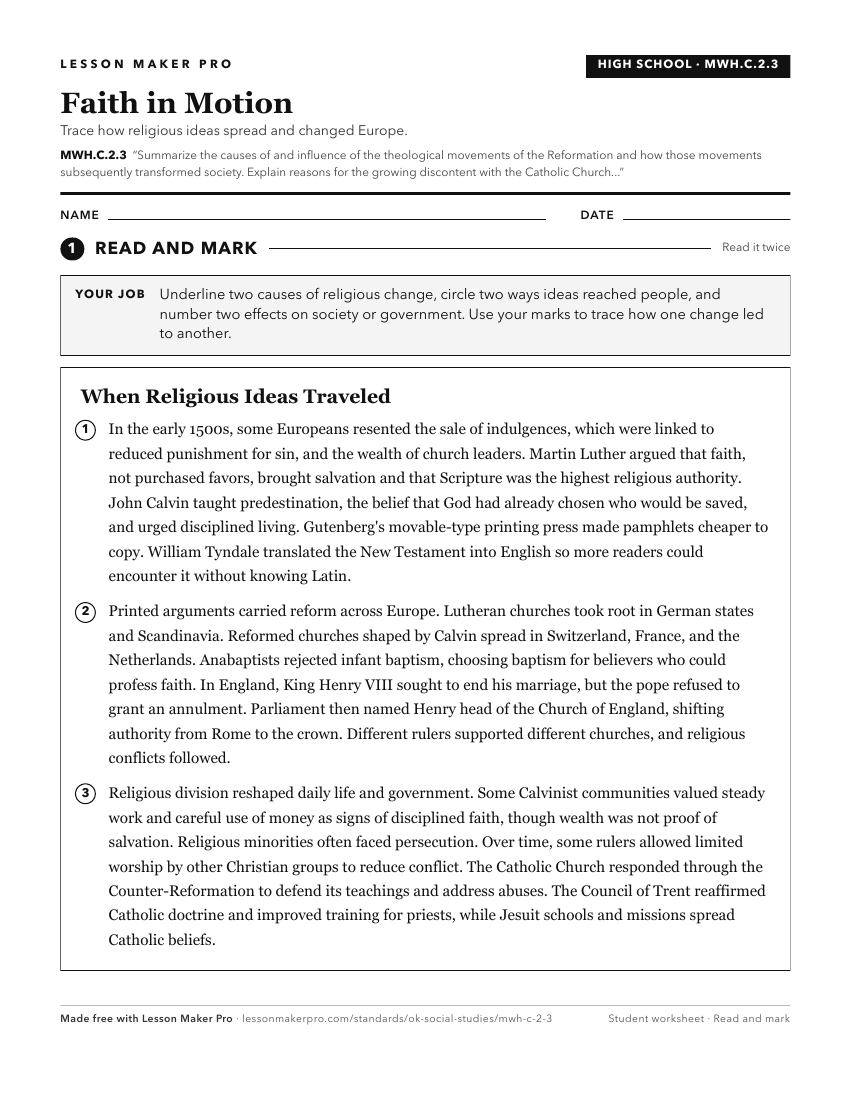
A ready-to-print activity worksheet aligned to MWH.C.2.3, with an answer key for the teacher on its own page. No account needed.
PDF, US Letter, prints cleanly in black and white.
Download the worksheetKeep exploring
Related Standards
Turn this cluster into a lesson
Grade, subject, topic, and the complete cluster are prefilled. Create one free, no account needed.
Also for this cluster:Make a WorksheetMake a QuizMake a Sub Lesson