Oklahoma Social Studies MWH.C.2.2
Standard Cluster
- MWH.C.2
- Analyze patterns of social, economic, political, and cultural changes during the Late Middle Ages to the Age of Exploration.
Assess the origins and the significance of the Italian Renaissance and the revival of classical learning. Examine intellectual development and advances (i.e., vernacular literature and expanded literacy, the arts, engineering, human anatomy) focusing on selected historical figures (e.g., Machiavelli, Michelangelo, daVinci, Raphael, Erasmus). Describe how humanism furthered the values of republicanism, liberty, and individualism.
Oklahoma Academic Standards for Social Studies (2026) · MWH.C.2
Cluster contents
Standards in This Cluster
MWH.C.2.2 is a cluster heading. These are the individual standards under it.
Teacher's field guide
What This Cluster Means
What Students Need to Do
- Students explain why wealthy Italian cities became centers for studying Greek and Roman works. They use the work of artists and writers to describe changes in art, anatomy, literature, and politics. They connect humanist ideas to individual choice, civic freedom, and self-government.
What Mastery Looks Like
- Students explain how trade wealth and patrons supported artists and scholars. They use a work by Michelangelo or Leonardo to show how classical study shaped art or anatomy. They explain how vernacular writing reached more readers and connect Machiavelli's republican arguments to civic liberty.
Common Misconceptions
- Students may think Greek and Roman learning vanished, though scholars in the Byzantine and Islamic worlds preserved many texts. They may assume all humanists rejected religion or supported republican government. They may also read Renaissance talk of liberty as equal rights for women and the poor.
How to Assess It
- Exit ticket: Explain how trade wealth supported classical learning in Florence. Then use Michelangelo's David, displayed outside the city hall, to connect a humanist idea to republican liberty.
Lesson moves
Ways to Teach It
Give pairs a trade-route map and cards labeled Florentine bankers, Greek manuscripts, Medici patrons, and Michelangelo; have them build a cause-and-effect chain.
Display Michelangelo's David outside Florence's city hall; ask how the statue could express both individual strength and pride in a republic.
Deal cards showing Raphael's School of Athens, Leonardo's anatomy sketches, and Machiavelli's Discourses; teams match each to an advance and defend their choices.
Show photos of a local public mural and Michelangelo's David; ask whose values each work puts in public view.
Free download
Printable MWH.C.2.2 Worksheet
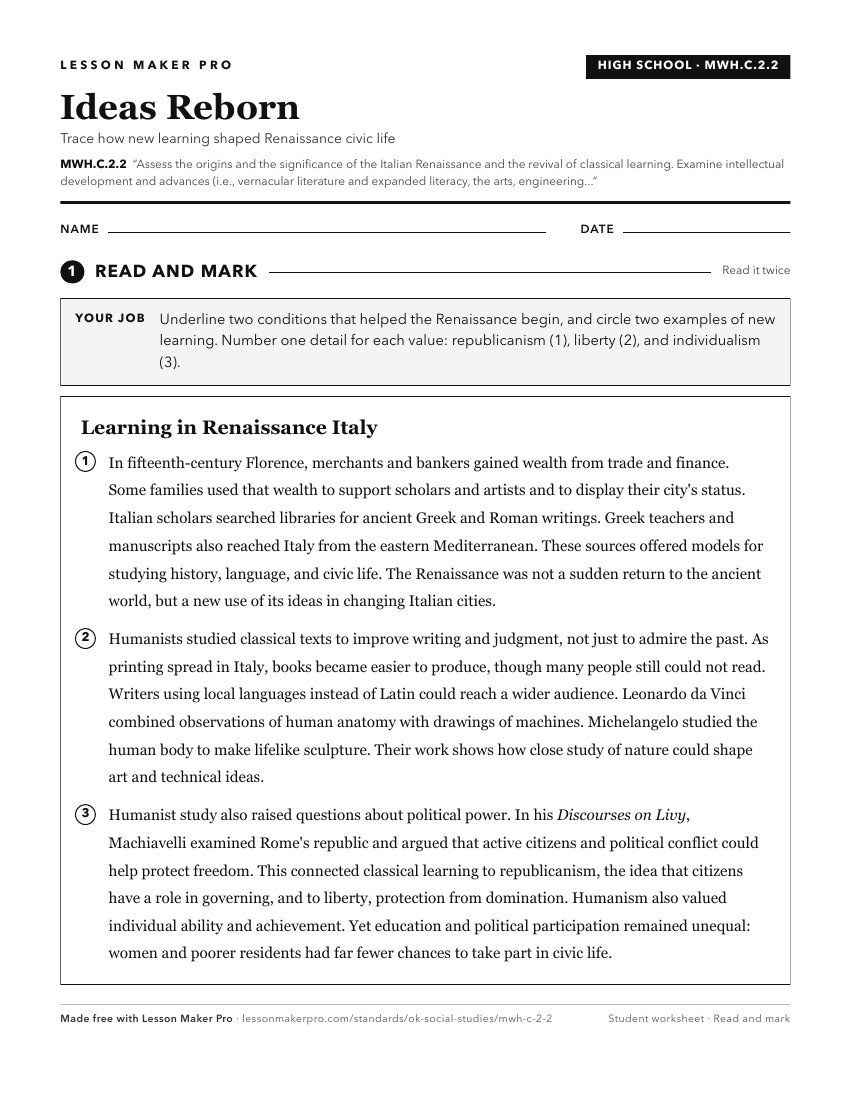
A ready-to-print activity worksheet aligned to MWH.C.2.2, with an answer key for the teacher on its own page. No account needed.
PDF, US Letter, prints cleanly in black and white.
Download the worksheetKeep exploring
Related Standards
- MWH.C.2.4
Evaluate the legacy of the Scientific Revolution on society, focusing on major theories and discoveries.
- AWH.C.7.4
Analyze the influence of Greek civilization on Roman art, literature, society, and government.
- AWH.C.10.5.B
Identify the growing influence of universities, Roman law, canon law, and Scholasticism.
Turn this cluster into a lesson
Grade, subject, topic, and the complete cluster are prefilled. Create one free, no account needed.
Also for this cluster:Make a WorksheetMake a QuizMake a Sub Lesson