Oklahoma Social Studies AWH.C.10.5
Standard Cluster
Examine religious, intellectual, cultural, technological, and economic developments in medieval Europe from the Norman Conquest to 1300. Describe the clash between papacy and empire with regards to the development of law. Identify the growing influence of universities, Roman law, canon law, and Scholasticism. Describe significant aspects of medieval culture, including architecture. music, art, and literature. Explain the emergence of a modern economy, the growth of commerce, towns, and a merchant class. Identify technological and agricultural improvements (e.g., plough, windmills, watermills). Describe military improvements (e.g., mounted knight and fortifications). Evaluate the impact of Marco Polo’s travels to India and China.
Oklahoma Academic Standards for Social Studies (2026)
Cluster contents
Standards in This Cluster
AWH.C.10.5 is a cluster heading. These are the individual standards under it.
- AWH.C.10.5.A
Describe the clash between papacy and empire with regards to the development of law.
- AWH.C.10.5.B
Identify the growing influence of universities, Roman law, canon law, and Scholasticism.
- AWH.C.10.5.C
Describe significant aspects of medieval culture, including architecture. music, art, and literature.
- AWH.C.10.5.D
Explain the emergence of a modern economy, the growth of commerce, towns, and a merchant class.
- AWH.C.10.5.E
Identify technological and agricultural improvements (e.g., plough, windmills, watermills).
- AWH.C.10.5.F
Describe military improvements (e.g., mounted knight and fortifications).
- AWH.C.10.5.G
Evaluate the impact of Marco Polo’s travels to India and China.
Teacher's field guide
What This Cluster Means
What Students Need to Do
- Students explain why popes and emperors fought over legal authority and how universities taught Roman law, church law, and Scholastic reasoning. They link plows and mills to growing trade and towns, and explain how knights and castles changed warfare. They use buildings, music, art, literature, and Marco Polo’s accounts to describe medieval culture and European views of Asia.
What Mastery Looks Like
- A student can explain a dispute over appointing bishops and distinguish church law from Roman law. They can connect improved farming to town growth and identify Gothic arches and chants as cultural examples. They can explain why castles helped defend against mounted attacks and assess Polo’s influence without claiming he began trade with Asia.
Common Misconceptions
- Students may assume the pope and emperor agreed on who could appoint bishops, or that Roman law and church law were the same. They may think universities taught only religion. Some credit Marco Polo with starting trade with Asia, though those trade routes already existed.
How to Assess It
- Ask students to write two cause-and-effect statements: one about how a dispute over appointing bishops affected authority, and one about how a watermill could help a town grow.
Lesson moves
Ways to Teach It
Make a waterwheel with index-card paddles and a skewer, turn it under a tap, then name a job it could do.
Write a three-sentence debate between a pope and an emperor over who appoints a bishop; give each side a reason.
Match cards labeled Roman law, canon law, Scholasticism, Gothic arch, and chant to examples, then explain two matches.
Compare a travel blog about China with a Marco Polo excerpt; flag claims needing proof and discuss how travel stories shape demand for goods.
Free download
Printable AWH.C.10.5 Worksheet
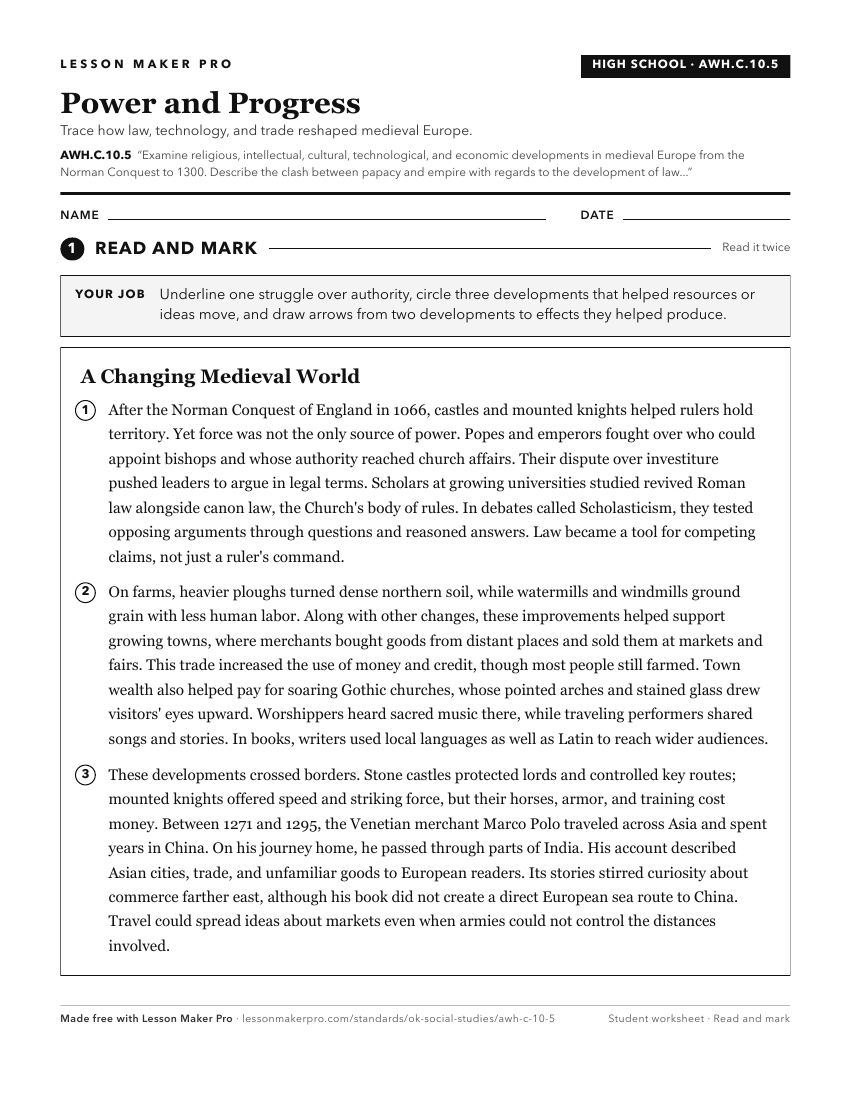
A ready-to-print activity worksheet aligned to AWH.C.10.5, with an answer key for the teacher on its own page. No account needed.
PDF, US Letter, prints cleanly in black and white.
Download the worksheetKeep exploring
Related Standards
- AWH.C.10.2
Examine how William the Conqueror at the Battle of Hastings established the French- speaking Normans as rulers of England and brought about a significant cultur...
- MWH.C.2
Analyze patterns of social, economic, political, and cultural changes during the Late Middle Ages to the Age of Exploration.
- AWH.C.10.3
Describe political developments in medieval Europe from the Norman Conquest to the Mongol Invasions, including the
- AWH.C.12.6
Examine transformations in medieval society.
Turn this cluster into a lesson
Grade, subject, topic, and the complete cluster are prefilled. Create one free, no account needed.
Also for this cluster:Make a WorksheetMake a QuizMake a Sub Lesson